


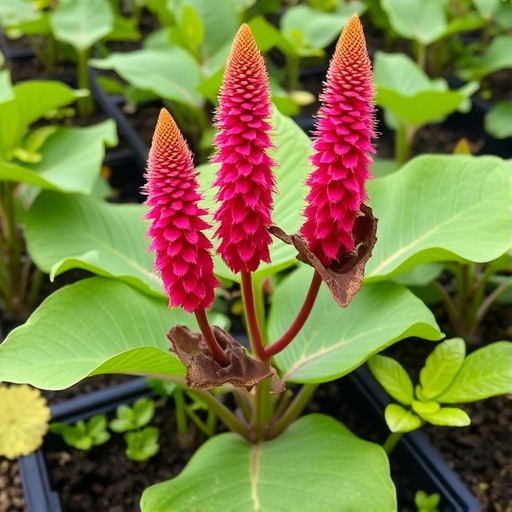
In a groundbreaking study spearheaded by researchers Yaacob, Sheba, and Lee, the integration of palm oil kernel biochar and boiler ash into agricultural practices has emerged as a promising strategy to boost the growth of Amaranthus viridis. This plant, known for its rich nutrient profile and health benefits, is an important component of various cuisines and is recognized for its potential in enhancing food security and promoting sustainable agricultural practices. The findings of this research align with the principles of the circular economy, illuminating the path toward innovative solutions for modern agricultural challenges.
The study meticulously investigates the role of palm oil kernel biochar and boiler ash as soil amendments. The research team utilized a series of controlled experiments to determine how these materials influence plant growth. Biochar, a carbon-rich product obtained from the pyrolysis of organic material, is known for its ability to improve soil quality due to its porous structure which enhances water retention and nutrient availability. Meanwhile, boiler ash, a byproduct of biomass combustion, contains essential minerals that are beneficial for plant health. By analyzing multiple parameters, the researchers aimed to quantify the effects these amendments have on the growth of Amaranthus viridis.
One of the key highlights of this research is the examination of reactive oxygen species (ROS) and their modulation in response to the applications of biochar and boiler ash. ROS are chemically reactive molecules containing oxygen that play dual roles in plant biology. While they can cause oxidative stress, leading to cellular damage, they are also essential in signaling pathways that promote growth and stress responses. The study reveals that the incorporation of biochar and ash triggers a positive modulation of ROS levels, which in turn stimulates the plant’s antioxidant mechanisms. This finding is particularly significant as it suggests a method of enhancing plant resilience against environmental stressors.
Furthermore, the research team dives deep into the biochemical pathways activated by ROS. The findings indicate that the introduction of these soil amendments leads to an upsurge in the synthesis of antioxidant compounds, including phenolics and flavonoids. These compounds are crucial not only for the plant’s defense mechanisms but also contribute to the nutritional profile of Amaranthus viridis, making it a more healthful food source. This enhanced nutritional quality could have far-reaching implications for consumer health and nutrition, emphasizing the importance of sustainable farming practices.
In recent years, the circular economy has gained traction as a framework for sustainable development. The concept champions the recycling and repurposing of materials to minimize waste and maximize resource efficiency. In this context, the findings from the study underscore the potential of utilizing agricultural byproducts, like palm oil kernel biochar and boiler ash, as part of a holistic approach to soil management. This not only alleviates waste disposal issues but also restores soil fertility, creating a win-win scenario for both the environment and agricultural productivity.
The researchers also discuss the economic implications of their findings. By promoting the use of local agricultural waste products, farmers can reduce reliance on chemical fertilizers, which can be both costly and detrimental to soil health over time. This shift can lead to lower production costs and improved yield stability for farmers, thereby enhancing their livelihoods. The study illustrates a clear pathway for smallholder farmers to adopt sustainable practices that can be beneficial for their economic viability while fostering environmental stewardship.
Moreover, the research emphasizes the importance of community involvement in executing such sustainable agricultural practices. Education and awareness campaigns can empower local farmers to understand the benefits of using biochar and boiler ash effectively. Such initiatives can facilitate the transition toward more sustainable farming methods, ensuring that communities are not only consumers of the final products but also active participants in the production process.
While the study showcases promising results, the researchers acknowledge the necessity for further research. Long-term field trials are essential to evaluate the efficacy of palm oil kernel biochar and boiler ash under varying environmental conditions. The team also suggests exploring the synergistic effects of these amendments with other sustainable practices, such as crop rotation and organic farming techniques. A comprehensive understanding of these interactions will be critical for maximizing agricultural productivity while minimizing the ecological footprint.
The significance of this research extends beyond regional agricultural practices; it touches on global issues of sustainability and food security. As the world grapples with the challenges of climate change, it becomes imperative to explore innovative agricultural solutions that can withstand environmental pressures. The findings from this study provide a valuable contribution to this ongoing dialogue, highlighting practical steps that can be taken to enhance crop resilience and nutritional quality.
As the push for sustainable agriculture continues to gain momentum, studies like this one are pivotal in guiding policy makers and stakeholders toward evidence-based decisions. By aligning agricultural practices with the principles of the circular economy, nations can work towards achieving sustainability goals, enhancing food security, and protecting the environment for future generations. The research conducted by Yaacob, Sheba, and Lee stands as a testament to the possibilities inherent in the intersection of environmental science and agricultural innovation.
In conclusion, the exploration of palm oil kernel biochar and boiler ash as soil amendments reveals potential strategies to enhance the growth of Amaranthus viridis, while simultaneously moderating ROS levels and boosting antioxidant activity. This study not only underscores the importance of integrating waste materials into agricultural systems but also highlights the broader implications of such practices within the framework of the circular economy. As we advance towards a more sustainable food system, the insights from this research may inspire farmers and policymakers alike to adopt practices that promote ecological and economic resilience in agriculture.
Yaacob, J., Sheba, M., Lee, G. et al. Circular economy in action: palm oil kernel biochar and boiler ash enhance growth of Amaranthus viridis via ROS-induced antioxidants modulation.
Environ Sci Pollut Res (2026). https://doi.org/10.1007/s11356-025-37363-7
Cite Scienmag News
Violet Maxwell. (January 14, 2026). Boosting Amaranthus Growth with Palm Oil Biochar. Scienmag. https://scienmag.com/boosting-amaranthus-growth-with-palm-oil-biochar/
Violet Maxwell. "Boosting Amaranthus Growth with Palm Oil Biochar." Scienmag, 14 January 2026, https://scienmag.com/boosting-amaranthus-growth-with-palm-oil-biochar/. Accessed 3 September 2026.
Violet Maxwell. "Boosting Amaranthus Growth with Palm Oil Biochar." Scienmag. January 14, 2026. https://scienmag.com/boosting-amaranthus-growth-with-palm-oil-biochar/


