


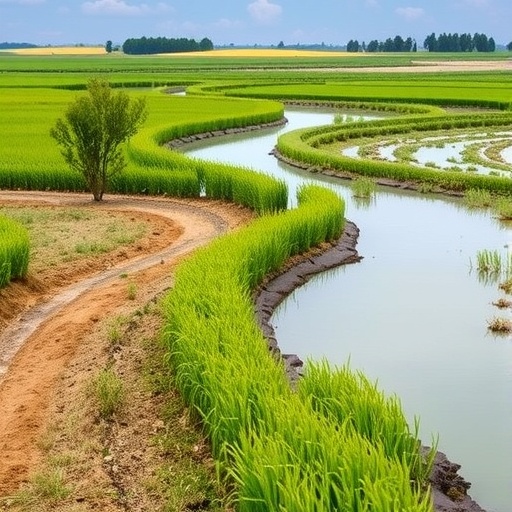
In the arid landscapes of Central Asia, a silent crisis unfolds as climate change exerts an unprecedented impact on agriculture. Recent research led by Peña-Guerrero et al. highlights the alarming rise in crop water consumption throughout the region, despite the adoption of less water-intensive agricultural practices. While one might expect advancements in sustainable farming to alleviate pressure on water sources, the study reveals a stark reality: the worsening effects of climate change are counteracting these efforts. This research not only underscores the necessity for reevaluating water management strategies but also calls into question the efficacy of existing agricultural policies in an era marked by dwindling water resources.
Central Asia, known for its vast steppes and arid climate, has historically relied on irrigation to sustain its agricultural output. Farmers have increasingly turned to less water-intensive crop varieties, which were anticipated to mitigate water scarcity. However, this new study unveils a paradox: even with the transition to more sustainable crops, water consumption has risen significantly. This discrepancy is attributed to increasingly frequent droughts, erratic rainfall patterns, and rising temperatures, all linked to climate change. The findings present a sobering reminder that climate adaptation strategies must evolve and include comprehensive approaches to manage water resources effectively.
The researchers utilized advanced modeling techniques to analyze crop water consumption across several countries in Central Asia. These models incorporated a wealth of climate data, agricultural practices, and historical weather patterns, providing a robust framework for understanding the nuanced relationship between climate change and water use in agriculture. The results indicated that despite a decrease in the use of more thirsty crops, the overall demand for water in agriculture has surged. This is largely due to the fact that warmer temperatures increase evaporation rates, thus requiring more water overall.
As Central Asian farmers grapple with the intense realities of climate change, the implications for food security are profound. Increased water consumption not only threatens agricultural sustainability but also raises concerns about the region’s ability to feed its growing population. The reliance on irrigation means that farmers are increasingly dependent on river systems and groundwater reserves, both of which are being strained by the effects of climate change. Such pressures exemplify the urgent need for more resilient agricultural systems that can withstand climate volatility while ensuring food production remains viable.
Furthermore, the research spotlights the regional disparities in water availability and management. Some areas are experiencing more acute water shortages, leading to competition among farmers and communities for access. This rising tension over water resources has the potential to exacerbate socio-economic inequalities and fuel conflicts. As climate change continues to alter the hydrological cycle, the need for equitable water management solutions becomes paramount. Policymakers must prioritize collaboration and innovative resource-sharing agreements to mitigate these tensions.
Adapting to these changing conditions requires both immediate and long-term strategies. Farmers must be equipped with the tools and knowledge to implement water-efficient practices while maintaining crop yields. Investment in research and development of drought-resistant crop varieties can play a crucial role in shaping the future of agriculture in Central Asia. Such initiatives should also encompass community-led approaches, where local knowledge and practices are harmonized with scientific research, creating a more holistic understanding of sustainable farming.
Moreover, these developments highlight the significance of integrated water resource management (IWRM) as a cornerstone to address the dual challenges of climate change and water scarcity. Achieving IWRM requires an inclusive approach involving all stakeholders, from government agencies and NGOs to local communities and farmers. It is crucial to foster dialogue and collaboration, ensuring that decisions are made transparently and benefit the broader population rather than a select few. The research affirms that only through collective efforts can Central Asia hope to adapt to the evolving climate landscape.
Innovative technologies also hold the promise of enhancing water efficiency in agriculture. Precision irrigation systems, for example, allow for targeted water application that can significantly reduce wastage. Farmers can also leverage satellite imagery and other remote sensing technologies to monitor crop health and soil moisture levels accurately. By harnessing data-driven approaches, agronomists and farmers can make informed decisions about when and how much water to apply, thereby optimizing resource utilization.
Public awareness and education are equally vital in driving the necessary changes in agricultural practices. Engaging communities in discussions about climate change impacts and water conservation strategies fosters a culture of sustainability. Educational programs that highlight the importance of conserving water and adopting climate-smart agricultural practices can empower individuals to take action in their own farming systems. As sustainable practices permeate local cultures, the potential for collective impact increases exponentially.
Finally, governments and international organizations must step up their efforts to provide financial and technical support to farmers striving for sustainable practices. Grants, subsidies, and access to affordable technologies can help alleviate the economic burdens associated with transitioning to more water-efficient farming methods. This financial backing not only supports farmers but also enhances national food security and economic stability across the region.
In conclusion, the research conducted by Peña-Guerrero and colleagues illuminates a pressing dilemma: in the face of climate change, Central Asia’s agricultural systems must adapt swiftly and efficiently to new realities. The rising water consumption, despite efforts to reduce dependence on water-intensive crops, serves as a clarion call for action. Addressing these challenges requires multi-faceted strategies, robust collaboration among stakeholders, innovative technologies, and unwavering commitment to sustainability. The path forward necessitates a reimagining of agricultural paradigms, equipping farmers with the resources needed to thrive in an uncertain climate future.
As the clock ticks on our planet’s environmental challenges, the urgency to address water consumption in agriculture has never been greater. The call is clear: we must act decisively to protect our water resources, ensure food security, and build resilient agricultural systems that can weather the storms of climate change. Only then can Central Asia hope to secure a sustainable and food-rich future for generations to come.
Peña-Guerrero, M.D., Senay, G.B., Umirbekov, A. et al. Climate change has increased crop water consumption in Central Asia despite less water-intensive cropping.
Commun Earth Environ (2026). https://doi.org/10.1038/s43247-025-03142-y
Cite Scienmag News
Alan Morgan. (January 8, 2026). Climate Change Boosts Crop Water Use in Central Asia. Scienmag. https://scienmag.com/climate-change-boosts-crop-water-use-in-central-asia/
Alan Morgan. "Climate Change Boosts Crop Water Use in Central Asia." Scienmag, 8 January 2026, https://scienmag.com/climate-change-boosts-crop-water-use-in-central-asia/. Accessed 2 September 2026.
Alan Morgan. "Climate Change Boosts Crop Water Use in Central Asia." Scienmag. January 8, 2026. https://scienmag.com/climate-change-boosts-crop-water-use-in-central-asia/


