


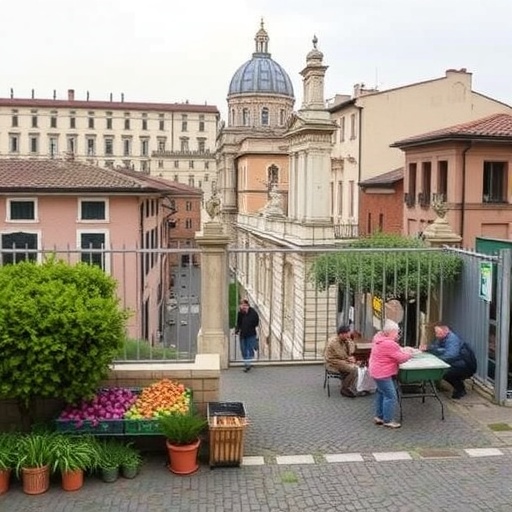
In an age where food security is a critical global issue, research on food poverty has surfaced as a pivotal area of study. A recent publication sheds light on this concern by focusing specifically on the metropolitan City of Rome, Italy, revealing compelling insights into the stark disparities that exist between urban and rural areas. This investigation, conducted by a multidisciplinary team, aims to map the uneven geography of food poverty, providing pertinent evidence that could inform policy interventions and social strategies.
The study reveals that food poverty is not just a statistical anomaly but a complex social issue defined by multiple dimensions. Urban environments, with their dense populations and diverse communities, often exhibit varying degrees of food access, quality, and affordability. The research uncovers a grim reality where certain districts grapple with high rates of food insecurity, while others enjoy an abundance of resources. Conversely, rural areas also face unique challenges, such as geographic isolation and limited availability of fresh produce, contributing to a nuanced landscape of food poverty that transcends mere economic indicators.
One of the standout features of this research is its comprehensive methodology, which incorporates geographic information systems (GIS) to visualize and analyze food poverty across different regions. By mapping demographic data alongside food access points, the researchers have constructed a detailed territorial analysis. This methodology enables a more profound understanding of how socio-economic factors correlate with food access, revealing pockets of vulnerability that may otherwise go unnoticed. Such insights are invaluable for local authorities and organizations aiming to devise targeted interventions.
Additionally, the study provides a robust analysis of the contributing factors to food poverty. Elements such as income disparities, educational levels, transportation access, and cultural attitudes towards food were examined in detail. The interaction of these factors creates a complex web of influences that shapes food security outcomes. For example, in urban settings, low-income households may rely heavily on convenience stores that offer limited fresh produce, exacerbating nutritional deficiencies. Meanwhile, rural communities might struggle with transportation issues that hinder their ability to access larger grocery stores or farmers’ markets.
The research also highlights the role of policy and governance in addressing food poverty. Strategies implemented by the local government are crucial in mitigating these disparities. The study emphasizes the need for integrated approaches that connect food distribution systems with community development initiatives. This holistic perspective can lead to sustainable solutions that not only address immediate food needs but also foster long-term resiliency in both urban and rural areas.
Furthermore, the research team engaged with local communities to gather qualitative data, providing a human dimension to the study. Interviews and focus groups revealed personal stories and experiences related to food poverty, underscoring the emotional and psychological impact of food insecurity. Participants shared their struggles to acquire nutritious food and the stigma often associated with relying on food aid. These voices are essential in framing the discussion around food poverty and ensuring that solutions are aligned with the needs of the affected populations.
Importantly, the findings of this study extend beyond the borders of Rome, resonating with global discussions on food security. As urbanization continues to rise, understanding the intricacies of food access in different contexts becomes paramount. The implications of this research resonate not only with policymakers in Italy but also with international organizations and governments worldwide committed to eradicating hunger and fostering equitable access to food resources.
In conclusion, the mapping of food poverty within the metropolitan City of Rome offers a critical lens through which to examine the intersection of urbanization and food security. By leveraging innovative methodologies, engaging with affected communities, and analyzing the role of policy, this research stands as a significant contribution to the field. As the world grapples with the challenges of food poverty, studies like this underscore the urgent need for collaborative efforts to ensure that all individuals, regardless of their geographic location, have access to healthy and sufficient food.
Such evidence-driven insights are crucial as they inform future research and policy development. The ongoing dialogue surrounding food security must continue to evolve, incorporating new data and perspectives that reflect the realities of those living in food poverty. This collective understanding will guide our pursuit of sustainable solutions that strive for equity and wellness in food systems globally.
As we look towards a future where food security is a foundational right, the lessons learned from this research in Rome pave the way for similar studies across the globe, reinforcing the universal nature of this pressing challenge. Food poverty is indeed a multifaceted issue that requires an equally multifaceted approach—one that champions collaboration, inclusiveness, and innovation, ensuring that no community is left behind in the quest for food justice.
Manetti, I., Scannavacca, F., Felici, F.B. et al. Mapping the uneven geography of food poverty in urban and rural areas: a territorial analysis within the metropolitan City of Rome, Italy.
Discov Sustain (2026). https://doi.org/10.1007/s43621-025-02561-3
Cite Scienmag News
Violet Maxwell. (January 6, 2026). Uneven Food Poverty: A Geographic Study in Rome. Scienmag. https://scienmag.com/uneven-food-poverty-a-geographic-study-in-rome/
Violet Maxwell. "Uneven Food Poverty: A Geographic Study in Rome." Scienmag, 6 January 2026, https://scienmag.com/uneven-food-poverty-a-geographic-study-in-rome/. Accessed 1 September 2026.
Violet Maxwell. "Uneven Food Poverty: A Geographic Study in Rome." Scienmag. January 6, 2026. https://scienmag.com/uneven-food-poverty-a-geographic-study-in-rome/


