


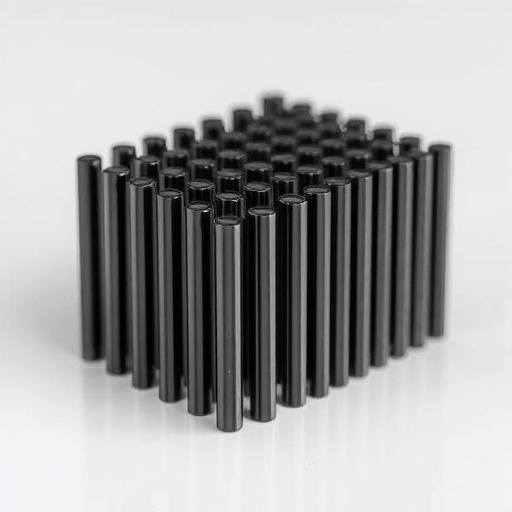
In a groundbreaking study poised to reshape the field of energy storage, researchers have developed an innovative asymmetric potassium ion (K⁺) capacitor that leverages porous carbon embedded with niobium oxide (Nb₂O₅) nanorods for its electrodes. This advancement, reported by Marnadu, Arunkumar, and Devi in their impending publication in “Ionics,” highlights the potential of potassium ions as a viable alternative to lithium ions in energy storage applications.
The growing demand for efficient energy storage solutions necessitates the exploration of alternative materials and configurations. As traditional lithium-ion batteries face sustainability issues and supply chain constraints, potassium ion batteries emerge as a promising solution, primarily due to the abundance and cost-effectiveness of potassium compared to lithium. This work, therefore, provides a crucial step forward in utilizing potassium as a medium for energy storage.
The unique design of this K⁺ capacitor involves a combination of porous carbon and Nb₂O₅ nanorods, ingeniously optimizing charge storage and enhancing overall performance. Porous carbon serves as an excellent conductor, facilitating rapid electron transport and maximizing surface area for charge accumulation. In contrast, the Nb₂O₅ nanorods not only contribute to structural integrity but also improve electrochemical kinetics, significantly enhancing the capacitor’s charge-discharge cycles.
The research team meticulously designed the porous carbon structure to optimize the ion adsorption capacity, ensuring a high energy density while maintaining rapid charge capabilities. This intricate relationship between the porous architecture and the embedded niobium oxide plays a pivotal role in mitigating conventional drawbacks associated with potassium ion capacitors, such as slow kinetics and limited cycle life. The integration of these materials paves the way for capacitors with superior performance metrics, particularly in terms of energy and power density.
Laboratory tests indicate that this asymmetric K⁺ capacitor demonstrates impressive energy and power density, outperforming several existing technologies. The charging and discharging rates exhibit remarkable efficiency, which is critical for applications in renewable energy systems, where swift energy release and storage can make or break performance. This capability effectively positions the K⁺ capacitor as a flexible utility in various applications, from electric vehicles to grid storage systems.
Furthermore, the longevity of the K⁺ capacitor is noteworthy. Conducting extensive cycling tests revealed that the capacitor maintained a substantial percentage of its performance after numerous charge-discharge cycles, underscoring its potential for long-term applications in an ever-evolving energy landscape. By ensuring a stable charge-discharge cycle over time, this technology can significantly reduce the need for frequent replacements, thus promoting sustainability.
One of the fascinating aspects of this research is the scalability of the production process. The synthesis of porous carbon and Nb₂O₅ nanorods entails techniques that can be readily scaled, making this technology accessible for commercial production. As the world pivots towards cleaner, more sustainable technologies, the ability to produce this K⁺ capacitor on a larger scale presents a crucial opportunity for industries aiming to reduce their carbon footprint.
Moreover, the scientific community anticipates that this novel K⁺ capacitor will spur further research into alternative ion batteries. By showcasing the viability of potassium as an energy storage medium, this study opens up avenues for investigating several other material combinations that could enhance performance and sustainability. The prospect of discovering novel materials to complement potassium ion technology is indeed an exciting frontier in energy research.
This K⁺ capacitor’s structural innovation is also a noteworthy departure from traditional capacitor design paradigms, reflecting an evolution in thinking about how best to maximize energy storage efficiency. Researchers emphasize that these advancements underscore the importance of interdisciplinary collaboration in addressing the complex energy challenges of the 21st century.
As the study prepares for publication in early 2026, the researchers are hopeful that their findings will catalyze a broader conversation about energy storage technologies. Their work not only contributes essential data to the growing body of knowledge but also poses foundational questions about the future of energy systems and the role that less conventional materials like potassium may play.
In conclusion, the development of an asymmetric potassium ion capacitor based on porous carbon and Nb₂O₅ nanorods signifies an important leap toward sustainable and efficient energy storage solutions. The implications of this research could extend well beyond academic interest, transforming industries and laying groundwork for more sustainable energy practices. As we stand on the brink of this energy transition, innovations like these will undoubtedly lead the way to a more resilient, sustainable future.
Marnadu, R., Arunkumar, S., Devi, S. et al. Asymmetric type potassium ion (K+) capacitor based on porous carbon embedded Nb2O5 nanorods as electrode.
Ionics (2026). https://doi.org/10.1007/s11581-025-06919-5
Cite Scienmag News
Faith Mcneil. (January 3, 2026). Novel K+ Capacitor Utilizes Nb2O5 Nanorods in Carbon. Scienmag. https://scienmag.com/novel-k-capacitor-utilizes-nb2o5-nanorods-in-carbon/
Faith Mcneil. "Novel K+ Capacitor Utilizes Nb2O5 Nanorods in Carbon." Scienmag, 3 January 2026, https://scienmag.com/novel-k-capacitor-utilizes-nb2o5-nanorods-in-carbon/. Accessed 4 September 2026.
Faith Mcneil. "Novel K+ Capacitor Utilizes Nb2O5 Nanorods in Carbon." Scienmag. January 3, 2026. https://scienmag.com/novel-k-capacitor-utilizes-nb2o5-nanorods-in-carbon/


