

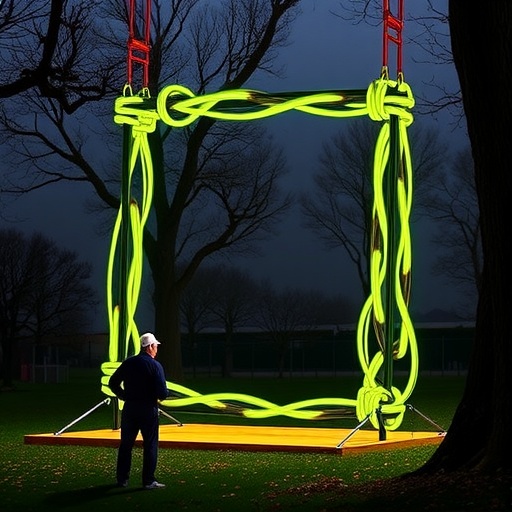
Prepare for a mind-bending journey into the very fabric of reality, where abstract mathematical constructs are beginning to reveal profound connections to the physical universe. Scientists have long sought to bridge the gap between pure mathematics and the tangible world, and a recent breakthrough in the esoteric field of knot theory, specifically focusing on the concept of “Hecke lifting conjectures for framed knots,” is poised to do just that, potentially revolutionizing our understanding of fundamental physics. This isn’t mere academic conjecture; it’s a bold proposition that could unlock secrets as profound as the nature of spacetime itself, hinting at a unified theory that has eluded physicists for decades. The implications are so vast they verge on the science fiction, yet they are deeply rooted in rigorous mathematical proofs, suggesting that the universe might be woven from threads of pure mathematical elegance.
At the heart of this astonishing development lies the intricate world of knot theory, a branch of mathematics that studies the ways in which objects can be embedded in space. While seemingly a playful exploration of tangled loops, knot theory has, over time, proven to be a surprisingly powerful tool for modeling complex phenomena, from the folding of DNA to the dynamics of quantum entanglement. The new research delves into a particularly sophisticated area: Hecke algebras, which are algebraic structures that arise in the study of representation theory and have deep connections to quantum topology. The conjecture explored in this work posits a relationship, a “lifting,” between different types of mathematical objects related to framed knots, suggesting a fundamental interconnectedness that could have far-reaching consequences for how we perceive physical reality.
The concept of a “Hecke lift” itself is a technical marvel, involving a sophisticated process of transforming one mathematical object into another while preserving crucial underlying structures. In the context of framed knots, this lifting process is theorized to connect abstract algebraic representations to more concrete geometric properties. Imagine it as finding a hidden blueprint that dictates how complex knot configurations can be generated from simpler building blocks, a principle that mirrors how fundamental particles combine to form larger structures in physics. This is not just about abstract symbols on a page; it’s about uncovering a hidden generative mechanism that could be playing out at the most fundamental levels of our universe, a resonant echo of mathematical order within the perceived chaos of existence.
The term “framed knot” itself carries significant weight. A framed knot is not just a simple loop; it’s a loop accompanied by an additional structure, akin to a tiny coordinate system attached to every point along the knot. This framing adds crucial information, allowing mathematicians to distinguish between knots that might otherwise appear identical in three-dimensional space. This precision is vital for the Hecke lifting conjecture, as it ensures that the transformations being studied are not losing subtle but critical details. This meticulous attention to detail in the mathematical framework directly translates to the potential for understanding the subtle nuances of physical phenomena that have, until now, remained stubbornly opaque to scientific inquiry, pushing the boundaries of our comprehension.
The research specifically investigates whether a certain type of algebraic structure, derived from these framed knots, can be “lifted” to a more encompassing and powerful structure. This lifting is not a trivial operation; it implies a hierarchy of mathematical existence, a deeper layer of reality that governs the properties of the objects we observe. If the conjecture holds true, it suggests that the intricate patterns we see in the universe, from the orbits of planets to the quantum fluctuations of empty space, could be direct manifestations of these higher-level algebraic principles, pointing towards a universe that is not merely governed by physical laws but is, in essence, a manifestation of them.
This mathematical insight has the potential to radically alter our understanding of quantum field theory, the current bedrock of our description of fundamental forces and particles. Quantum field theory is notoriously complex, plagued by infinities and requiring sophisticated regularization techniques to make sense of. The Hecke lifting conjecture suggests that a more elegant and fundamental description might exist, one where these seemingly chaotic quantum phenomena emerge from the structured relationships of framed knots. This could offer a path towards a more unified and less paradoxical understanding of the quantum realm, potentially resolving long-standing issues that have puzzled physicists for generations.
Furthermore, the implications extend beyond quantum mechanics into the realm of gravity and spacetime. String theory, one of the leading candidates for a theory of everything, posits that fundamental particles are actually tiny vibrating strings. The intricacies of knot theory, with its ability to describe complex topological structures, could provide a novel mathematical language to describe the behavior of these strings or other fundamental constituents of spacetime. The idea that the very geometry of the universe could be intrinsically linked to topological properties, as suggested by this research, is a tantalizing prospect that could bridge the gap between general relativity and quantum mechanics.
The beauty of this research lies in its unexpected origins. Knot theory, a field that might seem far removed from the empirical realities of physics, is now providing the very tools and language needed to describe these fundamental realities. It’s a testament to the interconnectedness of scientific disciplines and the power of abstract thought to illuminate the workings of the natural world. The Hecke lifting conjecture, therefore, is not just a statement about mathematical objects; it’s a profound hypothesis about the underlying order and structure of the universe itself, a kind of cosmic grammar waiting to be deciphered, promising a deeper appreciation of the universe’s intricate design.
The research paper, published by S. Zhu in the European Physical Journal C, provides a rigorous mathematical framework for exploring this conjecture. While the full implications are still being unraveled, the initial findings are generating significant excitement within the theoretical physics community. The ability to connect abstract algebraic concepts to potentially observable physical phenomena is the holy grail of theoretical physics, and this work offers a compelling glimpse into such a possibility, opening up new avenues for exploration and discovery, pushing the boundaries of what we deem possible.
The scientific community is buzzing with the potential ramifications of this breakthrough. Researchers are already beginning to explore how the Hecke lifting conjecture might be applied to specific problems in quantum gravity and particle physics. The prospect of a mathematical framework that elegantly unifies disparate areas of physics is incredibly alluring, and this knot theory-based approach offers a novel and promising avenue for achieving that goal. It’s a testament to the enduring power of curiosity and the relentless pursuit of understanding the universe’s deepest secrets, a beacon of hope for a more complete and coherent scientific worldview, beckoning us toward a grander understanding.
The journey from abstract mathematical conjecture to concrete physical theory is often a long and arduous one. However, the elegance and potential explanatory power of the Hecke lifting conjecture for framed knots suggest it could be a significant step forward. It offers a new perspective, a novel lens through which to view the fundamental workings of the universe, suggesting that mathematical beauty is not just an aesthetic quality but a fundamental descriptor of reality itself, a deeply ingrained principle that structures all that we observe.
This research pushes the boundaries of our imagination, inviting us to consider the universe not just as a collection of particles and forces, but as a vast and intricate topological structure governed by profound mathematical relationships. The Hecke lifting conjecture serves as a powerful reminder that the most profound discoveries often lie at the intersection of seemingly unrelated fields, a testament to the interconnected tapestry of knowledge that defines scientific endeavor, a constant pursuit of deeper truth.
The implications for future research are immense, potentially paving the way for new experimental probes to test these theoretical predictions. If the conjecture proves robust, it could lead to new ways of thinking about quantum entanglement, gravity, and perhaps even the very origin of the universe. It’s a thrilling time to be at the forefront of scientific inquiry, where the abstract musings of mathematicians are beginning to whisper secrets of the cosmos, promising a future where our understanding of reality is transformed beyond recognition, a truly exhilarating prospect for all of humanity.
This breakthrough signals a potential paradigm shift in theoretical physics, moving beyond incremental advances to a more fundamental reimagining of reality. The universe, it seems, might be far more mathematically structured than we ever dared to imagine, a testament to the power of human intellect to unravel its deepest mysteries. The Hecke lifting conjecture for framed knots is not just an equation on a blackboard; it’s a potential key to unlocking the deepest secrets of existence, a thrilling promise of a more profound and unified understanding of everything.
Subject of Research: The research explores the Hecke lifting conjecture within the framework of framed knot theory, investigating the connection between algebraic structures derived from these mathematical objects and their potential implications for fundamental physics.
Article Title: On Hecke lifting conjecture for framed knots
Article References:
Zhu, S. On Hecke lifting conjecture for framed knots.
Eur. Phys. J. C 85, 1478 (2025). https://doi.org/10.1140/epjc/s10052-025-15222-6
Image Credits: AI Generated
DOI: https://doi.org/10.1140/epjc/s10052-025-15222-6
Keywords: Knot Theory, Hecke Algebra, Hecke Lifting Conjecture, Framed Knots, Theoretical Physics, Quantum Field Theory, Quantum Gravity, Mathematical Physics, Topology, Representation Theory


