


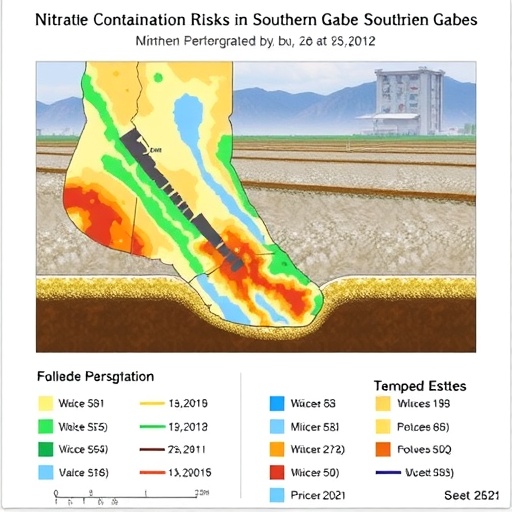
In arid regions across the globe, groundwater remains the primary source of fresh water for agriculture, industry, and human consumption. However, the delicate balance ensuring the quality of this vital resource is increasingly threatened by contamination, with nitrates being among the most pervasive pollutants. A groundbreaking study has emerged from Southeastern Tunisia, specifically targeting the Southern Gabes region, to assess the extent and risks of nitrate contamination in its groundwater. Published in Environmental Earth Sciences, this research sheds critical light on how arid environments face unique challenges in safeguarding their subterranean water reserves.
The Southern Gabes area, characterized by its arid climate and reliance on groundwater for multiple sectors, presents an ideal case study to explore nitrate pollution dynamics. Nitrate contamination is of particular concern due to its solubility and mobility in water systems, often originating from agricultural runoff, domestic wastewater, and industrial discharges. This research elucidates the spatial distribution of nitrates and the hydrogeological processes controlling their movement, providing a foundation for better management strategies in similar arid settings globally.
Utilizing an integrative methodology, the researchers combined extensive field sampling, geochemical analyses, and advanced hydrogeological modeling approaches. Groundwater samples were collected from a wide array of wells across the Southern Gabes territory, representing different aquifer depths and land-use contexts. The chemical characterization included measuring nitrate concentrations alongside a suite of related parameters such as pH, electrical conductivity, and isotopic markers, offering a comprehensive view of water quality and contaminant sources.
One of the pivotal findings of the study is the identification of localized “hotspots” where nitrate levels significantly exceed the World Health Organization’s recommended threshold for potable water. These hotspots correlate strongly with areas of intensified agricultural activity, highlighting the anthropogenic origin of contamination. The study underscores how fertilization practices, often employed to boost crop yields in this arid region, simultaneously heighten the vulnerability of groundwater to nitrate infiltration, especially in the absence of adequate mitigation measures.
Hydrogeochemical facies analyses further revealed the complex interactions between natural mineral dissolution processes and anthropogenic inputs shaping groundwater chemistry. The heterogeneity of the geological formations underneath Southern Gabes also influences nitrate retention and transport, with certain sedimentary layers acting either as barriers or conduits. This nuanced understanding challenges previous assumptions that arid aquifers are uniformly susceptible or resistant to such contamination, pressing for location-specific management approaches.
Another key insight relates to seasonal and climatic influences. Groundwater nitrate concentrations exhibited temporal variability linked to precipitation patterns and groundwater recharge rates, albeit these are generally limited in arid settings. The study’s robust temporal dataset spanning multiple years enabled the team to discern that episodic rainfall events can exacerbate nitrate leaching from surface sources into the subsurface, demonstrating that even minimal precipitation can have outsized effects on contaminant dynamics.
Addressing human health implications, the research draws attention to the chronic exposure risk posed by elevated nitrate levels, which are associated with methemoglobinemia in infants and potential links to carcinogenic outcomes in adults. Given the reliance on untreated groundwater for drinking in many communities of Southern Gabes, the findings elevate the urgency for public health interventions and stricter regulatory enforcement to minimize nitrate inputs and protect vulnerable populations.
The study’s multivariate statistical analysis dissects the relative contribution of different nitrate sources. Alongside agricultural fertilizers, animal husbandry waste and sewage discharge emerge as significant contributors. This holistic source apportionment informs targeted mitigation efforts, advocating for integrated watershed management that engages multiple sectors spanning farming practices, wastewater treatment, and urban planning.
A striking aspect of this research is the proposed conceptual model that integrates hydrogeological, geochemical, and human activity factors to predict nitrate contamination risks. This model serves as a decision-making tool for policymakers and water resource managers in arid regions facing similar contamination challenges. By simulating various scenarios, stakeholders can evaluate the effectiveness of potential interventions before costly implementations.
Furthermore, the authors stress the importance of continuous monitoring and data sharing to track nitrate trends over time. They advocate leveraging emerging technologies such as remote sensing and automated sensor networks to enable real-time water quality surveillance, enabling early warning systems that can promptly trigger remedial actions before contamination reaches dangerous thresholds.
Environmental sustainability implications also emerge from the study. Excessive nitrate levels affect aquatic ecosystems and soil health, compromising biodiversity and long-term agricultural productivity. In arid zones where ecosystem resilience is already fragile, nitrate pollution compounds vulnerability, threatening the balance between human needs and nature. Thus, the research calls for sustainable agricultural intensification strategies combined with enhanced water governance frameworks to align economic development with environmental stewardship.
Critically, the Southern Gabes case serves as a microcosm for similar arid landscapes worldwide, where water scarcity coincides with expanding agricultural demands. The insights gained contribute valuable knowledge towards global efforts underpinned by the United Nations Sustainable Development Goals (SDGs), particularly SDG6 on clean water and sanitation. Through a combination of scientific rigor and practical relevance, the study advances both academic understanding and actionable solutions.
In conclusion, the investigation into nitrate contamination within Southern Gabes groundwater emphasizes the inherent complexity of water quality management in arid regions. By revealing key contamination pathways, risk factors, and mitigation avenues, the research lays a robust foundation for safeguarding public health and ecological balance. As climate change intensifies water scarcity and anthropogenic pressures mount, such integrative studies become indispensable in ensuring sustainable water futures.
This study is a compelling reminder of the interconnectedness of human activities and natural systems, especially in delicate environments where water is a precious and limited resource. Protecting groundwater quality requires coordinated, multidisciplinary approaches that combine science, policy, and community engagement to build resilient arid zone water management frameworks.
Cite Scienmag News
Eleanor Cresswell. (December 27, 2025). Nitrate Contamination Risks in Southern Gabes Groundwater. Scienmag. https://scienmag.com/nitrate-contamination-risks-in-southern-gabes-groundwater/
Eleanor Cresswell. "Nitrate Contamination Risks in Southern Gabes Groundwater." Scienmag, 27 December 2025, https://scienmag.com/nitrate-contamination-risks-in-southern-gabes-groundwater/. Accessed 28 August 2026.
Eleanor Cresswell. "Nitrate Contamination Risks in Southern Gabes Groundwater." Scienmag. December 27, 2025. https://scienmag.com/nitrate-contamination-risks-in-southern-gabes-groundwater/


