


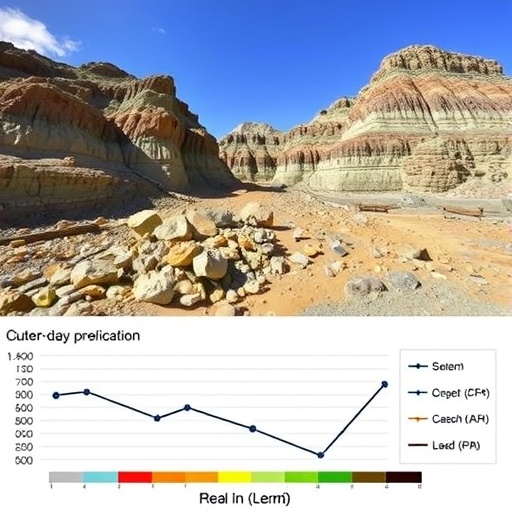
Uncertainty in mineral prospectivity mapping has long posed challenges for geologists and mining companies worldwide. In a groundbreaking study by Nwaila, Durrheim, and Frimmel, a new approach to uncertainty analysis is unveiled that promises to transform resource exploration in South Africa, specifically targeting iron (Fe) and manganese (Mn) deposits. This innovative methodology integrates advanced data analysis techniques with geological assessments to provide a robust framework for identifying mineral-rich areas, hence improving the potential for successful extraction and reducing financial risks.
Traditionally, mineral prospectivity mapping has relied heavily on expert knowledge and historical data, often leading to subjective interpretations and variable outcomes. The new study emphasizes a systematic approach that employs statistical models, allowing researchers and mining professionals to quantify uncertainties associated with mineral exploration. By applying these models, the authors demonstrate how, even in the face of incomplete data, one can derive meaningful insights regarding the likelihood of finding economically viable mineral deposits.
The findings presented in this study center around the application of a prototype for Fe–Mn exploration in South Africa, a region rich in mineral resources but plagued by uncertainties regarding their distribution and abundance. South Africa’s geological framework is complex, necessitating advanced methodologies to navigate its intricacies. The researchers leveraged an array of geospatial data, compiling geological, geochemical, and geophysical information to create a comprehensive model that reflects the true potential of the mining landscape.
A critical aspect of the research was the development of a robust uncertainty analysis framework that integrates various data sources and delineates the degree of confidence associated with each prospecting area. This technique not only enhances the reliability of mineral mapping but also serves to optimize resource investment decisions in regions that may have been previously overlooked due to perceived risks. As stakeholders in the mining industry grapple with the volatility of market conditions, such an approach can decisively impact the long-term viability of exploration initiatives.
As the researchers executed their prototype methodology, they meticulously characterized the existing mining landscape, analyzing historical data to identify patterns that could inform future explorations. The results were striking: not only did the framework highlight previously identified deposits, but it also revealed potential new targets for exploration that had not been considered before. This dual capability of validating and discovering variables heralds a new era in mineral exploration strategies.
The methodology’s success lies in its adaptability to various geological contexts, making it not just a localized solution but a potential game-changer for the global mining industry. With the increasing demand for critical minerals like iron and manganese—key components in steel production and renewable energy technologies—the ability to assess and mitigate risks associated with exploration can provide a significant competitive advantage. By prioritizing data-driven decision-making, the industry can pivot toward more sustainable practices while satisfying the burgeoning global appetite for mineral resources.
Furthermore, the study raises the question of how technology and innovative analytical methods can be leveraged to streamline traditional mining practices. As artificial intelligence and machine learning continue to gain footholds in various sectors, the mining industry stands at a crossroads. The adoption of these advanced technologies in mineral prospectivity mapping not only has the potential to enhance efficiency but also promises to foster environmental accountability by minimizing exploratory drilling and maximizing data utility.
Peer-reviewed publications such as this one play a pivotal role in disseminating knowledge and best practices throughout the scientific and engineering communities. By inviting scrutiny and fostering discussion, the authors contribute significantly to the ongoing dialogue surrounding efficient mineral resource management. Empowering stakeholders with validated methods can lead to a more informed approach to exploration, driving both innovation and a cultural shift towards responsible mining practices.
The essence of the study extends beyond simply identifying mineral resources. It encapsulates the broader theme of risk management in the mining sector—an increasingly relevant concern in an era marked by environmental scrutiny and socio-economic challenges. By creating a robust uncertainty analysis framework, the research underscores the importance of judicious decision-making—one that reconciles economic ambitions with environmental stewardship.
In conclusion, the approach presented by Nwaila, Durrheim, and Frimmel represents a significant leap forward in mineral prospectivity mapping. Through rigorous uncertainty analysis, their study not only enhances the understanding of mineral distributions in South Africa but also sets a precedent for future explorations worldwide. By harnessing the power of comprehensive data analysis to minimize risk, the mining industry can embark on a path that ensures both profitability and sustainability—an imperative in today’s evolving global landscape.
This study not only underscores the potential of quantitative analysis in geology but also invigorates the conversation around responsible resource exploration. As more researchers and industry professionals embrace similar methodologies, the potential for discovering new mineral deposits while minimizing environmental impact will pave the way for a more sustainable and efficient mining future.
The synergy between innovative research and practical application promises to unlock the next wave of exploration advancements. As the world moves toward a more resource-conscious paradigm, the insights gained from this study may catalyze a shift in how mining companies approach uncertainty, making them more agile and informed in their operations.
With a clear roadmap laid out by the authors and a commitment to continuous improvement, the mining industry is poised to tackle the challenges ahead and embrace the opportunities that lie within the earth’s crust.
Cite Scienmag News
Eleanor C. (December 24, 2025). Enhancing Mineral Prospecting: Uncertainty Analysis for Fe-Mn. Scienmag. https://scienmag.com/enhancing-mineral-prospecting-uncertainty-analysis-for-fe-mn/
Eleanor C. "Enhancing Mineral Prospecting: Uncertainty Analysis for Fe-Mn." Scienmag, 24 December 2025, https://scienmag.com/enhancing-mineral-prospecting-uncertainty-analysis-for-fe-mn/. Accessed 29 August 2026.
Eleanor C. "Enhancing Mineral Prospecting: Uncertainty Analysis for Fe-Mn." Scienmag. December 24, 2025. https://scienmag.com/enhancing-mineral-prospecting-uncertainty-analysis-for-fe-mn/


