


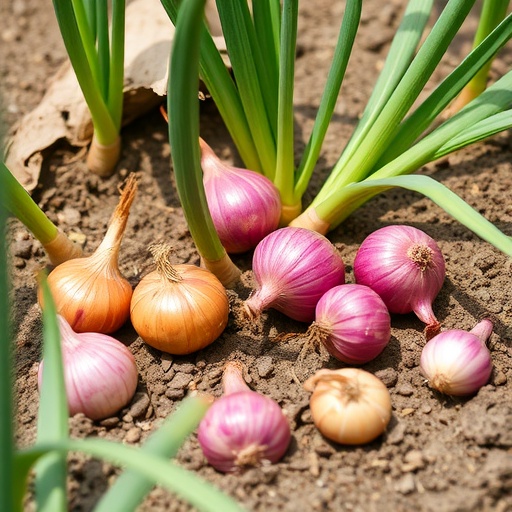
In an age where agricultural challenges are rising due to climate change and increasing population demands, innovative irrigation techniques have emerged as a critical focus of research. A recent study conducted in Sekota, Northern Ethiopia, has shed light on the significant impact of deficit irrigation on onion yield and water use efficiency. This research provides compelling insights into sustainable agricultural practices that can help address both food security and water scarcity—two issues that are becoming increasingly intertwined.
Deficit irrigation, a strategic approach that involves applying water below the full crop requirements, has shown promising results in improving water use efficiency. Most studies have emphasized this method’s potential to maximize yields while minimizing water consumption. The ongoing challenge, however, is understanding how different levels of water stress affect various crop types, in this case, onions. The research undertaken by T. Asmelie and M. Dessie is pivotal in that it not only assesses the yield response of onions but also rigorously evaluates the accompanying water use efficiency, a vital metric in sustainable agriculture.
The experimentation was meticulously designed to gauge the performance of onion crops under varied irrigation levels. Factors such as crop growth parameters, physiological responses, and yield outcomes were analyzed thoroughly. The researchers used a combination of field experiments and controlled water application methods to delineate the relationships between water usage and crop output. This robust methodology allowed for a comprehensive understanding of how onions respond not just to standard irrigation practices but also to more water-efficient methods.
The results were nothing short of enlightening. It was observed that onions exhibit a remarkable ability to adapt to varying water regimes. With careful management, even under deficit conditions, the yield did not plummet as might have been traditionally expected. Instead, appropriate levels of stress actually prompted the onion plants to optimize their growth responses. Interestingly, this study found that moderate deficit irrigation could lead to not just maintenance but potentially an increase in water use efficiency, which is vital for locations struggling with water scarcity.
As the study divulges, the most significant improvement in water use efficiency was recorded under certain irrigation thresholds. Crop physiological responses, including stomatal conductance and transpiration rates, were measured to gain insights into how the onions regulated their hydration status. Understanding these physiological nuances is essential for futurist agronomy. It enables farmers to cultivate onions, or other crops, in a way that conserves water without sacrificing quality or quantity.
The timing of irrigation was another crucial variable in the study. The researchers highlighted that the optimal timing for applying limited water resources correlated closely with the growth stages of the onions. Strategic irrigation can bolster yield and enhance water utilization, making it a win-win for farmers facing the dual threats of drought and the economic pressures of meeting market demands.
This research comes at a time when water scarcity and food security are pressing global issues. The implications of Asmelie and Dessie’s findings are vast and significant, extending beyond the boundaries of Ethiopia. For regions that experience similar climatic conditions and agricultural challenges, applying these strategies for deficit irrigation can prove transformative. Implementing such practices could help ensure sustainable food production even with the looming specter of resource shortages.
Moreover, farmer education stands out as a critical component for widespread adoption of these findings. By understanding the importance of irrigation timing and water management strategies, farmers can make informed decisions that will ultimately lead to more sustainable farming practices. Workshops, seminars, and partnerships with agricultural organizations could facilitate this crucial knowledge transfer, empowering local communities to optimize their agricultural yield while conserving precious water resources.
Looking ahead, further research could expand on these findings by exploring the economic implications of adopting such irrigation practices. What does it mean for a farmer’s bottom line when they shift to deficit irrigation? Not only could water savings be realized, but also reductions in pumping costs and labor associated with more extensive irrigation methods. The economic viability of sustainable practices will be a considerable factor determining their adoption in various geographical contexts.
In conclusion, the powerful insights yielded from this research on deficit irrigation of onions provide a beacon of hope amidst global agricultural dilemmas. By harnessing these innovative water-saving strategies, farmers can navigate the dual challenges of water scarcity and food production demands. As global populations swell and climate change impacts agricultural landscapes, the need for sustainable farming practices has never been clearer. Continuing to explore methods that optimize yields while conserving water is vital. Let this study serve as a cornerstone for future research endeavors that support sustainable agriculture, benefitting ecosystems and communities alike.
In their study, Asmelie and Dessie do not just illustrate the potential of deficit irrigation; they pave the way for future innovations. By prioritizing agricultural sustainability with empirical evidence, they present a clarion call for researchers, farmers, and policymakers alike. The journey towards sustainable and efficient agriculture is a collective effort, where every research insight adds valuable threads to the fabric of global food security.
Cite Scienmag News
Alan Morgan. (December 23, 2025). Onion Yield and Water Efficiency Under Deficit Irrigation. Scienmag. https://scienmag.com/onion-yield-and-water-efficiency-under-deficit-irrigation/
Alan Morgan. "Onion Yield and Water Efficiency Under Deficit Irrigation." Scienmag, 23 December 2025, https://scienmag.com/onion-yield-and-water-efficiency-under-deficit-irrigation/. Accessed 1 September 2026.
Alan Morgan. "Onion Yield and Water Efficiency Under Deficit Irrigation." Scienmag. December 23, 2025. https://scienmag.com/onion-yield-and-water-efficiency-under-deficit-irrigation/


