


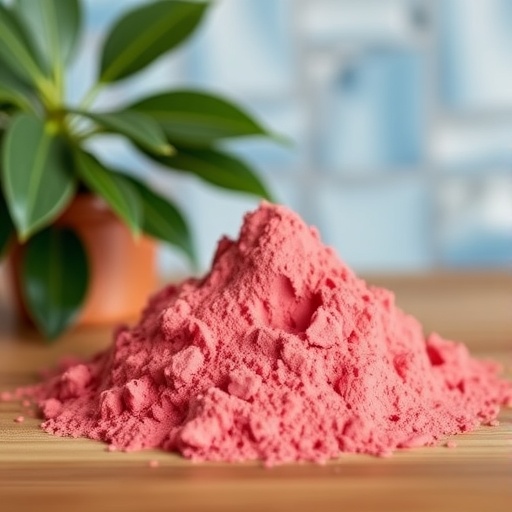
In recent years, the growing concern about water pollution has led researchers to intensify their efforts in developing effective methods for the removal of toxic dyes from wastewater. One such study, conducted by I. Fellah, I. Boumnijel, M. Bechelany, and their team, delves into a promising approach for tackling the challenge posed by rhodamine B dye, a synthetic dye commonly found in industrial effluents. The researchers have turned their attention to citric acid-modified clay as an innovative adsorbent, unveiling its potential effectiveness in the removal of this highly sought-after pollutant from water.
Rhodamine B, characterized by its bright fluorescent properties, is widely used in various industries, including textiles, paper, and plastics. However, its presence in water bodies poses a significant risk to aquatic ecosystems and human health. The urgency to find efficient methods for removing such dyes from wastewater has become paramount. In their research, the authors meticulously investigated the adsorption capacities of citric acid-modified clay, revealing insights into its kinetics, thermodynamics, and adsorption isotherms.
The modification of clay with citric acid represents a significant breakthrough in the realm of wastewater treatment. The researchers demonstrated that this modification enhances the adsorption ability of clay by introducing functional groups that better interact with rhodamine B dye molecules. By conducting a series of experiments, they carefully evaluated how different parameters, such as pH, initial dye concentration, and contact time, affect the adsorption process. Their findings indicated a direct correlation between these factors and the efficiency of rhodamine B removal, showcasing the viability of this approach in real-world applications.
A key aspect of the study focused on the kinetics of rhodamine B adsorption. The researchers adopted various kinetic models to analyze the data collected from their experiments. The results revealed that the adsorption process follows a pseudo-second-order kinetic model, suggesting that the rate-limiting step may involve chemical interactions between the dye and the modified clay surface. This insight is crucial for designing more effective wastewater treatment systems, as it allows for predictive modeling of dye removal performance under different operational conditions.
In addition to kinetics, the thermodynamic analysis presented in the study offers valuable information regarding the feasibility of the adsorption process. The researchers examined changes in Gibbs free energy, enthalpy, and entropy during the adsorption of rhodamine B onto citric acid-modified clay. Their findings revealed that the process is spontaneous and endothermic, indicating that higher temperatures can enhance the adsorption efficiency. This aspect opens up avenues for optimizing treatment conditions to maximize dye removal efficiency in practical applications.
Furthermore, the article provides detailed insights into adsorption isotherms, a key component in understanding how adsorbates interact with adsorbents at equilibrium. The Langmuir and Freundlich isotherms were employed to model the adsorption data, providing a framework for understanding the distribution of rhodamine B on the modified clay. The results favored the Langmuir isotherm, suggesting the formation of a monolayer coverage of dye molecules on the adsorbent surface. This finding is particularly important, as it reinforces the potential utility of citric acid-modified clay in real-world situations where efficient dye removal is necessary.
The implications of this research extend beyond academic curiosity; they have the potential to influence environmental policy and industrial practices focused on wastewater management. The team’s innovative approach not only demonstrates the efficacy of using citric acid-modified clay as an adsorbent for rhodamine B but also serves as a benchmark for future studies aimed at developing cost-effective and environmentally friendly solutions for the treatment of industrial wastewater.
As industries continue to grapple with stringent regulations regarding dye discharge into water bodies, the need for sustainable and efficient wastewater treatment methods has never been greater. The findings presented by Fellah and colleagues advocate for the adoption of modified clay materials in large-scale applications, highlighting their potential to significantly reduce the environmental impact of textile and dye industries. By integrating such innovative solutions into existing practices, stakeholders can work towards achieving a more sustainable balance between industrial operations and environmental stewardship.
Moreover, the research team underscores the importance of continued exploration of natural materials for environmental remediation. The use of citric acid to modify clay not only emphasizes the value of organic compounds in enhancing adsorption capacity but also lends itself to a more sustainable approach to wastewater management. This innovative method could inspire further developments in the field, leading to the discovery of additional natural materials with similar or improved adsorption properties.
In conclusion, the comprehensive study conducted by I. Fellah, I. Boumnijel, M. Bechelany, and their team sheds light on an effective and eco-friendly method for the removal of rhodamine B dye from wastewater. By harnessing the potential of citric acid-modified clay, they have opened up new avenues for research in sustainable wastewater treatment. As the world increasingly confronts the challenges posed by pollution, the insights gained from this study could play a pivotal role in shaping future innovations and policies aimed at protecting our water resources.
In summary, the urgency to address water pollution, especially from chemical dyes like rhodamine B, drives innovative research such as that conducted by Fellah and her colleagues. Their findings offer a beacon of hope in the battle against water pollution, showcasing how modified natural materials can be leveraged to create effective, sustainable solutions for the treatment of contaminated water. As we look to the future, the evolving landscape of environmental science will undoubtedly continue to be enriched by such pioneering investigations.
Cite Scienmag News
Eleanor C. (December 22, 2025). Citric Acid-Modified Clay Efficiently Removes Rhodamine B. Scienmag. https://scienmag.com/citric-acid-modified-clay-efficiently-removes-rhodamine-b/
Eleanor C. "Citric Acid-Modified Clay Efficiently Removes Rhodamine B." Scienmag, 22 December 2025, https://scienmag.com/citric-acid-modified-clay-efficiently-removes-rhodamine-b/. Accessed 29 August 2026.
Eleanor C. "Citric Acid-Modified Clay Efficiently Removes Rhodamine B." Scienmag. December 22, 2025. https://scienmag.com/citric-acid-modified-clay-efficiently-removes-rhodamine-b/


