


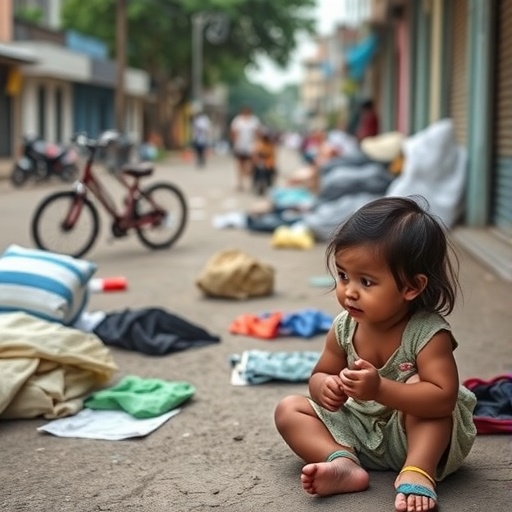
In a groundbreaking study published in the premier BMC Psychology journal, researchers Hassan, Kassim, Yunus, and their colleagues have unveiled critical insights into the health-related quality of life (HRQoL) among urban children living in poverty. As the world grapples with rising urbanization and persistent socioeconomic disparities, understanding the intricate interplay between poverty and child well-being has never been more urgent. This study meticulously explores how the multifaceted challenges of impoverished urban environments translate into compromised physical, mental, and social health outcomes for children, providing a nuanced perspective that demands policymakers’ and public health officials’ immediate attention.
Urban poverty represents a unique milieu in which the rapid concentration of people, limited access to resources, and social inequalities converge to create environments that are often hostile to childhood development. Children residing in these settings face compounded adversities that extend beyond mere economic deprivation. The study sheds light on how overcrowding, inadequate housing, pollution, and limited access to educational and recreational facilities severely impinge upon their day-to-day experiences, thereby eroding crucial dimensions of their quality of life. This multidimensional assessment underscores an urgent public health issue that transcends traditional measures of disease and mortality, emphasizing the broad and interrelated spectrum of health determinants affecting this vulnerable population.
What sets this research apart is its comprehensive approach to measuring HRQoL using both subjective and objective indicators tailored specifically for children. By employing psychometrically validated tools, the researchers were able to capture children’s self-reported perceptions of their well-being alongside clinical assessments and environmental evaluations. This dual strategy illuminates discrepancies between perceived and actual health conditions, which can be critical for designing targeted interventions. Furthermore, it reveals how children’s voices, often overlooked in research, provide essential insights into their lived realities and coping mechanisms, highlighting resilience factors that can be bolstered through community and policy action.
Delving deeper into the psychological dimensions, the study unearths a striking prevalence of mental health challenges among urban poor children, including increased anxiety, depression, and behavioral issues. These findings are particularly alarming given the well-documented long-term consequences of early-life psychological distress on educational attainment, social integration, and economic productivity. The research delineates the role of environmental stressors such as exposure to violence, social exclusion, and uncertainty about basic needs, all of which amplify psychological vulnerability. It also points to systemic deficiencies in mental health services accessibility, spotlighting a critical gap that exacerbates these outcomes and perpetuates cycles of poverty and ill-health.
Physical health parameters provide another crucial dimension in this expansive analysis. The study correlates poverty with a higher incidence of chronic illnesses, nutritional deficiencies, and impaired physical functioning. Infrastructural inadequacies, including limited access to clean water and sanitation, alongside suboptimal nutritional intake due to food insecurity, are identified as major contributors. By integrating geospatial data on urban infrastructure and environmental hazards, the authors adeptly illustrate how spatial inequalities within cities translate into disparate health risks. This granular understanding is vital for crafting place-based public health interventions that prioritize the most affected neighborhoods and optimize resource allocation.
The research further interrogates social determinants intrinsic to urban poverty, such as family stability, social support networks, and educational opportunities. It reveals how weakened family structures, parental stress, and lack of social cohesion intensify health disparities, effectively trapping children in vulnerability cycles. Conversely, the presence of positive social relationships emerges as a significant protective factor, reinforcing the concept that community-level interventions and strengthening social capital can substantially mitigate the adverse impacts of poverty. These insights confirm that addressing HRQoL requires not only medical and nutritional strategies but also profound social reforms and community empowerment initiatives.
Innovatively, the study employs advanced statistical modeling to parse out the complex interdependencies between various determinants of health quality. Utilizing structural equation modeling, the authors disentangle direct and indirect pathways through which poverty influences HRQoL, offering a more precise understanding of causal mechanisms. This sophisticated analytical framework enables the identification of leverage points for interventions that can confer maximal benefit, such as improving housing quality or enhancing school environments. The methodological rigor demonstrated here sets a benchmark for future research aiming to tackle intricate public health issues through comprehensive, data-driven approaches.
Equally important, the article addresses the challenge of measuring quality of life in pediatric populations within low-resource urban settings. Traditional HRQoL instruments often fail to account for cultural context and environmental specifics, resulting in potential biases and underestimations. To overcome these limitations, the researchers adapted existing tools and developed novel modules that capture culturally relevant aspects of well-being, including community safety perceptions and access to play. This culturally sensitive methodology ensures that assessments truly reflect children’s realities and facilitates the development of culturally appropriate interventions that resonate with targeted populations.
The implications of this study are profound for public health policies and urban planning. By elucidating the multifactorial deficits that impoverished urban children face, it calls for integrated strategies that encompass health care, education, housing improvement, and social services. The authors advocate for multisectoral collaboration that transcends traditional silos, urging governments and stakeholders to align efforts towards creating healthier, more equitable urban environments. This vision is in line with the Sustainable Development Goals, emphasizing the reduction of inequalities and the promotion of well-being for all children irrespective of socioeconomic background.
Moreover, the research highlights the importance of early intervention. Given the plasticity of childhood development, it argues that timely social, educational, and health-related programs can substantially alter life-course trajectories. By targeting critical developmental windows, such interventions not only improve immediate HRQoL but also reduce future burdens on healthcare systems and social services. The study thus reinforces the rationale for investing in early childhood development as both a humanitarian imperative and a cost-effective public health strategy.
Notably, the study paves the way for further research by identifying gaps in current knowledge. While the findings are robust, the authors acknowledge limitations related to the cross-sectional design and suggest longitudinal studies to capture dynamic changes and causal inferences over time. They also call for expanding research to different urban contexts globally to validate and generalize findings, recognizing the heterogeneity of urban poverty across regions. This openness to iterative research reflects a commitment to evolving understanding and continuous improvement in addressing complex social determinants of health.
From a technical perspective, this work exemplifies the increasing role of interdisciplinary collaboration in health research. The team integrates expertise from clinical psychology, epidemiology, urban planning, and sociology, showcasing the synergies achieved through such cross-disciplinary methods. The use of geographic information systems (GIS) alongside traditional health surveys is especially noteworthy, representing a cutting-edge approach that enhances the spatial and environmental contextualization of health data. This integrated methodology enriches the analytical depth and policy relevance of the findings, offering a model for future research in similarly complex fields.
In summary, this seminal study by Hassan and colleagues offers an invaluable examination of the health-related quality of life among urban poor children, delineating the formidable challenges they face and the pathways through which poverty exacts its toll. It combines rigorous methodological innovations with a passionate advocacy for social justice, underscoring the urgent need for comprehensive, contextually tailored responses. By elevating the voices and experiences of children often overlooked in health discourse, this research charts a hopeful course towards healthier urban futures grounded in equity and inclusion.
As urban populations continue to swell worldwide, the findings from this work resonate far beyond the studied communities, serving as a clarion call for global action. The study stresses that mitigating the deleterious effects of poverty on childhood health requires bold commitment and innovative solutions that prioritize holistic well-being. Effective intervention goes beyond isolated medical treatments to embrace social, economic, and environmental reforms that dismantle the roots of inequality. In doing so, it lays the foundation for cities where every child’s potential can flourish unhindered by the shackles of poverty.
Ultimately, the study’s impact lies in its capacity to inspire change that is both evidence-based and empathetic. By translating complex data into human stories and actionable knowledge, it bridges the gap between science and society. Researchers, practitioners, and policymakers alike stand to benefit from this rich resource, which advances understanding while igniting momentum towards a future in which urban poverty no longer predetermines a child’s health destiny.
Cite Scienmag News
Silas Everden. (December 22, 2025). Urban Poverty’s Impact on Children’s Health Quality. Scienmag. https://scienmag.com/urban-povertys-impact-on-childrens-health-quality/
Silas Everden. "Urban Poverty’s Impact on Children’s Health Quality." Scienmag, 22 December 2025, https://scienmag.com/urban-povertys-impact-on-childrens-health-quality/. Accessed 28 August 2026.
Silas Everden. "Urban Poverty’s Impact on Children’s Health Quality." Scienmag. December 22, 2025. https://scienmag.com/urban-povertys-impact-on-childrens-health-quality/


