


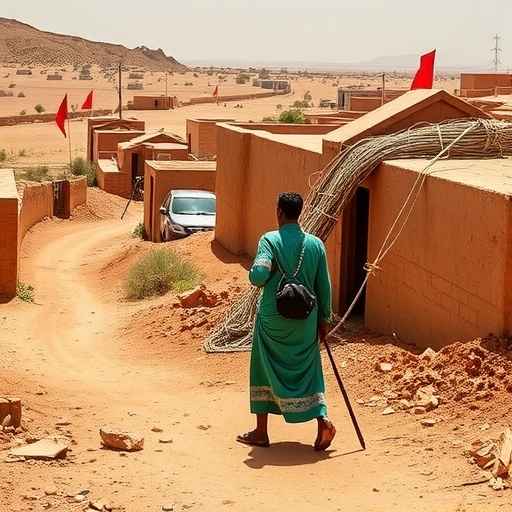
In a groundbreaking study set to be published in 2025, researchers have unveiled critical insights into the intricate relationship between social-ecological crises and spatial mobility in Morocco’s High Atlas region. The paper, authored by Kmoch, Bou-Lahriss, Ait Babahmad, and their collaborators, sheds light on how these interconnected crises are forcing communities to adapt, relocate, or abandon their ancestral lands in pursuit of better living conditions. This phenomenon echoes broader global patterns of migration instigated by environmental pressures and social issues, reflecting a pressing need for comprehensive policy responses.
The research focuses on several compounding factors that characterize the High Atlas area, including climate change, resource depletion, and socioeconomic instability. Boasting a diverse ecosystem, the region is increasingly vulnerable to these pressures, which threaten not only the environment but also the livelihoods of the indigenous communities who rely on agriculture and livestock. The findings of this study highlight a complex web of interactions; local populations are experiencing firsthand the impacts of environmental degradation, which in turn exacerbates socioeconomic inequalities and compels mobility.
Moreover, the study meticulously outlines the multiple dimensions of social-ecological crises. Climate unpredictability manifests through decreased rainfall, increasing temperatures, and the intensification of droughts. These changes have led to diminishing water supplies and crop yields, fuelling food insecurity. The resulting discontent often manifests as tension within local communities, influencing migration patterns as families seek viable alternatives elsewhere. The researchers emphasize how these phenomena are not just isolated incidents but part of a larger narrative affecting numerous regions worldwide.
In investigating the phenomenon of land abandonment in the High Atlas, the study reveals heart-wrenching stories of families who have reluctantly left their farms and homes. This trend is not simply a matter of economic necessity; it involves deep emotional and cultural ties to the land that are now being severed. The paper poignantly illustrates the psychological toll on communities as they navigate the challenges of displacement, offering a human perspective on an issue often viewed through a purely economic lens.
A significant finding of the research underscores the contribution of ineffective governance and inadequate policy to the ongoing crises. Many local farmers report frustration with governmental responses to their plight, highlighting the absence of comprehensive strategies aimed at supporting vulnerable populations in the face of environmental challenges. The paper stresses the need for a multi-faceted approach to policy that prioritizes sustainability, social safety nets, and local empowerment in decision-making processes.
As the study progresses, it draws parallels between the experiences of communities in Morocco and those facing similar circumstances globally. The authors note that the phenomenon of forced migration due to social-ecological crises is not unique to the High Atlas but resonates across diverse contexts. This comparative perspective enriches the research, providing valuable insights into potential solutions that could mitigate the impacts of such crises.
The researchers also highlight the role of external factors, such as global markets and international policies, in shaping local realities. The push for higher profits has often led to the over-extraction of natural resources, leaving local communities grappling with the fallout. This critique of global economic structures encourages a reconsideration of how market forces influence environmental degradation and, consequently, human mobility.
An important facet of the research examines how technology can play a dual role in these crises. While modern advancements can provide innovative solutions and enhance agricultural practices, they can also exacerbate existing inequalities. Disparities in technological access mean that wealthier farmers may adapt more successfully, while poorer households remain trapped in cycles of vulnerability. The paper calls for equitable access to technological resources alongside traditional practices, offering a holistic approach to both environmental and social sustainability.
Delving deeper into the local context, the paper offers case studies of various communities, showcasing their resilience and adaptation strategies amid adversity. These narratives serve not only as testimonials to the spirit of human tenacity but also as valuable lessons for policymakers. By understanding the lived experiences of those most affected, stakeholders can craft more targeted and effective interventions.
The findings also underscore the importance of education in fostering a comprehensive understanding of social-ecological interdependencies. Empowering community members with knowledge about sustainable practices, climate resilience, and effective resource management enhances their capacity to adapt. Education emerges as a cornerstone of resilience, helping communities navigate the uncertainties of a rapidly changing world.
As the study reaches its conclusions, it emphasizes the critical need for collaborative efforts among various sectors. Scholars, community leaders, policymakers, and international organizations must unite to create sustainable frameworks that address the root causes of social-ecological crises. The authors advocate for a transdisciplinary approach that integrates diverse perspectives to design solutions that are both context-specific and scalable.
In addressing the broader implications of their findings, the research team issues a clarion call to the global community. They argue that the impacts seen in Morocco’s High Atlas serve as a microcosm of the larger challenges faced worldwide, where social inequalities and environmental crises intertwine. This recognition is essential in galvanizing action, inspiring a collective response to promote resilience and equity in the face of inevitable change.
Looking forward, the study serves as a springboard for further research into the dynamics of social-ecological crises and migration patterns. As the authors acknowledge, ongoing observation and analysis are crucial for tracking these evolving phenomena. Future studies can build upon their findings to develop a more nuanced understanding of how different regions respond to crisis, ultimately informing policies that prioritize human dignity and environmental stewardship.
In sum, Kmoch and colleagues’ research offers a profound glimpse into the intricate dance between humans and their environments, highlighting that the challenges posed by social-ecological crises demand urgent attention and innovative solutions. The interconnectedness of these issues affirms that our approaches must be comprehensive, navigating the complexities of human experience while advocating for the health of the planet.
Kmoch, L.M., Bou-Lahriss, A., Ait Babahmad, R. et al. Compounding social-ecological crises drive spatial mobility and land abandonment in Morocco’s High Atlas.
Ambio (2025). https://doi.org/10.1007/s13280-025-02323-5
Cite Scienmag News
Violet Maxwell. (December 20, 2025). Interlinked Crises Propel Mobility and Land Abandonment in Morocco. Scienmag. https://scienmag.com/interlinked-crises-propel-mobility-and-land-abandonment-in-morocco/
Violet Maxwell. "Interlinked Crises Propel Mobility and Land Abandonment in Morocco." Scienmag, 20 December 2025, https://scienmag.com/interlinked-crises-propel-mobility-and-land-abandonment-in-morocco/. Accessed 1 September 2026.
Violet Maxwell. "Interlinked Crises Propel Mobility and Land Abandonment in Morocco." Scienmag. December 20, 2025. https://scienmag.com/interlinked-crises-propel-mobility-and-land-abandonment-in-morocco/


