


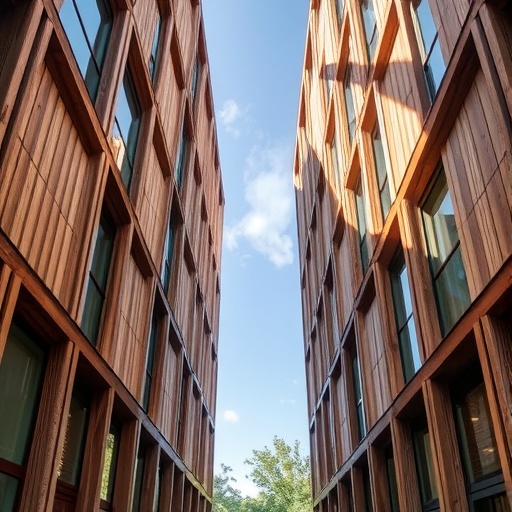
In the quest for sustainable construction, tall timber buildings have emerged as a promising solution, brilliantly merging the elegance of architecture with the imperatives of ecological responsibility. Recent research by Hayrettin E. Ilgın offers a profound insight into the design determinants that influence the core efficiency of these structures. As urban populations continue to swell and climate concerns gain paramount importance, understanding the intricacies of timber building design is critical in shaping the cities of the future.
Timber, historically favored for its aesthetic qualities, is now being recognized for its sustainability credentials. Its potential for carbon sequestering stands in stark contrast to traditional concrete constructs. The ability of timber to store carbon not only aids in reducing greenhouse gas emissions but also presents the opportunity to counterbalance the environmental impact of urban sprawl. In this context, Ilgın’s work emphasizes the importance of strategic design choices in heightening the efficiency of timber buildings.
Buildings are no longer mere shelters; they are environments that exert a significant influence on their inhabitants. The central core of a tall building is crucial, serving as the spine for various functional components. Ilğın’s analysis suggests that allocating resources and structural integrity towards the core can markedly improve the building’s overall efficiency, paving the way for taller, more sustainable skyscrapers. A central efficient core minimizes resource consumption and streamlines the construction process, fundamentally redefining the parameters of building design.
Structural performance is an essential aspect of timber architecture. According to the findings presented, materials must be intelligently selected and strategically deployed to enhance not only the strength of the building but also its longevity. A robust timber core, for instance, can effectively manage lateral forces and loads that arise during wind events or seismic activities, which is pivotal in ensuring occupant safety. The study reveals that innovations in joint technology and cross-laminated timber can further bolster performance metrics, setting new standards in ultimate strength and serviceability.
Another crucial element highlighted in the research is the role of typological analysis in the design process. By classifying different forms of tall timber structures, Ilgın encourages architects and builders to adopt best practices, fostering a more holistic understanding of how specific designs can lead to efficiency gains. The categorization of typologies not only assists in the design phase but also in predicting performance outcomes, thereby guiding resource allocation effectively during the planning stages.
Adaptive reuse and modular design approaches emerge as pivotal themes within Ilgın’s research. As the construction industry grapples with waste and resource consumption, leveraging existing structures or incorporating modular components can significantly elevate sustainability. The adaptability of timber, coupled with its modular characteristics, means that buildings can be designed for disassembly and repurpose, heralding an era where structures are not merely built, but are part of a continuous cycle of use and reinvention.
Environmental impacts extend beyond the immediate ecosystem; they infiltrate the social fabric of urban areas. By integrating nature into urban landscapes through timber buildings, cities can cultivate greener environments that enhance public health. Ilgın points to the psychological benefits associated with natural materials: timber resonates with a comforting aesthetic and offers acoustic insulation, contributing to well-being. As such, the design of tall timber buildings is not just about structural efficiency; it embodies a broader approach to urban livability.
The research also delves into regulatory frameworks that traditionally hinder timber construction. While building codes have generally favored concrete and steel, there is an emerging shift. This research advocates for tailored regulations that appreciate and facilitate the unique properties of timber. Advocating for updated policies can stimulate innovation in timber construction, allowing architects to push boundaries and explore previously unimagined design options.
Across the globe, case studies of successful tall timber buildings shed light on practical applications of the principles discussed. Structures that exemplify core efficiency not only serve as landmarks but also educate communities about the potential of sustainable architecture. These case studies can inspire confidence among stakeholders, investors, and the public, promoting broader acceptance of timber as a mainstream building material.
Additionally, Ilgın’s research emphasizes the importance of collaboration among various stakeholders in the design and construction process. Engineers, architects, and builders must work seamlessly together to bring complex timber designs to fruition. The synthesis of expertise from multiple disciplines within architectural and engineering teams enables innovative problem-solving and creative strategies, essential components for realizing ambitious timber projects.
Monitoring and post-occupancy evaluations are essential to validating the claims related to the efficiency of timber buildings. By committing to long-term evaluations, stakeholders can gather data that refines building strategies and informs future designs. Continuous learning from these evaluations helps in making informed decisions about material choices and design strategies that resonate with sustainability metrics, thus fostering an evolving dialogue around building practices.
In terms of figures and projections, the tall timber sector is witnessing exponential growth. Researchers predict a significant uptick in the number of timber buildings as the industry moves toward greener solutions. Ilgın’s analysis aligns with this projection by asserting that the design determinants outlined will become increasingly vital as frameworks around sustainability in building practices solidify, necessitating rigorous adherence to efficient design parameters.
In conclusion, Ilgın’s research is not only a call to action but also a step toward pioneering a new era of architectural design — one that marries efficiency with environmental consciousness. The insights offered within this framework resonate with the growing mandate to innovate responsibly, ensuring that our urban future is not undermined by the consequences of past practices. As we forge ahead into a new age of construction, the principles outlined offer a roadmap that champions not only the aesthetic qualities of timber but its inherent capacity as a sustainable material.
The synthesis of research findings and practical applications culminates in an optimistic vision for tall timber buildings, reinforcing their potential to reshape skylines sustainably. As urban centers continue to expand, the intelligence embedded within timber building design must lead the charge, setting new standards for efficiency, safety, and environmental stewardship.
Ilgın, H.E. Design determinants of core efficiency in tall timber buildings: a typological analysis.
Discov Sustain 6, 1401 (2025). https://doi.org/10.1007/s43621-025-02266-7
Cite Scienmag News
Violet Maxwell. (December 19, 2025). Core Efficiency in Tall Timber Buildings: A Study. Scienmag. https://scienmag.com/core-efficiency-in-tall-timber-buildings-a-study/
Violet Maxwell. "Core Efficiency in Tall Timber Buildings: A Study." Scienmag, 19 December 2025, https://scienmag.com/core-efficiency-in-tall-timber-buildings-a-study/. Accessed 3 September 2026.
Violet Maxwell. "Core Efficiency in Tall Timber Buildings: A Study." Scienmag. December 19, 2025. https://scienmag.com/core-efficiency-in-tall-timber-buildings-a-study/


