


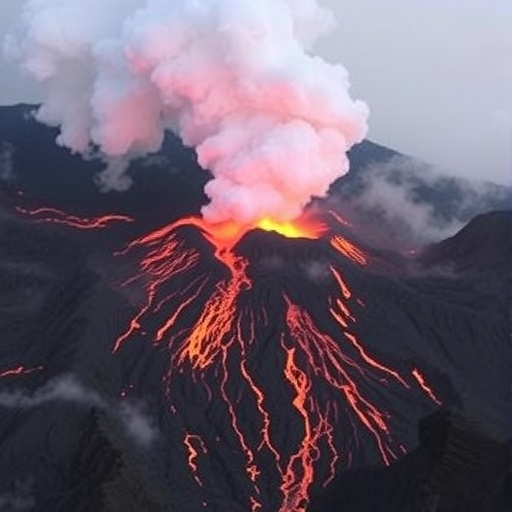
In the intricate and ever-evolving field of climate science, one of the most stubborn puzzles revolves around the interaction between aerosols and clouds—an interaction that holds profound implications for our understanding of climate change. A groundbreaking study led by Wang, Neubauer, Chen, and their colleagues, to be published in Nature Communications in 2025, sheds new light on why global climate models have struggled to accurately capture cloud responses to aerosol perturbations. Their research uniquely harnesses the natural laboratory provided by volcanic eruptions, revealing unexpected complexities and offering critical insights that could revolutionize climate modeling.
Aerosols, tiny particles suspended in the atmosphere, play a dual role in climate dynamics. They can scatter sunlight, leading to a cooling effect, or serve as cloud condensation nuclei (CCN), altering cloud microphysics and thus affecting cloud brightness, longevity, and precipitation patterns. The challenge lies in the fact that clouds are highly sensitive and dynamic systems governed by a multitude of interacting variables, making them notoriously difficult to model. The conventional representations of aerosol-cloud interactions in global climate models (GCMs) often result in significant uncertainties, limiting our predictive capabilities.
Volcanic eruptions provide an exceptional opportunity to study aerosol-cloud interactions on a large scale. Unlike anthropogenic aerosol emissions, which tend to be continuous and diffuse, volcanic events inject massive quantities of sulfate aerosols into the stratosphere within a short timespan, generating a distinct “pulse” of particulates that influences cloud formation and climate forcing in observable ways. Wang and colleagues utilize extensive satellite observations and sophisticated atmospheric data assimilation techniques to analyze these volcanic aerosol perturbations and their downstream impacts on cloud properties.
The study reveals that current GCMs inadequately represent the complexity of cloud responses triggered by volcanic aerosols. Notably, the models often underestimate changes in cloud droplet size distributions and cloud cover, which are critical factors influencing the Earth’s radiative balance. This underestimation stems from simplifications in aerosol microphysics and insufficient resolution of cloud-scale processes. More strikingly, the researchers discovered that models fail to reproduce the observed feedback mechanisms where aerosol-induced cloud brightening modulates atmospheric circulation and moisture transport, further influencing cloud dynamics.
Central to the study is the identification of nonlinear interactions that challenge the assumption of linearity often embedded in climate models. Volcanic aerosols do not merely increase CCN concentrations, but also interact with existing meteorological conditions in complex feedback loops, affecting cloud lifecycle stages such as formation, growth, and dissipation. These nuanced dynamics suggest that aerosol-cloud interactions cannot be accurately parameterized without capturing these interdependencies at finer spatial and temporal scales.
Wang et al. also emphasize the critical role of vertical aerosol distribution. Volcanic aerosols injected into the stratosphere have distinct radiative and chemical properties compared to boundary layer aerosols. The differential effects on cloud albedo and atmospheric heating profiles create stratification and stabilization phenomena that current models generally overlook. The authors argue for enhanced coupling between microphysical aerosol schemes and three-dimensional cloud dynamics within GCMs to more realistically simulate these processes.
A remarkable aspect of the study is the use of multi-instrument satellite datasets including those from polar-orbiting and geostationary platforms, enabling the team to dissect cloud-aerosol correlations on unprecedented temporal and spatial scales. This approach allows for validation and refinement of model parameterizations by confronting simulations directly with observed cloud optical thickness, droplet effective radius, and cloud fraction variations post-volcanic eruption. The findings demonstrate the potential of integrating observational constraints to improve model fidelity.
The implications of this research transcend academic interest. Accurate predictions of aerosol-cloud interactions are pivotal for climate change projections and policy-making. Overestimation or underestimation of cloud radiative forcing can skew simulations of global temperature trends and hydrological cycles. The study highlights the urgency to revise climate models before they can reliably inform not only future climate scenarios but also geoengineering proposals that might attempt to manipulate aerosol concentrations for climate intervention.
Moreover, the study contends with the broader challenge of incorporating natural variability into climate predictions. Volcanic eruptions are episodic yet impactful, and their aerosol footprints significantly perturb the radiative forcing balance for several years. Understanding and accurately representing such episodic phenomena in climate models is vital for separating human-induced effects from natural variability and improving attribution science.
The authors propose pathways for advancing model frameworks, including the integration of more physically-based aerosol activation schemes, dynamic cloud microphysics modules capable of resolving droplet size distributions under varying aerosol loads, and high-performance computing enabling finer grid resolutions. The convergence of technological innovation, observational advancements, and theoretical progress gives hope that many of the current limitations can be overcome.
This pioneering research also primes the scientific community to rethink how uncertainties in cloud-aerosol interactions are handled in climate assessments. It calls for enhanced interdisciplinary collaboration, combining atmospheric chemistry, meteorology, data science, and computational modeling. The outcomes could bridge longstanding gaps and help reconcile disparities between model predictions and empirical observations that have fueled debates within climate science.
In conclusion, the insights derived from volcanic eruptions as natural experiments have unveiled critical inadequacies in current global climate models when simulating cloud responses to aerosols. This study is a clarion call for the climate modeling community to embrace greater complexity, leverage observational synergies, and refine their representation of aerosol-cloud interactions to enhance predictive accuracy. Such efforts will be central to improving our understanding of the climate system and guiding humanity’s response to climate change.
Cite Scienmag News
Russell Cooper. (December 18, 2025). Volcanic Eruptions Reveal Challenges in Cloud-Aerosol Modeling. Scienmag. https://scienmag.com/volcanic-eruptions-reveal-challenges-in-cloud-aerosol-modeling/
Russell Cooper. "Volcanic Eruptions Reveal Challenges in Cloud-Aerosol Modeling." Scienmag, 18 December 2025, https://scienmag.com/volcanic-eruptions-reveal-challenges-in-cloud-aerosol-modeling/. Accessed 3 September 2026.
Russell Cooper. "Volcanic Eruptions Reveal Challenges in Cloud-Aerosol Modeling." Scienmag. December 18, 2025. https://scienmag.com/volcanic-eruptions-reveal-challenges-in-cloud-aerosol-modeling/


