


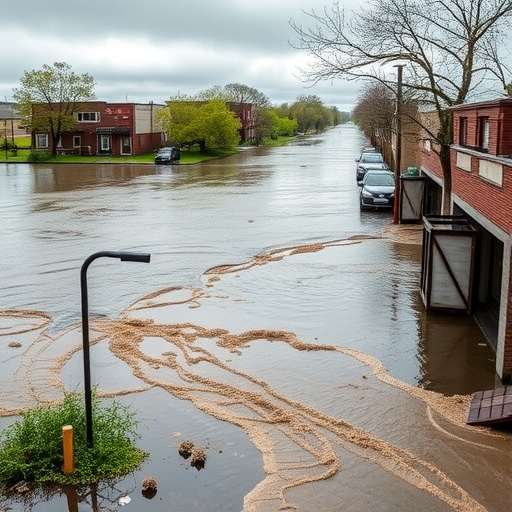
In recent years, the impact of climate change has become an undeniable reality, with flooding events becoming increasingly frequent and severe around the globe. Researchers have been focusing their efforts on understanding how emerging technologies can be harnessed to adapt to these extreme weather events. In a groundbreaking study, Zhong, Shang, Cui, and their colleagues have utilized text-based modeling to uncover sector-specific benefits emerging from the application of innovative technologies for extreme flood adaptation. This study, set to be published in Communications Earth & Environment in 2025, is poised to redefine how we view crisis management in the face of climate-driven challenges.
Flooding poses a significant threat not only to human lives but also to industries critical for economic stability. With urban areas becoming more vulnerable due to rising sea levels and increased rainfall intensity, the need for resilient infrastructures has reached a critical juncture. The study highlights various sectors, including agriculture, urban development, and transportation, each experiencing distinct challenges and opportunities in adopting new technologies for flood adaptation. Zhong and his co-authors meticulously analyzed how tailored technological solutions can mitigate risks while offering significant economic advantages.
Emerging technologies like artificial intelligence, big data analytics, and geospatial mapping have opened new frontiers in managing flood risks. Through the lens of text-based modeling, the researchers unearthed how these tools can be instrumental in predicting flood patterns, optimizing resource allocation, and developing on-the-ground solutions. The nuanced understanding gained from this approach permits stakeholders to make informed decisions that account for the complexities unique to their sectors. By responding to flood threats with precision, industries can minimize potential damage and increase their resilience.
In the agricultural sector, for example, the implications of flooding are multifaceted. Crop yields can be severely affected due to waterlogged fields, while livestock could face dire conditions if rapid adaptation measures are not in place. The researchers’ analysis revealed that precision agriculture technologies could be adapted to monitor field moisture levels in real-time, allowing farmers to make data-driven decisions about irrigation and crop selection in flood-prone areas. This proactive approach not only safeguards food production but also strengthens local economies.
Urban infrastructure is yet another sector gaining critical insights from this research. Traditional flood defenses, such as levees and floodwalls, are often insufficient in the face of extreme weather events. The findings of the study indicate that real-time data collection and analysis can guide the development of smart urban designs that integrate green infrastructure, such as permeable pavements and rain gardens. By utilizing these emerging technologies, cities can enhance their flood resilience while providing social and environmental co-benefits, such as improved air quality and urban biodiversity.
Transportation infrastructure, vital for economic activity and connectivity, is significantly threatened by flooding. Transportation agencies can optimize their responses by incorporating advanced modeling techniques explored in this study, enabling them to assess risk levels and prioritize repairs and upgrades based on future flood scenarios. For instance, by leveraging simulations derived from the research, transport planners can identify the most vulnerable routes and devise reactive plans to reroute traffic away from affected areas, ensuring that the logistics of cities remain robust even in the face of natural disasters.
The research by Zhong et al. underscores the importance of collaboration among stakeholders in effectively implementing these technologies. Governments, industry leaders, and communities must work together to develop tailored strategies for flood adaptation. By employing collective action and sharing data across sectors, the beneficial impact of these technologies can be amplified. High-level partnerships that pool resources and expertise could significantly enhance the effectiveness of flood adaptation initiatives at regional, national, and even global scales.
Moreover, public awareness plays a crucial role in the successful implementation of flood adaptation strategies. The study emphasizes the need for educating communities about the benefits of emerging technology in mitigating flood risks. By equipping the public with information about available tools and resources, individuals can proactively engage in disaster preparedness efforts. This grassroots involvement not only helps communities become more resilient but also fosters a culture of innovation that promotes continuous improvement in flood risk management.
As carbon emissions continue to rise, pushing global temperatures higher and changing weather patterns, the urgency to implement these technologies cannot be overstated. The study highlights the potential of not only reactive strategies but also the significance of preventive measures in flood adaptation. For example, integrating climate-resilient practices into urban planning processes ensures that new developments are designed with flood risks in mind, significantly reducing long-term economic and social costs.
The economic implications of applying such technologies for flood adaptation are profound. By investing in advanced flood prediction models, early warning systems, and rapid-response capabilities, sectors could save millions, if not billions, by avoiding potential damages. Given that the initial investments may require substantial funding, the study advocates for innovative financing models, including public-private partnerships. These collaborations can ensure that adequate financial resources are available to implement vital technologies while supporting sustained economic growth.
Emerging technologies also hold promise in terms of sustainability and environmental conservation. This research illuminates the pathways for regenerative practices that will not only aid in flood adaptation but also restore natural ecosystems. For instance, implementing green infrastructure can enhance local flora and fauna while simultaneously providing effective flood mitigation. The co-benefits derived from such strategies present an opportunity to integrate environmental stewardship with urgent climate adaptation needs, marrying economic growth with ecological integrity.
Ultimately, as global society seeks to grapple with the scourge of climate change-induced flooding, the insights shared by Zhong et al. serve as a clarion call for action. The ability to leverage emerging technologies for robust flood adaptation not only signals hope for vulnerable sectors but also reinforces the importance of visionary leadership in navigating an uncertain future. By embracing innovation, sectors can not only survive but thrive amidst the challenges that lie ahead.
This study paves the way for future research that can expand our understanding of technology-based adaptations necessary for more extensive climate challenges. Policymakers, urban planners, and industry stakeholders must heed these emerging insights to champion a sustainable and resilient future that can withstand the test of time. The transition towards a proactive rather than reactive approach in flood risk management represents a critical juncture for humanity, underpinning our collective well-being in this rapidly changing world.
As we eagerly await the full publication of this pioneering study in Communications Earth & Environment in 2025, it is clear that innovation, collaboration, and education will be the cornerstones in our fight against the increasingly severe threat posed by climate-induced floods. By unlocking the potential of cutting-edge technologies, society has an unparalleled opportunity to redefine its relationship with nature while safeguarding the health, safety, and prosperity of future generations.
Zhong, Y., Shang, W., Cui, S. et al. Text-based modeling reveals the sector-specific benefits of emerging technologies for extreme flood adaptation.
Commun Earth Environ (2025). https://doi.org/10.1038/s43247-025-03077-4
Cite Scienmag News
Violet Maxwell. (December 17, 2025). Emerging Technologies Boost Extreme Flood Adaptation Strategies. Scienmag. https://scienmag.com/emerging-technologies-boost-extreme-flood-adaptation-strategies/
Violet Maxwell. "Emerging Technologies Boost Extreme Flood Adaptation Strategies." Scienmag, 17 December 2025, https://scienmag.com/emerging-technologies-boost-extreme-flood-adaptation-strategies/. Accessed 4 September 2026.
Violet Maxwell. "Emerging Technologies Boost Extreme Flood Adaptation Strategies." Scienmag. December 17, 2025. https://scienmag.com/emerging-technologies-boost-extreme-flood-adaptation-strategies/


