


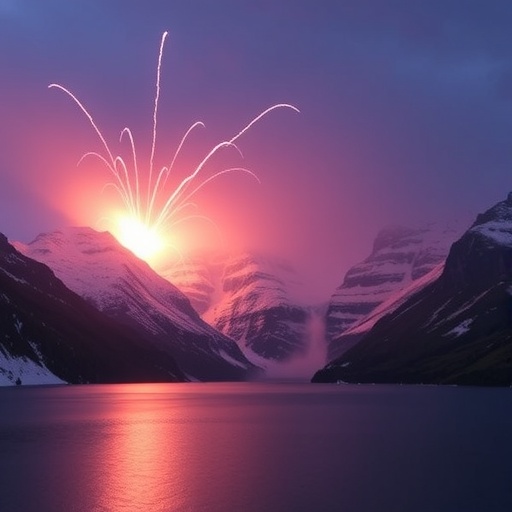
A recent groundbreaking study published in Nature Communications has shed new light on the increasing frequency of moraine-dammed lake outburst floods (GLOFs), a peril amplified by the relentless pace of global warming. These catastrophic events, where glacial lakes encased by debris accumulations suddenly breach their natural dams, have become alarmingly more frequent, posing a substantial risk to downstream communities and ecosystems. The research, spearheaded by Zhang, Wang, Kougkoulos, and colleagues, meticulously analyzes the interplay between rising global temperatures and the heightened instability of moraine dams, ultimately driving the increase in outburst floods. This emerging evidence is poised to reshape how scientists and policymakers understand hydrological hazards in a warming world.
Moraine-dammed lakes are natural reservoirs formed when retreating glaciers deposit moraines — accumulations of rock, soil, and debris — that act as dams, trapping meltwater. These lakes can grow over time as glaciers continue to melt, sometimes reaching volumes that exert immense pressure on their typically porous and fragile moraine walls. When the structural integrity of these dams is compromised, it can result in a sudden and devastating release of water, debris, and sediments, known as an outburst flood. Such floods have the potential to inflict widespread damage on human settlements, infrastructure, and natural habitats downstream.
The research utilizes state-of-the-art remote sensing data combined with historical flood records to provide comprehensive temporal and spatial analyses of moraine-dammed lake behavior. The authors report a marked uptick in the frequency of GLOFs in the last two decades, correlating this increase with escalating global mean temperatures. The comprehensive dataset includes satellite imagery capturing lake growth, moraine deformation, and eventual breaches, enabling the identification of critical thresholds at which moraine dams fail under climate-driven stressors.
One of the study’s key revelations is the pivotal role of enhanced glacial meltwater production driven by rising air temperatures in destabilizing moraine dams. As glaciers retreat and surface ice melts more rapidly, glacial lakes expand both in size and volume. The increase in lake water uplifted pressure exerted on the dam structures not only weakens them mechanically but also facilitates seepage pathways that can erode and undermine the moraine materials from within. Furthermore, permafrost thawing within moraines exacerbates this vulnerability, reducing material cohesion and making dam failure more likely.
In addition to hydrological pressures, Zhang et al. point to external triggers such as intense precipitation events, seismic activity, and ice avalanches cascading into moraine-dammed lakes as catalytic factors intensifying GLOF occurrence. Climate change is instrumental in altering precipitation patterns, making intense rainfall and subsequent floods more frequent and unpredictable. These episodic events can rapidly raise lake levels, exerting dynamic, transient loads on moraine dams which may exceed their load-bearing capacities and spark catastrophic failures.
The study also highlights regional variations in GLOF frequency and susceptibility closely tied to local climate regimes and geologic contexts. For example, high mountain ranges such as the Himalayas and the Andes exhibit a higher frequency of outburst floods compared to other glaciated regions, due both to their abundant glacial lakes and rapid glacial recession rates. The investigation underscores the importance of region-specific monitoring and hazard assessment to effectively mitigate risks for vulnerable populations residing downstream.
Zhang and colleagues employ advanced numerical modeling frameworks to simulate the complex interactions among glacier dynamics, thermal regimes of moraine dams, hydrological inflows, and mechanical failure mechanisms. These models integrate temperature projections from climate simulations, allowing forecasts of future GLOF occurrences under different warming scenarios. Predictive outputs suggest that unless greenhouse gas emissions are curtailed and adaptive measures undertaken, the frequency and magnitude of outburst floods will escalate, compounding hazards in alpine environments globally.
Beyond physical modeling, the research calls attention to the socio-economic dimensions of GLOFs. Increased population growth, infrastructural development, and resource extraction activities in mountain regions place more people and assets in harm’s way. Effective risk reduction requires integrated multidisciplinary approaches combining scientific insights with policy frameworks aimed at early warning systems, land-use planning, and community resilience building. The authors advocate for enhanced international collaboration leveraging emerging technologies such as real-time remote sensing and machine learning for rapid hazard identification.
The findings reinforce the urgent need to recalibrate disaster preparedness strategies, emphasizing continuous monitoring of glacial lakes and moraine dam stability. Governments and local authorities must recognize GLOF hazards as part of the broader climate risk landscape, embedding adaptive measures into sustainable mountain development plans. Upgrading existing vulnerability assessments to incorporate dynamic glacier-climate interactions is crucial for reducing future losses.
Another impactful dimension stressed by the study is the potential feedback loops between melting glaciers, GLOFs, and downstream water resources. While outburst floods represent destructive forces, glacial lake expansions also temporarily increase freshwater availability in some regions. Balancing water security concerns with hazard mitigation requires nuanced understanding of glacial hydrology and evolving climate trends.
In conclusion, this seminal research by Zhang et al. delivers the first large-scale quantitative evidence linking global warming directly to the surge in moraine-dammed lake outburst floods. Through robust observational datasets, innovative modeling techniques, and comprehensive hazard analysis, the study outlines a clear narrative: climate change is actively destabilizing the frozen mountain landscapes, precipitating increasingly frequent hydrological disasters. The urgency of addressing these risks transcends scientific disciplines, demanding coordinated global responses rooted in both mitigation and adaptation.
As the planet continues to warm, the stories inscribed in the retreating glaciers grow ever more critical to human survival and ecological balance. Zhang and colleagues’ contribution marks a vital step towards deciphering these stories, illuminating the pathways by which subtle climatic shifts cascade into dramatic, sometimes devastating natural events. It serves as a powerful reminder that the hidden threats locked in mountainous terrains warrant our full scientific attention and urgent policy action to safeguard lives and livelihoods.
Cite Scienmag News
Violet Maxwell. (December 17, 2025). Global Warming Sparks Frequent Moraine-Dammed Lake Outbursts. Scienmag. https://scienmag.com/global-warming-sparks-frequent-moraine-dammed-lake-outbursts/
Violet Maxwell. "Global Warming Sparks Frequent Moraine-Dammed Lake Outbursts." Scienmag, 17 December 2025, https://scienmag.com/global-warming-sparks-frequent-moraine-dammed-lake-outbursts/. Accessed 4 September 2026.
Violet Maxwell. "Global Warming Sparks Frequent Moraine-Dammed Lake Outbursts." Scienmag. December 17, 2025. https://scienmag.com/global-warming-sparks-frequent-moraine-dammed-lake-outbursts/


