


In a groundbreaking advancement that promises to revolutionize our comprehension of the universe’s most fundamental interactions, a team of physicists has unveiled a novel computational strategy that brings us tantalizingly close to a unified description of nature’s forces. This research, published in the esteemed European Physical Journal C, tackles an age-old challenge in theoretical physics: bridging the gap between the discrete, grid-like structure of lattice gauge theory and the smooth, continuous reality we observe at macroscopic scales. At its heart, the work introduces an ingenious method for dissecting complex quantum systems, allowing for more efficient and accurate simulations of the quantum chromodynamics (QCD) interaction, the very force that binds quarks together to form protons and neutrons, and by extension, all atomic nuclei. The implications of this breakthrough resonate deeply, potentially unlocking secrets about the early universe, the behavior of matter under extreme conditions, and paving the way for new discoveries in particle physics.
The intricate dance of fundamental particles and forces has long been a focal point of scientific inquiry. However, the mathematical framework required to accurately model these interactions, particularly at the quantum level, presents formidable computational hurdles. Lattice gauge theory, a cornerstone of modern particle physics, offers a powerful approach by discretizing spacetime into a four-dimensional lattice. While this technique has yielded immense success in understanding the strong nuclear force, particularly its behavior at low energies where it becomes incredibly complex and non-perturbative, the inherent discreteness introduces an artificiality that necessitates careful extrapolation to the continuous, macroscopic world. The challenge has always been to effectively remove this lattice artifact and accurately capture the physics of the continuum.
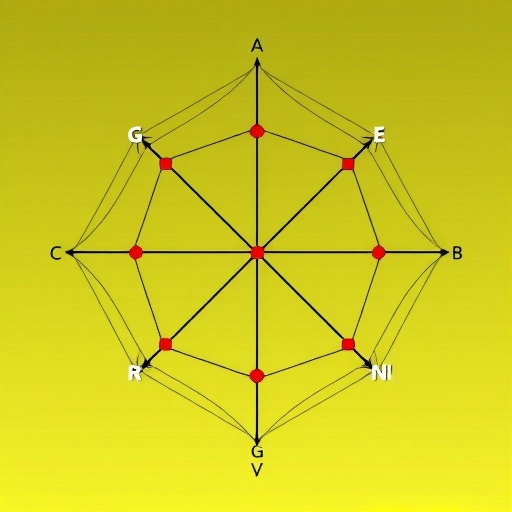
This is precisely where the innovation of Jakobs, Garofalo, Hartung, and their collaborators shines. Their meticulously designed computational technique employs a sophisticated concept known as “partitionings of SU(2).” SU(2) is a mathematical group that plays a crucial role in describing certain fundamental forces, including a simplified version of the strong force used in these theoretical explorations. By cleverly partitioning this group into smaller, more manageable pieces, the researchers can perform simulations on the lattice in a way that more closely mimics the behavior of the continuous theory. This clever decomposition allows for a more efficient exploration of the complex energy landscapes within the quantum system, reducing the computational cost while simultaneously enhancing the accuracy of the results obtained.
The significance of achieving the “continuum limit” in lattice gauge theory cannot be overstated. It represents the ultimate goal of these lattice simulations, where the spacing between the discrete points of the lattice becomes infinitesimally small, effectively transforming the grid into the smooth spacetime of Einstein’s relativity. Reaching this limit allows physicists to make direct comparisons between theoretical predictions and experimental observations with unprecedented precision. Without this extrapolation, lattice calculations remain somewhat abstract, providing insights into the underlying structure but lacking the direct verifiability that drives scientific progress. This new method represents a significant leap in making that transition smoother and more reliable.
The team’s approach specifically focuses on SU(2) gauge theory, a theoretically pivotal system that serves as a stepping stone towards understanding the more complex SU(3) theory that governs the actual strong force. By mastering the dynamics of SU(2) and demonstrating the efficacy of their partitioning method, they are laying a robust foundation for future investigations into real-world QCD. The insights gained from these simulations can illuminate phenomena such as quark confinement, the reason why quarks are never observed in isolation, and chiral symmetry breaking, a crucial process that dictates the properties of hadrons like protons and neutrons.
One of the most compelling aspects of this research is its direct impact on our ability to model extreme astrophysical environments. Consider the interiors of neutron stars, where matter is compressed to unimaginable densities, or the gargantuan energy releases during the early moments of the Big Bang. In these conditions, the strong nuclear force plays a dominant role, and its behavior is too complex to be fully understood through perturbative methods. Lattice gauge theory, amplified by this new computational technique, offers a powerful lens through which to peer into these enigmatic realms, potentially revealing the secrets of how matter behaves under duress and how the universe evolved from its fiery beginnings.
The “partitionings of SU(2)” method, while technical in its formulation, can be conceptually grasped as akin to breaking down a massive, intricate puzzle into smaller, more manageable sections. Instead of attempting to solve the entire puzzle at once, which would be computationally overwhelming, the researchers elegantly divide the problem into pieces. Each piece can then be solved with greater efficiency and accuracy, and the solutions are then stitched back together to reveal the complete picture. This decomposition strategy is what allows for the approaching of the continuum limit with greater fidelity, minimizing errors introduced by the discrete nature of the lattice.
Furthermore, the development of this enhanced simulation technique has profound implications for the ongoing quest to unify all fundamental forces of nature. While the Standard Model of particle physics has been incredibly successful, it does not encompass gravity and leaves certain questions unanswered about the relationship between the fundamental forces. By providing a more accurate and efficient tool for studying the strong nuclear force, which is one of the pillars of this unified quest, this research brings us closer to a comprehensive understanding of how all the forces interact and operate within the universe. It’s a crucial step towards a grander tapestry of physical laws.
The computational advancements described in this paper are not merely academic exercises; they are essential for pushing the boundaries of experimental physics as well. Powerful particle accelerators like the Large Hadron Collider (LHC) generate vast amounts of data that require sophisticated theoretical models for interpretation. The improved accuracy and efficiency offered by this new simulation method can directly aid in the analysis of experimental results, helping physicists to identify new particles, understand rare decay processes, and test the predictions of existing theories with greater rigor, ultimately guiding future experimental designs.
This research also opens up new avenues for exploring exotic states of matter. Beyond the commonly encountered states like solid, liquid, and gas, particle physics predicts the existence of states such as the quark-gluon plasma, a superheated, deconfined state of quarks and gluons that existed in the early universe and can be recreated in particle collisions. Understanding the phase transitions and properties of such states requires precise theoretical calculations, and the new partitioning method is ideally suited to tackling these complex challenges, offering a window into the very essence of matter.
The team’s meticulous work involved extensive numerical simulations, often requiring supercomputing resources to process the immense datasets generated. The validation of their approach involved comparing the results obtained from their partitioned SU(2) simulations with established theoretical predictions and, where possible, with experimental data from similar, albeit simplified, physical systems. This rigorous validation process instills confidence in the reliability and accuracy of their novel methodology.
The journey towards understanding the universe at its most fundamental level is a continuous process of refinement and discovery. This latest contribution represents a significant stride forward, offering a more precise and efficient way to explore the complex world of quantum field theory and its implications for the forces that govern our reality. The implications are far-reaching, promising to deepen our understanding of everything from the subatomic particles that make up our bodies to the vast cosmic structures that populate the universe.
The elegance of the computational strategy lies in its ability to decouple certain parts of the mathematical problem, making direct simulations on the lattice more amenable to analysis. This leads to a cleaner approach to extracting physical observables in the continuum limit, reducing systematic uncertainties that have plagued previous lattice calculations. This is a crucial aspect, as precision is paramount when unraveling the subtle nuances of fundamental physics.
In conclusion, the work presented by Jakobs, Garofalo, Hartung, and their colleagues marks a pivotal moment in the field of theoretical physics. Their innovative application of partitionings of SU(2) to Hamiltonian lattice gauge theory offers a powerful new tool for simulating fundamental interactions and advancing our understanding of the universe. As this method is further developed and applied to more complex systems, its impact on our scientific knowledge is poised to be nothing short of transformative, potentially ushering in a new era of discovery.
Jakobs, T., Garofalo, M., Hartung, T. et al. Dynamics in hamiltonian lattice gauge theory: approaching the continuum limit with partitionings of SU(2).
Eur. Phys. J. C 85, 1418 (2025). https://doi.org/10.1140/epjc/s10052-025-15120-x
Cite Scienmag News
Katie Riggs. (December 13, 2025). Hamiltonian Lattice Gauge Theory: Continuum Limit Approached. Scienmag. https://scienmag.com/hamiltonian-lattice-gauge-theory-continuum-limit-approached/
Katie Riggs. "Hamiltonian Lattice Gauge Theory: Continuum Limit Approached." Scienmag, 13 December 2025, https://scienmag.com/hamiltonian-lattice-gauge-theory-continuum-limit-approached/. Accessed 4 September 2026.
Katie Riggs. "Hamiltonian Lattice Gauge Theory: Continuum Limit Approached." Scienmag. December 13, 2025. https://scienmag.com/hamiltonian-lattice-gauge-theory-continuum-limit-approached/


