


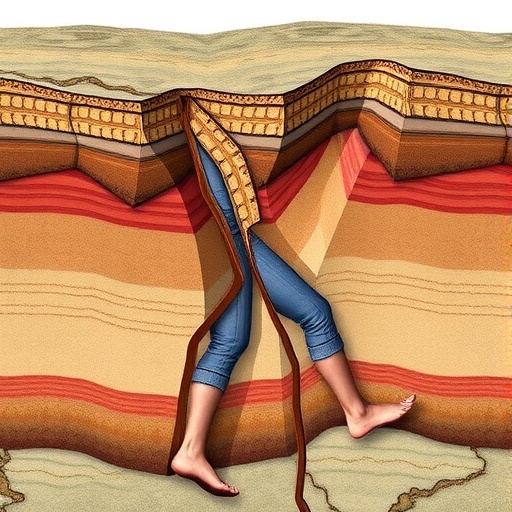
In a groundbreaking study poised to reshape our understanding of earthquake mechanics, researchers have unveiled new insights into how off-fault damage significantly influences near-surface rupture behavior, particularly within soft sedimentary environments. This research, conducted by De Paola, Bullock, Holdsworth, and their colleagues, and published in Nature Communications in 2025, brings to light the intricate interplay between seismic ruptures and the surrounding geological materials, potentially revolutionizing seismic hazard assessment and mitigation strategies for regions composed predominantly of unconsolidated sediments.
Earthquake ruptures traditionally have been conceptualized as primarily confined to the fault plane—the localized zone of intense shear displacement during seismic events. However, this new research emphasizes that damage processes extending beyond the immediate fault, commonly referred to as off-fault damage, govern the manifestation and evolution of ruptures at shallow depths. Such processes, occurring in the near-surface soft sediments, have long been underappreciated in seismic models despite their critical implications for ground shaking characteristics and the resultant structural impacts.
The study leverages a multidisciplinary approach combining field observations, laboratory experiments, and sophisticated numerical modeling to unravel the mechanisms underlying off-fault damage and its feedback effects on rupture propagation near the Earth’s surface. By focusing on soft sediment layers—materials that typically display complex mechanical behaviors distinct from hard rock—the researchers provide comprehensive evidence that near-surface ruptures are neither simply planar nor constrained solely within fault cores but exhibit distributed deformation patterns facilitated by this damage zone.
One of the central findings reveals that off-fault damage acts as a dynamic control system, modulating rupture velocity, slip distribution, and eventual near-surface ground displacement characteristics. This challenges conventional seismic rupture models that assume a sharp transition from fault slip to elastic deformation, suggesting instead a continuum of distributed cracking and inelastic deformation within sedimentary layers that absorb and dissipate seismic energy in diverse ways.
Near-surface soft sediments possess markedly lower shear strength and stiffness relative to deeper bedrock. The research illustrates that these mechanical properties foster the development of extensive fracturing and damage zones during earthquake slip, fundamentally altering the rupture path. These damage zones serve as buffers, redistributing stress, which in turn can accelerate or decelerate rupture fronts in unpredictable manners, thus complicating the task of forecasting surface rupture patterns and intensities during seismic events.
The implications for seismic hazard models are profound. Current models often treat near-surface ruptures as deterministic outputs given subsurface fault slip, yet the inclusion of off-fault damage mechanisms introduces variability and complexity previously unaccounted for. This necessitates rethinking infrastructure design codes in soft sediment regions, as damage may be more spatially extensive and heterogeneous than previously assumed, leading to unexpected damage patterns far from known fault traces.
Further, the study employs high-resolution numerical simulations integrating rate-and-state friction laws with damage mechanics frameworks to replicate observed rupture behaviors. These computational experiments reveal that rupture bifurcation and the creation of subsidiary fractures in sediments are direct consequences of stress redistribution driven by off-fault damage. By capturing this nuanced behavior, the models align closely with field data from recent near-surface rupture events, bolstering confidence in their predictive capabilities.
Laboratory shear tests performed on analogous soft sediment samples complement the modeling work by providing microstructural insights into grain rearrangement, pore collapse, and progressive microfracture development under dynamic loading conditions. These observations confirm that sediment fabric and composition critically influence rupture propagation and damage zone evolution, highlighting the importance of site-specific geological characterization for accurate seismic risk evaluation.
The researchers emphasize how off-fault damage extends the footprint of earthquake-induced deformation, which has been traditionally underestimated owing to the invisibility of subsurface fractures in routine surface mapping. Novel geophysical imaging techniques such as ground-penetrating radar and distributed acoustic sensing are suggested as essential tools to detect and monitor these hidden damage zones, thus enhancing early warning systems and post-earthquake assessments.
Moreover, the findings contribute to the ongoing discourse regarding earthquake nucleation and termination processes. Off-fault damage zones may function as both facilitators and inhibitors of rupture propagation depending on localized stress states and sediment properties, offering a more dynamic and complex picture of earthquake rupture dynamics than previously surmised.
From a broader geophysical perspective, this study underscores the necessity to view earthquake ruptures as three-dimensional phenomena deeply interconnected with the heterogeneous mechanical fabric of near-surface geological materials. It invites a paradigm shift from planar, two-dimensional rupture models to fully integrated 3D frameworks that better capture the essence and variability of seismic events in complex sedimentary basins worldwide.
The practical outcomes of this research extend beyond academia into civil engineering, urban planning, and disaster mitigation. Buildings, pipelines, and lifelines situated on soft sediments may experience unexpected ground deformation patterns due to dispersed damage zones, necessitating innovative engineering solutions and land-use policies sensitive to the newly recognized complexity of near-surface rupture behaviors.
Given the accelerating urbanization of sediment-filled basins and the increasing vulnerability of these regions to seismic activity, the revelations provided by De Paola and colleagues arrive at a critical juncture. Implementing their insights could enhance resilience and reduce economic and human losses during future earthquakes.
This work also opens avenues for interdisciplinary collaborations, combining geotechnical engineering, seismology, material science, and computational mechanics to build holistic models of seismic hazard. These integrative efforts could incorporate machine learning algorithms trained on diverse datasets to predict off-fault damage evolution and its impact on earthquake rupture scenarios.
In conclusion, the elucidation of off-fault damage as a key regulator of near-surface rupture behavior signifies a landmark advancement in earthquake science. It not only challenges long-held notions about fault mechanics but also provides a richer, more realistic framework to anticipate how earthquakes rupture and dissipate energy in vulnerable sedimentary environments. As this knowledge permeates seismic hazard assessment protocols and engineering practices, communities residing atop soft sediments stand to benefit from improved safety and preparedness against the ever-present threat of destructive seismic events.
Cite Scienmag News
Violet Maxwell. (December 13, 2025). Off-Fault Damage Shapes Ruptures in Soft Sediments. Scienmag. https://scienmag.com/off-fault-damage-shapes-ruptures-in-soft-sediments/
Violet Maxwell. "Off-Fault Damage Shapes Ruptures in Soft Sediments." Scienmag, 13 December 2025, https://scienmag.com/off-fault-damage-shapes-ruptures-in-soft-sediments/. Accessed 6 September 2026.
Violet Maxwell. "Off-Fault Damage Shapes Ruptures in Soft Sediments." Scienmag. December 13, 2025. https://scienmag.com/off-fault-damage-shapes-ruptures-in-soft-sediments/


