


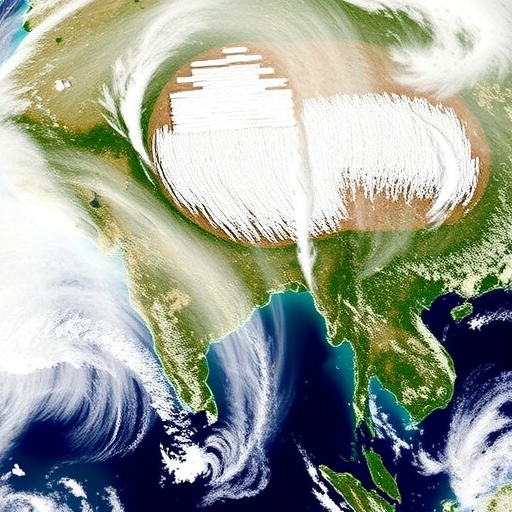
A groundbreaking global study has unveiled a remarkable climatic phenomenon linked to the widespread cultivation of paddy rice. Published recently in Nature Communications, the research harnesses cutting-edge satellite technology to reveal a significant and previously underappreciated effect: paddy rice fields contribute to extensive land surface cooling across multiple regions of the world. This discovery not only deepens our understanding of agricultural impacts on local and global climates but also introduces new perspectives on potential climate mitigation strategies involving land use and crop management.
For decades, the scientific community has acknowledged the complex interplay between agriculture, climate, and land surfaces. However, rice cultivation, especially in its paddy form with its characteristic flooded fields, presents unique biophysical and biochemical interactions with the environment. By using advanced global satellite mapping techniques, the research team led by Weng et al. has quantified the scale and magnitude of how these waterlogged ecosystems influence surface energy balances and, ultimately, the temperature dynamics of the regions they occupy.
Satellite remote sensing platforms, equipped with radiometers and thermal sensors, provided an unprecedented spatial and temporal resolution of land surface temperatures (LST) across large swaths of Asia, parts of Africa, and beyond—regions dominated by rice paddy agriculture. The meticulous analysis correlated shifts in temperature patterns with seasonal rice planting and harvesting cycles, revealing a consistent cooling effect coinciding with flooded field irrigation practices. This cooling is predominantly attributed to enhanced evapotranspiration and the high albedo of flooded paddies, which reflect more sunlight relative to dry land surfaces.
The implications of this phenomenon are profound. While traditional agriculture often exacerbates warming trends through deforestation, soil degradation, and greenhouse gas emissions, paddy rice cultivation emerges as a countervailing force that can locally moderate temperatures. This challenges prevailing narratives and calls for a more nuanced perspective on agricultural practices and their roles in climate dynamics. Such findings could drive initiatives aimed at leveraging wetland agriculture in climate adaptation frameworks.
Further insights from the study highlight that the cooling effect extends beyond the immediate proximity of the paddies. The large-scale evaporative cooling influences atmospheric moisture and temperature distributions, which could modulate regional weather patterns during critical growing seasons. This phenomenon introduces a feedback mechanism where agricultural land use influences climatic conditions, which in turn affect crop growth and yields, emphasizing the interconnectedness of land management and atmospheric science.
Moreover, the research details how this cooling potential varies with geographical and climatic contexts. In tropical and subtropical regions where water availability permits extensive paddy farming, the cooling is most pronounced. Conversely, in dryer regions or where irrigation limitations constrain flooded rice fields, such effects are comparatively muted. This spatial variability underscores the importance of integrating hydrological factors into assessments of agricultural climate impacts.
The study also addresses potential concerns related to greenhouse gas emissions from paddy fields, known primarily for methane production. Although rice paddies do emit methane—a potent greenhouse gas—the cooling effect from surface temperature reduction might partially offset the warming impacts at a localized scale. This complex balance between radiative forcing by methane and cooling from evapotranspiration necessitates further interdisciplinary research to fully understand the net climate implications.
One of the hallmarks of this research is its methodological innovation. Integrating satellite data with ground-based observations and high-resolution climate modeling, the team meticulously disentangled the various factors influencing temperature fluctuations. This comprehensive approach enabled the differentiation of paddy-induced cooling from other variables such as urbanization, natural vegetation changes, and broader global warming trends, strengthening the validity of their conclusions.
Besides its scientific merits, the study also estimates the potential future role of paddy rice cultivation in climate change mitigation. With global rice demand projected to increase driven by population growth, the expansion or intensification of paddy agriculture could inadvertently amplify the observed cooling effect. This presents an intriguing paradox in the agricultural-climate nexus, where food security goals and climate objectives might align, provided that water and land management practices are optimized.
The researchers emphasize caution, however, underscoring that paddy rice farming must be managed prudently, considering environmental sustainability and socio-economic factors. Expanding flooded fields without adequate water resources or in ecologically fragile regions could lead to unintended consequences. Thus, translating these climatic insights into policy requires careful multi-sector coordination, blending agricultural economics, hydrology, and climate science.
In conclusion, this first-of-its-kind global satellite mapping effort reveals that paddy rice cultivation is a critical, yet overlooked, driver of widespread terrestrial cooling. It reframes how we perceive the role of staple crop agriculture in influencing land surface temperatures and regional climates. As climate adaptation and mitigation strategies become increasingly urgent, incorporating these nuanced biophysical mechanisms can enhance the effectiveness of global climate policies, agricultural practices, and food production systems.
The findings invite a reevaluation of agricultural landscapes in climate models and environmental planning. They highlight the potent influence of human land use choices on the Earth’s energy balance. By embracing a systems-thinking approach, integrating remote sensing technologies, and enhancing climate-agriculture feedback understanding, we can develop innovative solutions to intertwined challenges of climate change and global food security.
With this landmark study, Weng and colleagues have illuminated a subtle but significant climate interaction, illustrating the power of interdisciplinary science and technology to uncover hidden planetary processes. The widespread cooling linked to paddy rice fields offers a hopeful avenue for balancing the demands of feeding billions and preserving a stable climate, exemplifying scientific innovation’s critical role in shaping a sustainable future.
Cite Scienmag News
Alan Morgan. (December 13, 2025). Global Satellite Reveals Cooling from Rice Cultivation. Scienmag. https://scienmag.com/global-satellite-reveals-cooling-from-rice-cultivation/
Alan Morgan. "Global Satellite Reveals Cooling from Rice Cultivation." Scienmag, 13 December 2025, https://scienmag.com/global-satellite-reveals-cooling-from-rice-cultivation/. Accessed 5 September 2026.
Alan Morgan. "Global Satellite Reveals Cooling from Rice Cultivation." Scienmag. December 13, 2025. https://scienmag.com/global-satellite-reveals-cooling-from-rice-cultivation/


