


It’s summer and time to enjoy the sunshine. But it’s also important to do so safely. Skin cancer is the most common form of cancer in the United States—and it’s most commonly caused by sun exposure. Research has shown that skin self-awareness and regular skin self-examinations are strongly linked to better treatment outcomes if you receive a skin cancer diagnosis.

Credit: OHSU, Lewis & Clark College, University of Oregon and The Ohio State University.
It’s summer and time to enjoy the sunshine. But it’s also important to do so safely. Skin cancer is the most common form of cancer in the United States—and it’s most commonly caused by sun exposure. Research has shown that skin self-awareness and regular skin self-examinations are strongly linked to better treatment outcomes if you receive a skin cancer diagnosis.
As part of an effort to identify effective interventions to increase skin self-examinations and decrease melanoma deaths, faculty from Oregon Health & Science University and Lewis & Clark—along with colleagues at the Fred Hutchinson Cancer Research Center and the University of Washington—have conducted the first population-based survey of melanoma literacy in the United States.
Knowledge + Confidence
Results from 2,326 responses to the survey of 15,000 households in Oregon, Washington, and Utah point to increasing melanoma knowledge combined with strengthening skin-check confidence as having great potential to increase early detection and save lives. The research is described in an article in the journal Pigment Cell & Melanoma Research called “Melanoma literacy among the general population of three western U.S. states.”
“The study we did with Oregon and two other states showed that, generally, people knew that they should check their own skin, but they did not feel confident that they would be able to do so successfully,” said Brian Detweiler-Bedell, professor of psychology and director of the Bates Center for Entrepreneurship and Leadership at Lewis & Clark. “So, there was a gap there.”
“We knew we needed to focus particularly on how to help people become more confident in their ability to check their own skin,” said Jerusha Detweiler-Bedell, professor of psychology and director of L&C’s Center for Community and Global Health.
The Detweiler-Bedels lead the behavioral science aspect of the research. The lead physician-scientist on the project is Dr. Sancy Leachman, John D. Gray Endowed Chair for Melanoma Research and Professor of Dermatology at Oregon Health & Science University’s School of Medicine.
“With melanoma, your eyes really can be your best tool. A mole or spot on your skin that is changing in appearance—size, shape, color—is a key indicator for melanoma,” said Leachman. “And the data is clear: When melanoma is caught early, in stage 1 or 2, the five-year relative survival rate is extremely high—almost 100 percent. When it’s caught late, in stage 4, the five-year relative survival is only 35 percent! That’s why it’s so important that people are empowered to check their skin regularly, and we get the word out about the tools that can help.”
Among respondents, skin self-exam performance was most strongly associated with higher melanoma knowledge and more self-efficacy, or confidence in one’s ability to effectively complete an action.
Social Media Ads
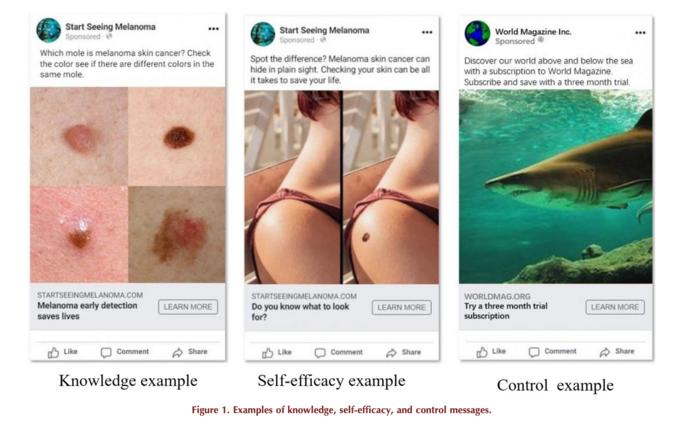
As a next step, Dr. Leachman and the Detweiler-Bedells collaborated with faculty at the Center for Science Communications Research at the University of Oregon to develop and test a number of social media advertisements intended to increase melanoma knowledge and skin-check confidence. The results were recently published in the journal JID Innovations in an article titled “Evidence-Based Communication to Increase Melanoma Knowledge and Skin Checks.”
“If you look at the results, the true active ingredient is confidence,” says Brian Detweiler-Bedell.
“We were able to demonstrate that the combination of knowledge and confidence is important, but in particular, it is the confidence that really matters,” says Jerusha Detweiler-Bedell. “Of course, you need to know what unhealthy or potentially suspicious moles look like. But you might ignore or just not even try to check your own skin if you don’t first believe in yourself.”
Additional authors include faculty from the Center for Science Communication Research, School of Journalism and Communication at University of Oregon, and the Department of Psychology, College of Arts and Sciences at The Ohio State University.
Journal
JID Innovations
Method of Research
Experimental study
Subject of Research
Not applicable
Article Title
Evidence-Based Communication to Increase Melanoma Knowledge and Skin Checks.
Article Publication Date
31-Mar-2024
COI Statement
None
Cite Scienmag News
Courtney Benton. (June 24, 2024). Doing a skin check? Confidence is key & social media ads may help. Scienmag. https://scienmag.com/doing-a-skin-check-confidence-is-key-social-media-ads-may-help/
Courtney Benton. "Doing a skin check? Confidence is key & social media ads may help." Scienmag, 24 June 2024, https://scienmag.com/doing-a-skin-check-confidence-is-key-social-media-ads-may-help/. Accessed 4 September 2026.
Courtney Benton. "Doing a skin check? Confidence is key & social media ads may help." Scienmag. June 24, 2024. https://scienmag.com/doing-a-skin-check-confidence-is-key-social-media-ads-may-help/

