


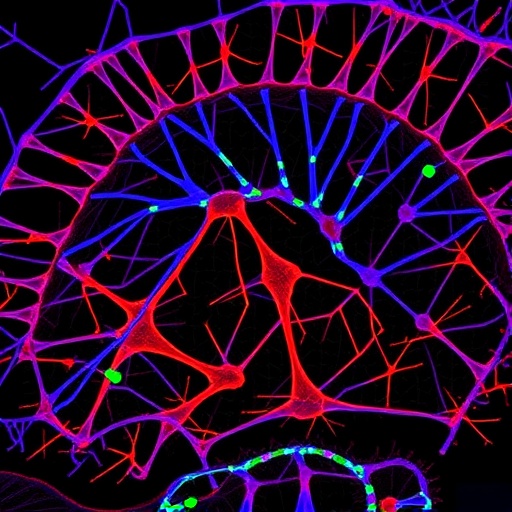
The development of the mammalian neocortex, the brain’s seat of higher cognitive functions, hinges on the precise orchestration of neural progenitor cells that yield the diverse classes of neurons required to form functional circuits. Among these progenitors, radial glial cells asymmetrically divide to produce intermediate progenitors (IPs), a secondary population that rapidly expands the neuronal pool through symmetric divisions. This tightly regulated balance between radial progenitors and IPs is fundamental to the generation of the upper-layer neurons critical for complex processing in the cerebral cortex. Despite its importance, the molecular mechanisms that calibrate this progenitor equilibrium and direct the resultant neuronal output have remained largely elusive.
A groundbreaking study by Casingal et al., published in Nature, unravels the role of the tuberous sclerosis complex (TSC) proteins as pivotal molecular regulators shaping this delicate progenitor balance in the developing neocortex. TSC proteins, well-known for their central role in metabolic control and cellular growth pathways, emerge as key modulators orchestrating the interplay between radial progenitors and IPs, ultimately influencing the architecture and neuronal composition of the cortex. By manipulating TSC expression in murine models during critical neurogenic windows, the researchers demonstrated that developmental deletion of TSC proteins skews the progenitor ratio, alters radial unit organization, and triggers an increased generation of upper-layer neurons—phenomena closely associated with aberrant cortical connectivity.
The study emphasizes the TSC complex’s integral influence on radial unit composition, a fundamental organizational principle in the neocortex characterized by columnar arrangements of clonally related neurons. Alterations in progenitor balance brought about by loss of TSC function disrupted the orderly assembly of these radial units, suggesting a mechanistic link between progenitor modulation and the spatial patterning essential for proper cortical wiring. These findings underscore a novel dimension of TSC biology beyond its canonical role in metabolic regulation, positioning it as a sculptor of neuronal diversity and cortical microarchitecture.
Intriguingly, the team extended their analysis to the evolutionary context by examining human genomic data, revealing that human-specific regulatory elements—human-gained enhancers—modulate TSC protein expression during cortical development. These enhancers appear to fine-tune progenitor balance, contributing to the expanded upper-layer neuron populations characteristic of the human neocortex. Given that upper-layer neurons are implicated in advanced cognitive faculties such as language, abstract reasoning, and social cognition, this regulatory modulation may have been instrumental in human brain evolution.
This evolutionary angle provides a compelling hypothesis: the downregulation of TSC protein expression through human-specific enhancers may have been an adaptive mechanism to promote radial unit sculpting and expand upper-layer neuron output, thereby underpinning the enhanced computational capacity of the human brain. By linking molecular modulation with species-specific cortical features, this study bridges developmental neurobiology with evolutionary neuroscience, opening pathways for understanding the genetic underpinnings of cognitive complexity.
On a cellular level, TSC proteins influence pathways central to cellular metabolism and growth—principally the mTOR signaling axis—known for integrating nutrient signals to regulate proliferation and differentiation. The disruption of TSC function—and thus deregulation of mTOR activity—alters progenitor lineage decisions, shifting the developmental trajectory toward increased neurogenesis of upper-layer neurons. This intersection between metabolic sensing and neurodevelopment highlights how progenitor fate is sensitive to intracellular metabolic states, which in turn can affect cortical cytoarchitecture and functionality.
The aberrant cortical connectivity observed following TSC deletion aligns with the hypothesis that progenitor imbalances and radial unit disorganization compromise circuit assembly. Upper-layer neurons are known to form extensive intracortical connections, facilitating long-range communication critical for integrative brain functions. Misregulation of their generation could therefore impact synaptic specificity and network dynamics, potentially modeling neurodevelopmental disorders associated with cortical circuit dysfunction.
Furthermore, the study’s findings resonate with broader research showing that neurogenic timing and progenitor pool dynamics are key determinants of cortical size and complexity. The duration of the neurogenic period and the proliferative capacity of intermediate progenitors have been linked directly to cortical expansion events during evolution. By pinpointing TSC proteins as molecular gears tuning these progenitor programs, this research provides a tangible target for further mechanistic exploration and potential therapeutic intervention.
Methodologically, the team employed a sophisticated combination of genetic manipulation, single-cell transcriptomics, and enhancer activity mapping, allowing high-resolution dissection of progenitor populations and their lineage outcomes. These techniques permitted an unprecedented view of how shifts in TSC activity reverberate through the developing cortex at both cellular and systems levels. Their integrative approach exemplifies the power of combining developmental biology with genomics and evolutionary analysis.
The implications of this study extend beyond basic science into clinical realms. Mutations in TSC genes are linked to tuberous sclerosis complex disorder, characterized by cortical malformations, epilepsy, and cognitive impairment. Understanding how TSC proteins regulate progenitor balance provides critical insights into how these phenotypes arise and raises the possibility of targeting metabolic pathways to correct developmental abnormalities.
In summary, Casingal et al. elucidate a novel molecular mechanism whereby TSC proteins serve as central regulators of progenitor balance in the neocortex, sculpting upper-layer neuron production and influencing cortical organization. Their work highlights evolutionary modulation of TSC expression as a driver of human-specific cortical complexity, cementing the TSC complex as a vital nexus in neurodevelopment and brain evolution. This study lays the groundwork for future investigations into metabolic control of neurogenesis and its impact on cognition and neurological disease.
By uncovering the intersection of metabolism, progenitor dynamics, and cortical circuitry, this research paves the way for innovative strategies aiming to fine-tune neurodevelopmental trajectories and tackle disorders rooted in progenitor dysregulation. It underscores the intricacy of molecular interplay that fashions the neocortex—our brain’s crown jewel enabling the rich tapestry of human thought, culture, and creativity.
Cite Scienmag News
Cassandra Pierce. (December 12, 2025). TSC Regulates Progenitors, Boosts Upper-Layer Neurons. Scienmag. https://scienmag.com/tsc-regulates-progenitors-boosts-upper-layer-neurons/
Cassandra Pierce. "TSC Regulates Progenitors, Boosts Upper-Layer Neurons." Scienmag, 12 December 2025, https://scienmag.com/tsc-regulates-progenitors-boosts-upper-layer-neurons/. Accessed 4 September 2026.
Cassandra Pierce. "TSC Regulates Progenitors, Boosts Upper-Layer Neurons." Scienmag. December 12, 2025. https://scienmag.com/tsc-regulates-progenitors-boosts-upper-layer-neurons/


