

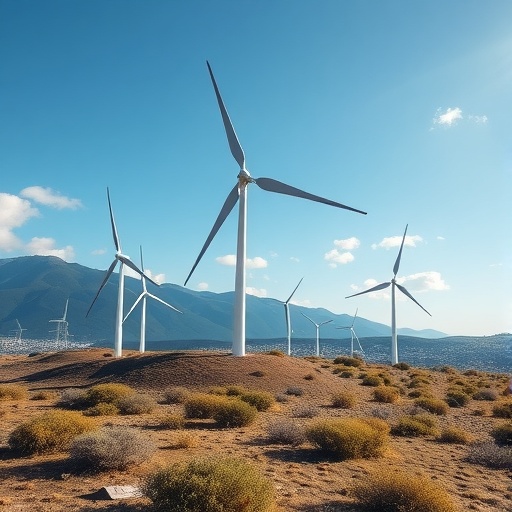
In a groundbreaking study that has the potential to revolutionize renewable energy planning, researchers Ding and Hsieh have introduced a novel technique for super-resolution wind mapping using deep learning. This innovation promises to significantly enhance the accuracy of wind resource assessments, crucial for optimizing wind energy deployment. As the world increasingly turns to sustainable energy sources to combat climate change, precise wind mapping becomes essential for ensuring efficient and economically viable energy solutions. With their deep learning approach, the authors are setting a new standard in the field of meteorological research and renewable energy planning.
The essence of this research lies in its ability to generate high-resolution wind maps from lower-resolution data. Traditional methods of wind mapping often rely on interpolation techniques that may not adequately capture the complexities of local wind patterns, particularly in heterogeneous terrain. However, Ding and Hsieh employ deep learning algorithms capable of analyzing and learning from vast datasets, leading to more accurate wind resource modeling. This advancement could be a game-changer for energy developers, policymakers, and researchers alike, providing them with detailed insights into wind behavior that were previously unattainable.
In their study, the authors meticulously explain the architecture of their deep learning model. By leveraging convolutional neural networks (CNNs), the researchers trained their model on a comprehensive dataset, including historical wind speed measurements and meteorological variables. This rich dataset allowed the model to recognize patterns and relationships that classical statistical methods might overlook. The training process involved several iterations, where the model learned to minimize errors in its wind speed predictions, ultimately achieving a level of accuracy that exceeds current mapping techniques.
One of the standout features of this research is its scalability. The deep learning model not only produces high-resolution maps but also adapts easily to various geographical regions and conditions. This adaptability is particularly critical when considering the diverse landscapes that wind farms may inhabit, from offshore locations to rugged mountains. As different regions present unique wind dynamics, the ability to apply the same deep learning framework across various contexts will enhance global efforts in renewable energy development.
Moreover, the implications of such accurate wind mapping reach far beyond just improved data quality. With better data comes the potential for reduced costs in energy project planning and implementation. Developers can make more informed decisions based on reliable wind forecasts, which can expedite the site selection process and optimize turbine placement. This efficiency can lead to significant financial savings, making renewable energy projects more commercially viable and contributing to the broader adoption of clean energy technologies.
The researchers also highlight the environmental significance of their findings. Accurate wind resource assessments are vital for minimizing the ecological impact of renewable energy development. By ensuring that wind farms are constructed in areas with the best potential for energy generation, developers can limit unnecessary land use and habitat disruption. This research, therefore, not only promotes renewable energy but also aligns with conservation efforts, emphasizing a balanced approach to environmental sustainability.
Another noteworthy aspect of the study is the potential for community engagement and public acceptance of wind energy projects. Misinformation and skepticism often arise in the renewable energy sector, fueled by the lack of understanding of local wind patterns and energy production potential. With the introduction of these high-resolution maps, stakeholders can better communicate the benefits and feasibility of wind projects to local communities. Transparent and accessible data can foster trust and encourage public participation in the transition to renewable energy.
Ding and Hsieh’s work also opens doors for future research and innovation in the field. As advancements in artificial intelligence continue to evolve, the methodologies developed in this study can be adapted and expanded to address other aspects of renewable energy forecasting, such as solar radiation assessment or hydropower potential. The interdisciplinary approach taken by the authors underscores the importance of integrating machine learning with environmental science, paving the way for more robust and innovative solutions to address the energy crisis.
Furthermore, the study’s findings are timely, coinciding with an increasing global focus on achieving net-zero emissions by mid-century. Policymakers and governments are ramping up their commitments to renewable energy, and precise wind mapping will play a pivotal role in guiding these efforts. By enabling better forecasting and site assessment, this research aligns with global initiatives aimed at transitioning to cleaner energy sources, reinforcing the critical need for technological advancements in this arena.
In conclusion, the innovative deep learning approach proposed by Ding and Hsieh offers a promising pathway toward more effective and sustainable renewable energy planning. The enhanced resolution of wind mapping has wide-ranging implications for energy developers, conservationists, and policymakers alike. As we continue to seek solutions to mitigate climate change, breakthroughs like these will be fundamental in guiding the transition toward a more sustainable and resilient energy future.
The potential impact of this research will surely resonate within the scientific community and beyond, challenging existing paradigms and encouraging the adoption of advanced technologies in environmental assessments. As the world moves forward, the integration of deep learning into wind mapping can serve as a beacon of hope, illustrating the power of innovation in the quest for sustainable solutions.
The researchers’ work exemplifies how synergy between technology and environmental science can yield transformative results. It not only amplifies our understanding of wind dynamics but also underscores the significant role of accurate data in driving the renewable energy revolution. As more entities recognize the value of such comprehensive mapping techniques, the stage is set for a new era of energy production that aligns closely with ecological sustainability and societal well-being.
In sum, Ding and Hsieh’s super-resolution wind mapping technique stands as a testament to the potential of cutting-edge technology in enhancing our renewable energy landscape. The future indeed holds promise as we harness such innovations to navigate our path toward a greener planet, where wind energy plays a crucial role in meeting our energy needs efficiently and sustainably.
Ding, JW., Hsieh, IY.L. Super-resolution wind mapping with deep learning for scalable renewable energy planning.
Commun Earth Environ (2025). https://doi.org/10.1038/s43247-025-03072-9
Cite this news
SCIENMAG. (December 11, 2025). Deep Learning Enhances Wind Mapping for Renewable Energy. https://scienmag.com/deep-learning-enhances-wind-mapping-for-renewable-energy/
SCIENMAG. "Deep Learning Enhances Wind Mapping for Renewable Energy." Scienmag, 11 December 2025, https://scienmag.com/deep-learning-enhances-wind-mapping-for-renewable-energy/. Accessed 28 August 2026.
SCIENMAG. "Deep Learning Enhances Wind Mapping for Renewable Energy." Scienmag. December 11, 2025. https://scienmag.com/deep-learning-enhances-wind-mapping-for-renewable-energy/


