


In the relentless global effort to mitigate climate change, carbon capture technologies have emerged as a critical line of defense, aiming to lower atmospheric CO2 concentrations by trapping emissions at their source. Yet, despite numerous advancements, current carbon capture systems wrestle with a pivotal challenge: the tradeoff between CO2 absorption capacity and the energy required to regenerate the capture medium. A breakthrough study by Guo and Hatton, published in Nature Chemical Engineering, introduces a novel approach that could revolutionize this balance by employing a thermally responsive pH regulator—tris(hydroxymethyl)aminomethane, more commonly known as Tris—in aqueous carbonate solutions. This method not only enhances CO2 absorption under ambient conditions but also dramatically reduces energy consumption during desorption, holding profound implications for industrial carbon capture.
The conventional carbon capture landscape primarily relies on solvents that absorb CO2 chemically or physically. While effective, these solvents often require substantial energy input to release the captured CO2 during regeneration, typically involving high temperatures, which drives up operational costs and limits deployment in many industrial settings. Guo and Hatton’s innovative system leverages the temperature-dependent equilibrium constant of Tris, allowing meticulous control over solution pH simply by adjusting temperature. This capability enables efficient capture of CO2 at lower energy thresholds, presenting a sustainable alternative to conventional technologies.
Tris, a widely known buffering agent, exhibits a unique thermal responsiveness: its ability to regulate pH varies with temperature changes. When integrated into aqueous carbonate solutions, Tris makes it feasible to orchestrate a pH swing triggered directly by temperature fluctuations. At ambient temperatures, the system maintains an elevated pH conducive to CO2 absorption. Upon mild heating—no greater than 60°C and at atmospheric pressure—the pH shifts favor desorption, enabling the release of concentrated, high-purity CO2 without the need for energy-intensive processes. This advancement positions the Tris-based system as an ideal candidate for scalable, energy-conscious carbon capture.
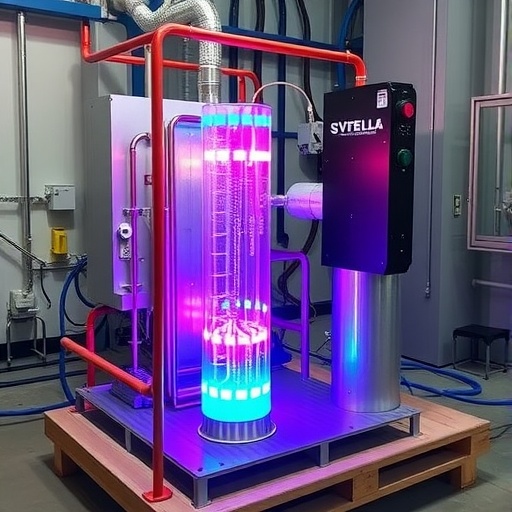
The researchers demonstrated the real-world viability of their approach through a continuous-flow reactor setup designed to process diluted CO2 streams, such as those from industrial flue gases ranging between 1% and 5% CO2 concentration. Remarkably, the system achieved efficient concentration of CO2 into streams of high purity, all while operating at significantly reduced energy inputs. Indeed, the energy demands were so modest they could be fully met by natural sunlight alone, signifying a substantial leap toward sustainable, renewable carbon capture methodologies.
Beyond energy savings, the continuous-flow reactor exhibited exceptional stability, maintaining operational performance for more than 240 hours without noticeable degradation or efficiency losses. This level of long-term durability implies that the Tris-augmented system can offer consistent performance over time, a crucial requirement for industrial applications. The stability, combined with energy efficiency, suggests that this design can withstand practical, everyday industrial conditions, further enhancing its potential for wide-scale adoption.
Guo and Hatton’s system also presents promising economic prospects. Traditional carbon capture technologies often impose significant operational and capital expenditures, limiting their widespread implementation. By minimizing the energy required for CO2 regeneration and harnessing sunlight as a renewable energy source, this approach could significantly reduce running costs. Additionally, the use of readily available and inexpensive materials like Tris adds to the economic feasibility, making this innovation accessible on a commercial scale.
The underpinning chemistry of this technology centers on the thermal modulation of pH facilitated by Tris, impacting the speciation and equilibrium of carbonate species in solution. As temperature changes, Tris’s proton affinity shifts, driving a controlled adjustment in the pH that toggles between states favoring absorption and desorption of CO2. This remote, reversible pH modulation mechanism circumvents the need for external chemical additives or drastic temperature variations, which traditionally hinder CO2 capture systems.
Furthermore, the system’s adaptability to dilute CO2 streams further broadens its applicability. Many industrial emission sources release CO2 at low concentrations, making capture challenging due to thermodynamic and kinetic limitations. By efficiently capturing and concentrating CO2 from streams as low as 1%, the Tris-based solution opens avenues for handling emissions from smaller-scale or distributed sources, such as manufacturing plants and power generation stations utilizing diverse fuel types.
The researchers’ achievement also dovetails with the rising interest in coupling carbon capture with utilization and storage pathways. The high purity CO2 streams produced in this process are well suited for downstream applications, such as enhanced oil recovery, chemical synthesis, or geological sequestration. Ensuring that capture technologies produce streams of sufficient purity reduces the cost and complexity of subsequent steps, reinforcing the attractiveness of this thermal pH regulation method for integrated carbon management frameworks.
Importantly, deploying a carbon capture process that functions efficiently at relatively low temperatures—around or below 60°C—broadens the spectrum of energy sources that can power CO2 release. This opens the door to harnessing low-grade waste heat, solar thermal energy, or other renewable energy inputs instead of relying on fossil-fuel-derived heat. It represents a transformative shift that could decouple carbon capture operations from carbon-intensive energy sources, aligning capture with broader decarbonization goals.
The integration into a continuous-flow reactor is another vital aspect of this work. Many laboratory-scale studies rely on batch processes that fail to replicate real-world industrial operation conditions. In contrast, continuous-flow systems offer steady-state operation, scalable throughput, and better process control—key factors for commercial viability. Guo and Hatton’s successful demonstration of a continuous reactor capturing and releasing CO2 efficiently signals readiness for further upscaling and industrial deployment.
Another crucial element of this technology lies in its sustainability credentials. The use of aqueous carbonate solutions, which are water-based and non-toxic, coupled with Tris, a common biochemical buffer, assures environmental benignity. Unlike many amine-based solvents used commercially, which can be volatile and degrade into hazardous byproducts, this system’s materials are more environmentally friendly and readily recyclable, addressing health and ecological concerns associated with existing carbon capture processes.
This pioneering work sets a new benchmark in carbon capture science by showcasing how intelligent manipulation of chemical equilibria via temperature-dependent pH modulation can maximize efficiency while minimizing energy inputs. It merges principles of physical chemistry, chemical engineering, and environmental science to meet one of the most pressing challenges of our time—scaling up carbon capture without imposing prohibitive energy or financial costs.
The findings from Guo and Hatton also hint at broader applications where thermally responsive regulatory chemistries could be engineered to control other gas absorption or separation processes. Such tunability in molecular interactions, achieved through temperature shifts, could unlock novel pathways in fields ranging from water treatment to air purification, extending the impact of this research beyond carbon capture.
As industrial sectors worldwide accelerate decarbonization efforts, innovations like this thermal pH regulation approach become invaluable tools for achieving climate targets outlined in international accords. Its compatibility with renewable energy integration, reduced emissions footprint, and economic sensibility place it at the forefront of technologies that bridge the gap between scientific innovation and practical deployment.
Future directions will likely explore optimization of reactor design, scaling studies, and integration with carbon utilization infrastructures. Furthermore, exploring other thermally responsive molecules or mixtures could fine-tune performance parameters, enhancing capture rates, selectivity, and operational robustness under diverse environmental and industrial conditions.
In summary, Guo and Hatton’s recent advance in leveraging Tris for temperature-triggered pH swings in aqueous carbonate solutions offers a compelling new paradigm for carbon capture technology. By solving the longstanding tradeoff between absorption capacity and energy demand for regeneration, this thermal pH regulatory system represents a critical step toward sustainable, economically viable, and scalable capture of CO2 emissions. If successfully translated into widespread use, it could play a vital role in the global transition to a net-zero future.
Cite Scienmag News
Sloane Callahan. (December 11, 2025). Boosting Continuous CO2 Capture with Thermal pH Control. Scienmag. https://scienmag.com/boosting-continuous-co2-capture-with-thermal-ph-control/
Sloane Callahan. "Boosting Continuous CO2 Capture with Thermal pH Control." Scienmag, 11 December 2025, https://scienmag.com/boosting-continuous-co2-capture-with-thermal-ph-control/. Accessed 4 September 2026.
Sloane Callahan. "Boosting Continuous CO2 Capture with Thermal pH Control." Scienmag. December 11, 2025. https://scienmag.com/boosting-continuous-co2-capture-with-thermal-ph-control/


