


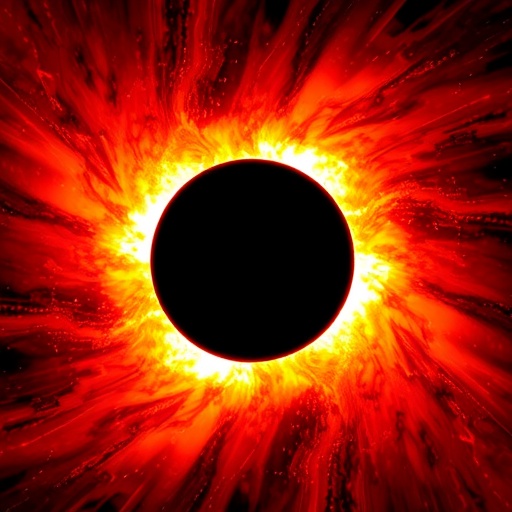
Embark on a journey to the very edge of our understanding of the cosmos, where the enigmatic embrace of black holes meets the subtle nuances of quantum mechanics. A groundbreaking new study, published in the recent edition of European Physical Journal C, has unveiled fascinating insights into the thermodynamic behavior of quantum fields in the extreme vicinity of a static black hole. This research, spearheaded by a formidable trio of physicists, Ertuğrul, Debir, and Akant, delves into the often-overlooked influence of boundary effects, revealing how the presence of an event horizon can profoundly alter the thermodynamic properties we associate with quantum phenomena. Imagine the vacuum of space not as an empty void, but as a seething cauldron of virtual particles constantly popping in and out of existence. Now, place a black hole, a gravitational behemoth capable of swallowing light itself, at its center. The interplay between these two seemingly disparate concepts is where the magic of this new research lies, pushing the boundaries of theoretical physics and offering a tantalizing glimpse into the universe’s deepest secrets.
The fundamental nature of spacetime near a black hole’s event horizon is a realm pregnant with paradox and profound implications for our understanding of reality. Unlike the relatively flat, predictable spacetime we experience in our everyday lives, the warped geometry surrounding a black hole creates conditions vastly different from anything we can directly observe or easily conceptualize. This extreme curvature isn’t just an aesthetic oddity; it fundamentally dictates how quantum fields behave. The research by Ertuğrul, Debir, and Akant meticulously examines how these quantum fields, which permeate all of existence and are responsible for the fundamental forces, are affected by this gravitational distortion. Their work suggests that the very fabric of reality, at these cosmic frontiers, behaves in ways that defy our conventional thermodynamic intuition, hinting at a rich tapestry of physical processes occurring just beyond our observational reach.
One of the central themes explored in this seminal paper is the concept of “boundary effects.” In thermodynamics, boundaries often play a crucial role in determining the behavior of systems. Consider how the walls of a container influence the pressure and temperature of a gas. Similarly, the event horizon of a black hole acts as a unique and formidable boundary for quantum fields. This gravitational boundary, a one-way membrane from which nothing, not even light, can escape, imposes stringent constraints on the field configurations and their associated energy distributions. The researchers have mathematically modeled how these constraints, imposed by the black hole’s intense gravity, lead to observable deviations from the thermodynamic laws that govern quantum fields in flat, unbounded spacetime, suggesting a profound interconnectedness between gravity and quantum thermodynamics.
The thermodynamic properties of quantum fields are typically described by concepts such as temperature, entropy, and energy. These properties arise from the collective behavior of a vast number of quantum particles and their interactions. However, when these fields are subjected to the extreme gravitational environment near a black hole, their usual behavior is significantly altered. Ertuğrul, Debir, and Akant’s detailed analysis demonstrates that the boundary effects stemming from the event horizon introduce modifications to these thermodynamic quantities. This implies that the “heat” and “disorder” of quantum fields near a black hole are not simply extrapolations of their behavior in less extreme environments but rather exhibit a distinct, gravity-induced phenomenology, offering a new paradigm for understanding black hole thermodynamics.
Specifically, the study addresses how the presence of the event horizon influences the vacuum fluctuations of quantum fields. In quantum field theory, even in the absence of matter or energy, the vacuum is a dynamic place, filled with transient particles called virtual particles. These fluctuations contribute to the overall energy and entropy of the vacuum. Near a black hole, however, the strong gravitational field can alter these fluctuations, leading to observable thermodynamic consequences. The paper meticulously quantifies these changes, providing a mathematical framework for understanding how the event horizon acts as a barrier that selectively permits or forbids certain quantum field configurations, thereby modifying its thermodynamic signature. This level of detail promises to revolutionize our approach to black hole thermodynamics.
The implications of this research extend far beyond mere theoretical curiosity; they touch upon some of the most profound mysteries of the universe, including the black hole information paradox. This paradox questions what happens to the information contained within matter that falls into a black hole. If black holes eventually evaporate via Hawking radiation, as theorized, and this radiation is purely thermal and random, then the original information appears to be lost forever, violating a fundamental principle of quantum mechanics. The findings of Ertuğrul, Debir, and Akant offer new avenues for exploring this paradox by suggesting that subtle boundary effects might encode information in ways we haven’t previously considered, potentially preserving it even as the black hole diminishes.
Moreover, the study provides a crucial stepping stone towards a unified theory of quantum gravity, the elusive framework that would reconcile the seemingly incompatible realms of general relativity and quantum mechanics. Black holes are arguably the most dramatic manifestations of gravity’s interaction with quantum phenomena, making them natural laboratories for testing theories of quantum gravity. By rigorously analyzing the thermodynamic consequences of quantum fields near these cosmic titans, this research contributes vital empirical, albeit theoretical, data points that can guide the development of more comprehensive models of the universe at its most fundamental level, bridging the divide between the very large and the very small.
The specific mathematical techniques employed in the paper are sophisticated and involve advanced concepts in quantum field theory in curved spacetime. Without delving into the intimidating jargon of the academic paper, it is sufficient to say that the researchers have utilized powerful theoretical tools to translate the abstract geometry of a black hole’s event horizon into concrete predictions about the thermodynamic properties of quantum fields. This rigorous approach ensures that their findings are not speculative but are grounded in the established principles of modern physics, lending significant weight to their conclusions and opening up new avenues for experimental verification, however challenging that might be.
The concept of a static black hole, as studied by the researchers, represents a simplified but crucial model. While real black holes are often dynamic and evolving, static black holes provide a stable and well-defined gravitational environment to isolate and study specific physical effects. By focusing on this idealized scenario, Ertuğrul, Debir, and Akant can precisely quantify the influence of the event horizon as a boundary, free from the complexities introduced by rotation or accretion. This careful methodological choice allows for a clearer understanding of fundamental principles before tackling more complex, real-world scenarios, a hallmark of strong scientific inquiry.
The notion that even the seemingly empty vacuum of space has measurable thermodynamic properties is a testament to the counter-intuitive nature of quantum mechanics. This research elevates this idea by demonstrating how these properties are not universal but are exquisitely sensitive to the gravitational environment. The event horizon of a black hole acts as a cosmic sculptor, shaping the thermodynamic landscape of the quantum fields that surround it. This intricate dance between gravity and quantum fields, as unveiled in this study, paints a picture of a universe far more interconnected and dynamic than previously imagined, pushing the boundaries of our cosmological imagination.
The paper suggests that the thermodynamics of quantum fields near a black hole is not simply a reflection of the black hole’s mass or temperature but is also intricately linked to the topological and geometric features of the spacetime at the event horizon. These geometrical properties, dictated by Einstein’s theory of general relativity, impose specific boundary conditions on the quantum fields, leading to deviations from the standard thermodynamic behavior. This intricate interplay between geometry and quantum mechanics is a cornerstone of ongoing efforts to unify physics, and this study provides crucial empirical guidance for such endeavors, enriching our understanding of gravitational influences on quantum systems.
This research offers a tantalizing possibility for understanding the nature of spacetime itself at its most fundamental level. If quantum fields exhibit unique thermodynamic behaviors near black holes due to boundary effects, it implies that spacetime is not merely a passive stage upon which physics unfolds but actively participates in shaping physical phenomena through its geometry and the very presence of boundaries like event horizons. This perspective hints at a deeper, more dynamic reality where gravity and quantum laws are inextricably interwoven, leading to emergent properties that are not apparent in simpler physical systems, thus revolutionizing our perception of the universe.
Looking ahead, the insights gleaned from this study will undoubtedly spur further theoretical investigations and potentially guide future observational efforts, however indirect. The challenge lies in devising ways to experimentally probe these extreme environments, which are by definition inaccessible. However, theoretical advances like this one can inform the development of novel observational signatures or guide the interpretation of data from astrophysical phenomena that might be influenced by these quantum-gravitational effects. The quest to understand the deepest workings of the universe is a long and arduous one, and this research marks a significant stride forward in that grand scientific expedition.
Ertuğrul, Debir, and Akant’s work serves as a potent reminder that the universe continues to hold profound mysteries, even in seemingly well-understood phenomena. The predictable thermodynamics we observe in our laboratories can be dramatically altered by the extreme conditions found at the edge of a black hole. This research is not just about black holes; it’s about the fundamental nature of reality, the intricate interplay between gravity and quantum mechanics, and the ongoing quest to unlock the universe’s deepest secrets. The implications are vast, promising to reshape our understanding of everything from the smallest quantum fluctuations to the grandest cosmic structures, opening up new frontiers for scientific exploration and discovery.
This meticulous investigation into the boundary effects on quantum fields near static black holes represents a significant advancement in theoretical physics. By precisely modeling how the event horizon influences the thermodynamic characteristics of quantum fields, Ertuğrul, Debir, and Akant have provided the scientific community with a sophisticated new lens through which to view the interplay of gravity and quantum mechanics. Their work not only deepens our understanding of black hole thermodynamics but also offers crucial insights that may pave the way for a more complete theory of quantum gravity, a long-sought goal that promises to unify the fundamental forces of nature and explain the universe in its entirety, thus marking a substantial contribution to our cosmic comprehension.
Ertuğrul, E., Debir, B. & Akant, L. Boundary effects on the thermodynamics of quantum fields near a static black hole.
Eur. Phys. J. C 85, 1392 (2025). https://doi.org/10.1140/epjc/s10052-025-15101-0
Cite Scienmag News
Grant Pearson. (December 8, 2025). Black Hole Thermodynamics: Boundary Effects Unveiled. Scienmag. https://scienmag.com/black-hole-thermodynamics-boundary-effects-unveiled/
Grant Pearson. "Black Hole Thermodynamics: Boundary Effects Unveiled." Scienmag, 8 December 2025, https://scienmag.com/black-hole-thermodynamics-boundary-effects-unveiled/. Accessed 3 September 2026.
Grant Pearson. "Black Hole Thermodynamics: Boundary Effects Unveiled." Scienmag. December 8, 2025. https://scienmag.com/black-hole-thermodynamics-boundary-effects-unveiled/


