


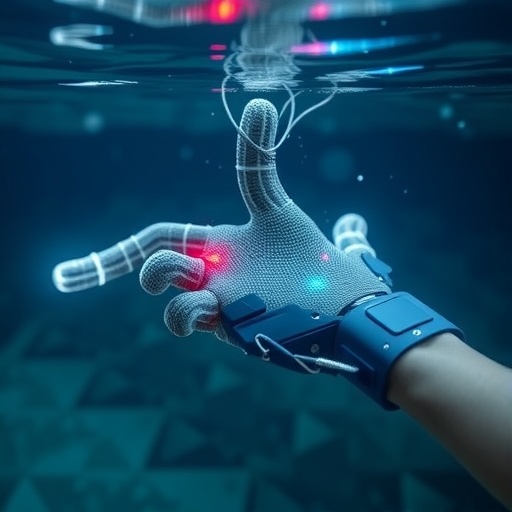
In a groundbreaking advancement at the intersection of robotics and material science, researchers have unveiled a new generation of bioinspired iontronic skin designed specifically for underwater tactile sensing—a technology that promises to revolutionize the capabilities of deep-sea robots. This newly developed sensor system mimics the sophisticated touch sensitivity found in marine organisms, enabling robots to perceive and interact with their harsh and complex oceanic environments in ways previously unattainable.
One of the fundamental challenges in underwater robotics lies in the need for durable, sensitive, and adaptable tactile sensors that can operate reliably under extreme pressure, corrosive saltwater, and varying temperatures. Traditional electronic skins tend to fail under these conditions due to material degradation or insufficient sensitivity to mechanical stimuli. Addressing this critical gap, the team led by Zheng and colleagues engineered an iontronic skin that harnesses ionic conduction mechanisms, inspired by the natural sensing systems found in deep-sea creatures.
This iontronic skin operates on principles distinct from conventional electron-based sensors. Ionic conduction, similar to biological processes in human skin and marine animals, allows the sensor to maintain sensitivity and signal integrity even at significant ocean depths. The researchers embedded soft, flexible materials incorporating ionic liquids into the sensor architecture, which bestowed the system with exceptional resilience and responsiveness to mechanical deformation, pressure changes, and tactile contact.
Drawing from the study of marine organisms such as cephalopods and deep-sea fish, which utilize highly specialized receptors to sense minute environmental cues, the scientists designed the skin’s microstructure to emulate these natural designs. This bioinspiration extends beyond mere structural mimicry—it results in a sensor that can dynamically adjust its mechanical properties, maintaining tactile acuity despite continuous and often harsh mechanical stress experienced in underwater exploration.
The fabrication process involved innovative microengineering techniques that layered ionic conductive gels with elastomeric substrates, producing a conformal skin capable of wrapping around flexible robotic limbs. This multi-layer configuration not only augments the sensor’s durability but also allows for spatially distributed sensing, critical for discerning subtle pressure gradients and texture variations underwater. The result is a tactile interface that delivers rich, high-fidelity sensory data to robotic control systems.
Extensive testing in simulated deep-sea environments demonstrated the sensor’s remarkable ability to detect and distinguish between various tactile inputs, ranging from soft touches to strong impacts. The skin exhibited rapid signal recovery and low energy consumption, key factors for autonomous robotic applications where power efficiency is paramount. Furthermore, the sensor maintained its functionality after prolonged exposure to corrosive saltwater, underscoring its suitability for long-term deployment.
Beyond tactile sensing, the iontronic skin has potential multifaceted applications, including pressure mapping and haptic feedback in underwater robotics. This capability could transform how subsea robots handle delicate tasks such as biological sampling, equipment manipulation, and infrastructure inspection. By providing robots with a sophisticated sense of touch, operators can achieve greater precision and responsiveness, reducing the risk of damage to both robotic assets and fragile marine ecosystems.
The integration of this bioinspired iontronic skin with existing underwater robotic platforms points toward a future where autonomous systems possess near-human levels of sensory perception in extreme environments. This breakthrough aligns with a broader trend in robotics emphasizing soft and flexible materials that replicate biological functions, pushing the boundaries of machine-environment interactions.
Crucially, this development addresses the urgent need for advanced underwater sensing technologies amidst the growing interest in ocean exploration and exploitation. The deep sea remains one of the least charted frontiers on Earth, with profound implications for climate science, resource management, and biodiversity conservation. Enhanced tactile sensing technologies empower robots to better navigate and interact with this environment, accelerating discovery while minimizing ecological impact.
The interdisciplinary nature of the research, combining insights from biology, materials science, fluid mechanics, and engineering, exemplifies the collaborative innovation driving modern technological breakthroughs. The team’s approach underscores the importance of studying nature’s designs to overcome engineering challenges, leveraging millions of years of evolutionary optimization to inspire next-generation robotics.
Looking forward, the researchers envision refining the iontronic skin to incorporate self-healing properties and multi-modal sensory functions, such as temperature and chemical detection. These enhancements would further augment robotic autonomy and versatility, enabling machines to perform complex reconnaissance and intervention tasks in underwater environments previously inaccessible or too hazardous for human divers.
This pioneering work not only represents a leap forward in marine robotic tactile sensing but also opens doors for deploying similar iontronic sensory skins in other aqueous or harsh settings, such as medical devices, wearable electronics, and industrial monitoring. The adaptability and robustness of ionic conduction materials establish a versatile platform for future sensor technologies across diverse fields.
The implications for industry are equally significant. With the advancement of offshore energy projects, underwater infrastructure maintenance, and search-and-rescue operations, robots equipped with sensitive, durable tactile skins will be indispensable tools. They will facilitate safer, more efficient, and environmentally responsible activities beneath the waves, marking a paradigm shift in subsea robotics.
In sum, the development of this bioinspired deep-sea iontronic skin represents a transformative step towards endowing underwater robots with a sophisticated sense of touch that rivals biological organisms. By marrying cutting-edge materials science with keen biological insights, Zheng and colleagues have charted a new course for underwater tactile sensing technologies, one poised to significantly expand human capabilities in exploring the depths of our planet’s oceans.
Cite Scienmag News
Denise Maddox. (December 8, 2025). Bioinspired Iontronic Skin Enhances Underwater Robot Touch. Scienmag. https://scienmag.com/bioinspired-iontronic-skin-enhances-underwater-robot-touch/
Denise Maddox. "Bioinspired Iontronic Skin Enhances Underwater Robot Touch." Scienmag, 8 December 2025, https://scienmag.com/bioinspired-iontronic-skin-enhances-underwater-robot-touch/. Accessed 3 September 2026.
Denise Maddox. "Bioinspired Iontronic Skin Enhances Underwater Robot Touch." Scienmag. December 8, 2025. https://scienmag.com/bioinspired-iontronic-skin-enhances-underwater-robot-touch/


