


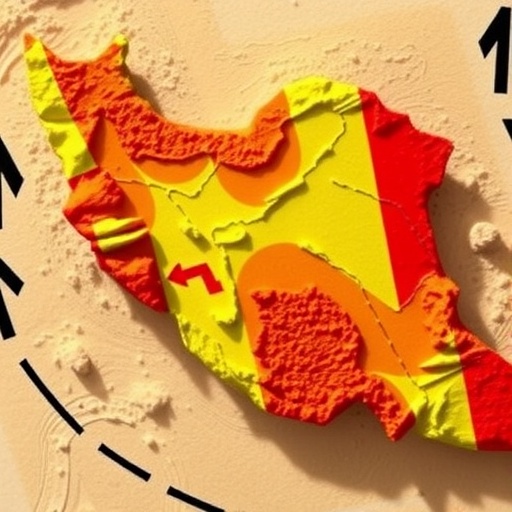
In a groundbreaking study published in the journal Natural Resources Research, a team of researchers led by V. Teknik, I. Monsef, and A. Abdelnasser has unveiled a transformative approach to mineral prospectivity mapping that leverages advanced machine learning techniques. This research is particularly significant for the Iranian Plateau, an area known for its rich geological heritage and potential for untapped mineral resources. The study emphasizes the crucial role of big geospatial data in detecting high-potential metallogenic zones in this region, aiming to enhance mineral exploration efficacy and sustainability.
The research employs sophisticated machine learning algorithms to analyze extensive datasets generated from various sources, including geological surveys, remote sensing, and geophysical data. By harnessing the power of these computational methods, the authors can identify patterns and correlations that may be overlooked by traditional mapping techniques. This innovative approach not only accelerates the prospecting process but also minimizes environmental impacts associated with exploratory drilling and mining.
A key aspect of this study is its focus on integrating multiple data layers, including lithology, geochemistry, and structural geology. By doing so, the researchers created a comprehensive model that provides a holistic view of the mineral potential across the Iranian Plateau. The integration of big data analytics with geology allows for more precise predictions regarding the locations of valuable mineral deposits, thereby informing exploration strategies.
The researchers utilized various machine learning techniques, including supervised learning algorithms such as Random Forests and Support Vector Machines. These algorithms were trained using historical mining data, allowing them to learn from previous successful prospecting efforts. By validating their model against known mineral deposits, the authors were able to demonstrate a high degree of accuracy in their predictions, showcasing the potential of machine learning in mineral exploration.
Additionally, the study highlights the advantages of using big geospatial data in a real-world application. The authors collected data from satellite imagery, aerial surveys, and ground-based geological investigations to enhance their predictive modeling. This comprehensive dataset serves as a valuable resource that can be updated continuously, ensuring that the prospectivity maps remain relevant as new data becomes available.
The implications of this research extend beyond just the Iranian Plateau; the methodologies and technologies developed in this study could benefit mineral prospecting globally. With many regions facing similar geological challenges, the potential for machine learning to revolutionize the field of mineral exploration is significant. By optimizing resource allocation and reducing ecological footprints, this approach could pave the way for more sustainable mining practices.
Moreover, the study underscores the importance of interdisciplinary cooperation between geologists, data scientists, and environmentalists. The successful application of machine learning in mineral prospectivity mapping is not solely a technological endeavor but also a collaborative effort that draws on the expertise of various fields. This teamwork is essential for developing comprehensive solutions to the challenges faced by the mining industry in the 21st century.
In the context of the Iranian Plateau, the research addresses the need for efficient exploration techniques in a region known for its complex geological setting. The presence of various tectonic forces and geological formations creates both opportunities and challenges for mineral exploration. The authors have tackled these complexities head-on by developing a model that accounts for the intricate relationships between geological variables.
Furthermore, the study brings to light the importance of utilizing high-resolution data in creating mineral prospectivity maps. The enhancement of spatial resolution from conventional mapping methods to more detailed geospatial analysis can lead to better-informed decisions regarding where to direct exploration efforts. This precision is crucial in a time when resources are limited, and environmental considerations are paramount.
In conclusion, the research by Teknik, Monsef, and Abdelnasser marks a significant advancement in the field of mineral prospectivity mapping, demonstrating the potential of machine learning to transform traditional exploration practices. By harnessing big geospatial data and advanced computational techniques, this study offers a promising pathway toward more efficient and sustainable mineral resource development. The broader implications of this work suggest a future where technology and geology work in tandem to meet the global demand for minerals responsibly.
The authors hope that their findings will not only aid in identifying new mineral deposits but also inspire further research into the applications of machine learning in other geological contexts. As the mining industry continues to evolve, the integration of innovative technologies will be essential in addressing the myriad challenges that lie ahead.
The potential for future studies to build on this foundational work is considerable, and collaboration across disciplines will be necessary to maximize these efforts. As we move forward, embracing the insights offered by machine learning and big data will be critical in navigating the evolving landscape of mineral exploration and sustainability.
The implications of the study are far-reaching, offering a new lens through which to view mineral prospecting in a time when global resource demands are increasing. The commitment to sustainability, coupled with technological innovation, has the potential to reshape how we approach mineral resource development in the modern world.
With the Iranian Plateau serving as a focal point for this study, the findings underscore the importance of applying new methodologies to older geological paradigms. The blending of traditional practices with cutting-edge technology is poised to redefine the boundaries of what is possible in mineral exploration.
This research not only sets a precedent for future work but also highlights the vital role of embracing technology in traditional industries. As we strive for advancements in exploration and resource management, the lessons learned from this study will be invaluable.
Overall, the pioneering study by Teknik and colleagues is a significant step forward in mineral prospectivity mapping, opening new avenues for research, exploration, and sustainable practices that align with global environmental goals.
Cite Scienmag News
Eleanor C. (December 2, 2025). AI Unlocks High-Potential Mining Areas in Iran. Scienmag. https://scienmag.com/ai-unlocks-high-potential-mining-areas-in-iran/
Eleanor C. "AI Unlocks High-Potential Mining Areas in Iran." Scienmag, 2 December 2025, https://scienmag.com/ai-unlocks-high-potential-mining-areas-in-iran/. Accessed 29 August 2026.
Eleanor C. "AI Unlocks High-Potential Mining Areas in Iran." Scienmag. December 2, 2025. https://scienmag.com/ai-unlocks-high-potential-mining-areas-in-iran/


