


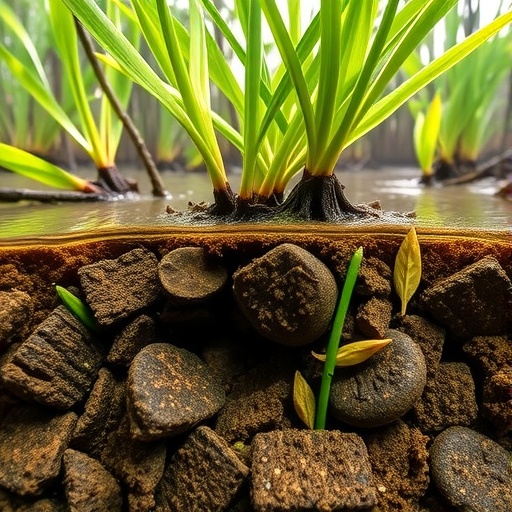
A recent study published in the journal Commun Earth Environ sheds light on an intriguing phenomenon occurring at the intersection of aquaculture and natural wetland ecosystems. Researchers Yang, Liu, and Lin explore how organic acids discharged from high-elevation shrimp ponds migrate and transform as they enter the soil of estuarine mangrove wetlands. This work not only reveals the potential environmental impacts of aquaculture practices but also emphasizes the complex interactions between human activities and natural ecosystems.
The backdrop of this study is the growing aquaculture industry, particularly in high-elevation regions where shrimp farming is becoming increasingly popular. While shrimp farming provides substantial economic benefits, it also poses significant environmental challenges. The effluent from these shrimp ponds often contains a variety of organic acids that can change the chemical composition of adjacent ecosystems, especially when released into sensitive habitats like mangrove wetlands. The implications of these changes are profound, affecting soil chemistry, nutrient cycling, and ultimately the health of the mangrove ecosystem.
In their research, the authors utilized a combination of field experiments and numerical simulations to trace the migration of organic acids from shrimp ponds into the wetland soil. They meticulously measured the concentrations of various organic acids in the effluents and the surrounding soils, observing significant gradients that indicated active transport and transformation processes. The use of advanced modeling techniques allowed them to predict how these acids would behave under various environmental conditions, providing insights into the long-term impacts of shrimp farming.
One of the key findings of the study is that the organic acids discharged from the shrimp ponds are not simply detrimental pollutants. Instead, they undergo transformation processes in the soil, where they can interact with soil organic matter and microbial communities. This transformation can lead to the formation of new, more stable organic compounds that might contribute positively to soil health, at least in the short term. However, the long-term effects remain uncertain and warrant further investigation.
The ramifications of this research extend beyond the immediate environmental concerns. Understanding how organic acids migrate and transform opens up paths for innovative management strategies in aquaculture. This knowledge can guide farmers toward practices that reduce harmful discharges while potentially enhancing soil quality in adjacent wetlands. Such strategies could help balance economic interests with ecological integrity, a critical objective in sustainable development.
Moreover, the numerical simulations employed by the authors serve as a powerful tool for predicting future scenarios related to shrimp farming and mangrove health. By integrating various parameters, the models can simulate the interactions between different acid concentrations, microbial activities, and soil properties, enabling foresight into potential environmental impacts. Such predictive capabilities are indispensable for policymakers and conservationists seeking to manage coastal and estuarine ecosystems more effectively.
The researchers also acknowledge that estuarine mangrove wetlands are vital ecosystems that provide numerous services, from carbon sequestration to shoreline protection. Thus, any changes induced by adjacent aquaculture can have far-reaching consequences. This study underscores the interconnectedness of human activities and natural processes, emphasizing the need for a holistic approach to environmental management.
The findings invite further inquiry into different types of organic acids and their varied impacts on soil and microbial communities. As researchers delve deeper into these dynamics, it may become possible to develop specific mitigation strategies tailored to different ecological scenarios, thereby enhancing the resilience of mangrove ecosystems against the backdrop of climate change and human influence.
Another important aspect of this research is its context within broader environmental concerns. The ongoing degradation of coastal ecosystems due to human activity, climate change, and pollution underlines the urgency of understanding the mechanisms at work in these environments. The study by Yang, Liu, and Lin adds a critical piece of the puzzle by illuminating how aquaculture practices can be both a source of pollutants and, through thoughtful management, a potential catalyst for ecological restoration.
In conclusion, this research represents a significant step forward in understanding the complexities of organic acid behavior in coastal ecosystems. It opens new doors for innovative aquaculture practices that not only aim for economic returns but also strive to maintain ecological balance. The intricate relationships between human activity and natural processes demand further exploration, but this study sets a solid foundation for future investigations and sustainable practices.
As aquaculture continues to expand globally, this research serves as a reminder of the delicate balance required to manage our resources responsibly. The findings motivate a necessary conversation among stakeholders—including farmers, scientists, and policymakers—about how to harmonize agricultural productivity with environmental stewardship. This mission is ever more crucial as the world grapples with the realities of climate change and biodiversity loss.
By bringing attention to the dynamics between high-elevation shrimp farming and mangrove ecosystems, Yang, Liu, and Lin remind us that environmental conservation is not simply an act of protection but also one of mindful interaction. As we strive to innovate and improve aquaculture, let us not forget the importance of understanding our ecosystems in their entirety.
Cite Scienmag News
Violet Maxwell. (November 18, 2025). Transforming Shrimp Pond Acids into Mangrove Soil. Scienmag. https://scienmag.com/transforming-shrimp-pond-acids-into-mangrove-soil/
Violet Maxwell. "Transforming Shrimp Pond Acids into Mangrove Soil." Scienmag, 18 November 2025, https://scienmag.com/transforming-shrimp-pond-acids-into-mangrove-soil/. Accessed 1 September 2026.
Violet Maxwell. "Transforming Shrimp Pond Acids into Mangrove Soil." Scienmag. November 18, 2025. https://scienmag.com/transforming-shrimp-pond-acids-into-mangrove-soil/


