


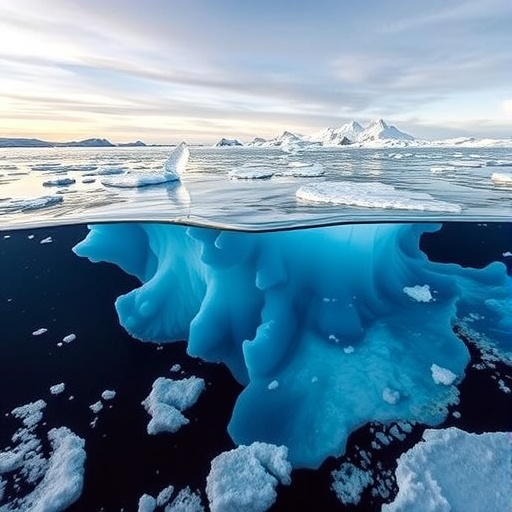
The vast and frozen landscape of Antarctica hides within it one of the most critical yet least understood arenas where climate dynamics unfold: the ocean-filled cavities beneath massive glaciers. These cavities, often stretching far beneath the floating ice shelves of glaciers like Thwaites and Pine Island in the Amundsen Sea Embayment of West Antarctica, play a decisive role in the fate of the Antarctic ice sheet and thus, global sea levels. Recent groundbreaking research now illuminates how small-scale oceanic phenomena—known as submesoscale motions—actively invade these cavities, driving enhanced melting from below and potentially accelerating ice loss at a scale that resonates worldwide.
Thwaites and Pine Island glaciers command attention because they contribute to more than one-third of the total ice depletion from Antarctica, making their stability paramount to understanding future sea-level rise. These glaciers have been observed retreating at an alarming pace, a phenomenon linked to a complex interplay of processes involving the atmosphere, ocean, and sea ice. However, beneath the floating ice shelves lie cavities where warm ocean waters can intrude, directly melting the ice from beneath—a process notoriously difficult to observe and quantify due to observational challenges and computational limitations.
The new study, leveraging cutting-edge ice–ocean numerical simulations resolving at an unprecedented 200-meter scale, combined with rare in situ observations under the ice, captures the dynamic behavior of ocean submesoscales. Such features, which range in size from 1 to 10 kilometers, were traditionally thought to be transient or insignificant in polar regions but are revealed here as ubiquitous actors in the Amundsen Sea Embayment. Their ability to propagate from the open ocean into the submarine ice cavities and foster intense localized melting represents a paradigm shift in our understanding of ice–ocean interactions.
Submesoscale motions emerge from sharp gradients in ocean properties such as temperature and salinity, often manifesting as narrow filaments, eddies, and fronts. These structures have distinctive physical characteristics that allow them to transport heat and salt efficiently over relatively short distances and brief timescales. Within the Amundsen Sea Embayment, these processes lead to episodic intrusions of warmer water entering the glacier cavities, promoting melting rates that fluctuate substantially over time and space.
Quantitative analysis from the simulations indicates that submesoscales account for approximately one-fifth of the total variance observed in submarine melt rates. This finding contradicts previous assumptions that larger-scale ocean processes dominated melting dynamics. Instead, it suggests that these smaller, often overlooked motions play a crucial role in controlling melt-induced ice shelf thinning and destabilization. The identification of this core mechanism adds a vital piece to the intricate puzzle of Antarctic ice mass balance.
Moreover, the study reveals a critical positive feedback mechanism: as submesoscale features enhance basal melting, the resultant thinning of the ice shelves decreases their buttressing effect, leading to further ice shelf retreat and potentially more submesoscale intrusion events. This feedback loop amplifies the sensitivity of ice shelves to ocean warming, making them increasingly vulnerable as global temperatures climb. The implications extend beyond the Amundsen Sea, resonating across the Antarctic continent and raising urgent questions about the trajectory of global sea-level rise.
The model-data synthesis approach adopted in this analysis is particularly noteworthy. Observational data below the ice—a notoriously challenging environment—were synergized with high-resolution simulations to unearth the complex interplay of processes at scales that conventional models cannot resolve. This methodological breakthrough sets a new standard for polar oceanography and glaciology, enabling more precise forecasts of ice sheet responses to ongoing and future climate change.
A critical takeaway from this research is the realization that future climate warming scenarios will likely intensify ocean-induced melting by augmenting the frequency and intensity of submesoscale intrusions. These events, currently episodic but impactful, could escalate, triggering accelerated disintegration of ice shelves and glaciers thousands of kilometers from current observation stations. Such changes bear profound consequences not only for Antarctica’s structural integrity but for coastal communities worldwide as they face rising seas.
Understanding the mechanisms driving submarine melting within ice cavities has been stymied for decades by the inaccessible nature of sub-ice environments and the computational challenges posed by their multiscale dynamics. The integration of high-resolution numerical modeling with rigorous field measurements in this study overcomes many of these hurdles, providing a compelling depiction of oceanic processes that threaten the stability of polar ice sheets. It lays the groundwork for next-generation predictive models that can better incorporate these critical mesoscale-to-submesoscale interactions.
This research also highlights the importance of continued monitoring and expanding observational networks beneath ice shelves. As the climate system evolves, capturing the transient nature of submesoscale features becomes essential for accurately tracking how Antarctic glaciers respond. Technological advances in autonomous underwater vehicles, remote sensing, and coupled ice–ocean modeling will be pivotal to maintaining this observational capability and translating data into actionable insights.
The fate of West Antarctica’s ice is emblematic of broader planetary feedbacks linked to human-driven climate change. With this enhanced understanding of the hidden processes amplifying ice mass loss, climate models can better integrate the cascading effects that small-scale ocean features have on large-scale ice dynamics. This integration is crucial for improving projections of sea-level rise that inform global policy and risk management strategies in vulnerable coastal zones.
In sum, the discovery that ocean submesoscale motions are not merely peripheral but key drivers of submarine melting beneath Antarctic ice shelves represents a significant leap forward in climate science. It underscores the complex, multiscale nature of interactions between ice and ocean and exposes new vulnerabilities within Antarctic ice sheets that were previously underappreciated. The study’s revelations urge the scientific community to recalibrate how they assess ice shelf stability under the duress of a warming planet.
The broader context of these findings reaches into the interdisciplinary domains of oceanography, glaciology, and climate modeling, breaking new ground on how polar systems respond to environmental shifts. Researchers and policymakers alike must reckon with the stark reality that submesoscale-driven melt processes can amplify ice sheet mass loss, contributing more unpredictably and rapidly to global sea level changes than prior models suggested. This research elevates the imperative for urgent action to mitigate greenhouse gas emissions and intensify adaptation planning.
Ultimately, the integrative, high-resolution examination of submesoscale ocean motions shaping submarine melting advances our grasp of Earth’s climate machinery. It challenges the scientific orthodoxy around the drivers of ice mass loss and points toward a future where small-scale features yield outsized impacts. As the Amundsen Sea glaciers continue to change, vigilant research and observation will be paramount to decoding the Antarctic cryosphere’s response and safeguarding coastal populations worldwide.
Cite Scienmag News
Violet Maxwell. (November 18, 2025). Ocean Submesoscales Drive Antarctic Ice Melting. Scienmag. https://scienmag.com/ocean-submesoscales-drive-antarctic-ice-melting/
Violet Maxwell. "Ocean Submesoscales Drive Antarctic Ice Melting." Scienmag, 18 November 2025, https://scienmag.com/ocean-submesoscales-drive-antarctic-ice-melting/. Accessed 5 September 2026.
Violet Maxwell. "Ocean Submesoscales Drive Antarctic Ice Melting." Scienmag. November 18, 2025. https://scienmag.com/ocean-submesoscales-drive-antarctic-ice-melting/


