


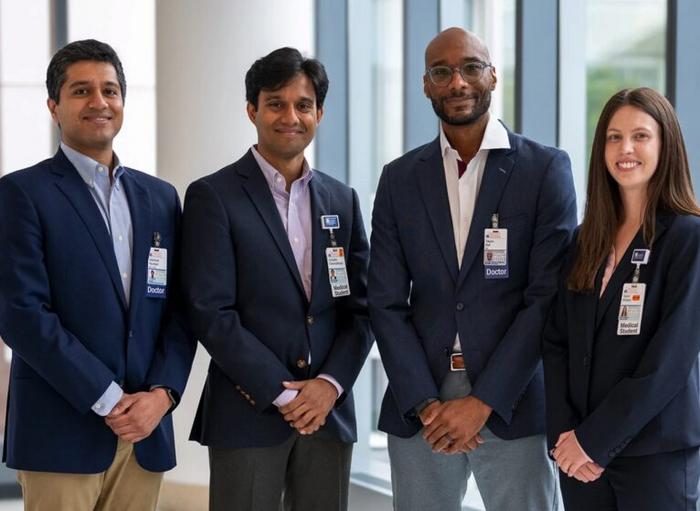
New University of Virginia School of Medicine research is shedding light on how federal funding helped scientists understand the COVID-19 virus, develop new treatments and deploy lifesaving vaccines in record time.

Credit: Cecelia Rooney | UVA Health
New University of Virginia School of Medicine research is shedding light on how federal funding helped scientists understand the COVID-19 virus, develop new treatments and deploy lifesaving vaccines in record time.
The UVA Health researchers used advanced “machine learning” – a form of artificial intelligence – to analyze the thousands of scientific publications that resulted from the National Institutes of Health’s deployment of more than $4 billion to combat the pandemic. This analysis allowed the researchers to categorize the types of research the money supported and determine how and where the funding was used to launch clinical trials of treatments and vaccines.
“The COVID-19 pandemic presented an unprecedented public-health challenge. The scientific community needed to rapidly act to come up with solutions to not only combat the virus but understand how we can prevent something like this from happening again,” said Taison D. Bell, MD, of UVA Health’s Division of Pulmonary and Critical Care Medicine and Division of Infectious Diseases and International Health. “The NIH is the largest public funder of biomedical research, so we believe it was vital to study how $4 billion of NIH funding was allocated and used during the pandemic.”
Acting Fast Amid the COVID-19 Pandemic
The UVA researchers used advanced tools they have developed over the last eight years to analyze more than 14,600 scientific publications funded by more than 2,400 federal grants awarded between January 2020 and December 2021. Most of the publications appeared in peer-reviewed scientific journals, but some appeared on what are known as “preprint servers.” Preprint servers allow scientists to share their discoveries with their colleagues quickly, but, unlike peer-reviewed journals, the findings are not vetted by other scientists prior to publication.
UVA’s machine-learning model determined that the top three research topics investigated by COVID-related publications were clinical trials and outcomes research (8.5% of papers), coronavirus-related heart and lung damage (7.3%), and COVID-19 transmission/epidemiology (7.2%). But scientists used the money to investigate not only science directly related to the virus itself, but also related areas such as vaccine hesitancy, effective vaccine distribution, health disparities and general virology (the study of viruses), the UVA researchers found.
Five states received approximately half of the $4 billion in emergency COVID-19 funding, the analysis reveals: North Carolina, Washington, New York, California and Massachusetts. Of the more than 1,800 clinical trial sites testing treatments and vaccines, most, unsurprisingly, were in major urban areas where COVID had stricken many people, the researchers found. (Clinical trials, in general, tend to take place in more urban areas where it is easier to recruit volunteers.)
The Importance of Preprints
In a new scientific paper outlining their findings, the UVA researchers note the rise of preprint servers during the pandemic: “During the pandemic, this fast dissemination of basic science in preprint servers may have supported hypothesis generation and preliminary validation for groups to augment their research,” they wrote. “The higher proportion of cell/molecular studies in preprint servers indicates that researchers may have wanted to expedite access to highly valuable data early in the pandemic to foster further scientific inquiry and collaboration at the basic science level in areas such as SARS CoV-2 transmission and vaccine development. There might also be an element of authors initially submitting to preprints if they believed their work could be subject to a long peer-review process because, perhaps, of a shortage of reviewers in their target journals during the pandemic.”
The UVA researchers are urging additional research to do a deeper dive into what they found and to look at, for example, the results of other COVID funding sources, such as private philanthropy and the Department of Defense. By understanding how COVID research funding was used and the benefits it had, the country will be better prepared to respond to the next pandemic, they say.
“This work is the first to shed light on how billions of federal money was used to study and combat the COVID-19 pandemic,” said researcher Ani Chandrabhatla. “The framework and software we developed to study NIH funding helped us understand where and how funding was deployed and, even more, what topics researchers were studying with that funding.”
Findings Published
The researchers have published their findings in a pair of papers in the scientific journal Open Forum Infectious Diseases. The research team included Adishesh K. Narahari, Anirudha S. Chandrabhatla, Taylor M. Horgan, D. Chris Gist, Mark A. Lantieri, Paranjay D. Patel, Jeffrey M. Sturek, Claire L. Davis, Patrick E. H. Jackson and Taison D. Bell.
To keep up with the latest medical research news from UVA, subscribe to the Making of Medicine blog at http://makingofmedicine.virginia.edu.
Journal
Open Forum Infectious Diseases
Cite Scienmag News
Kristina Jarvis. (June 7, 2024). How $4 billion funded the unprecedented COVID-19 pandemic response. Scienmag. https://scienmag.com/how-4-billion-funded-the-unprecedented-covid-19-pandemic-response/
Kristina Jarvis. "How $4 billion funded the unprecedented COVID-19 pandemic response." Scienmag, 7 June 2024, https://scienmag.com/how-4-billion-funded-the-unprecedented-covid-19-pandemic-response/. Accessed 5 September 2026.
Kristina Jarvis. "How $4 billion funded the unprecedented COVID-19 pandemic response." Scienmag. June 7, 2024. https://scienmag.com/how-4-billion-funded-the-unprecedented-covid-19-pandemic-response/

