


Curiosity Rover Uncovers Mars’ Subsurface Water Secrets
Abu Dhabi, UAE, November 12, 2025 – Recent research conducted by scientists at New York University Abu Dhabi (NYUAD) has unveiled compelling new evidence suggesting that liquid water once flowed beneath the surface of Mars, challenging existing notions of the planet’s historical habitability. This groundbreaking study, which was published in the esteemed Journal of Geophysical Research – Planets, solidifies the long-held belief that Mars had conditions suitable for life for much longer than previously assumed.
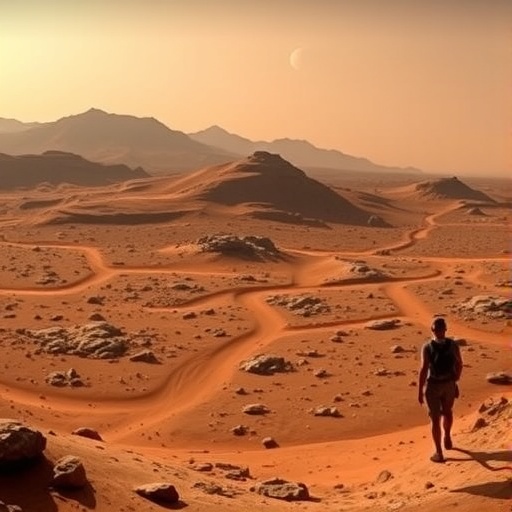
The research centered around the analysis of ancient sand dunes located within the Gale Crater, an area that has been thoroughly explored by NASA’s Curiosity rover. For many years, Gale Crater has been a focal point for Martian research due to its rich geological history and varied terrain. Scientists from NYUAD, led by Principal Investigator Dimitra Atri, conducted a meticulous comparison between data collected by Curiosity and rock formations found in the UAE desert that developed under resembling conditions on Earth, allowing for significant insights into Mars’ past.
Upon examination, Atri and her team found that a nearby Martian mountain had facilitated the penetration of water into the dunes through minute fissures, allowing this essential resource to infiltrate the sandy terrain from below. This interaction between water and sand led to the formation of various minerals, notably gypsum, which is similarly found in arid environments on Earth. The presence of gypsum raises intriguing possibilities, as these minerals have the potential to trap and preserve organic material, making them prime candidates for future exploratory missions aimed at uncovering remnants of ancient life forms that may have once existed on the Red Planet.
Atri emphasized the importance of their findings, noting that Mars did not simply transition from habitable and wet conditions to an inhospitable dry state. Instead, even after the planet’s lakes and rivers vanished from its surface, water continued to migrate underground in small amounts. This subtler form of hydration could have created protected environments capable of sustaining microbial life, thus extending the window during which life could have potentially thrived on Mars.
Bringing to light this nuanced understanding of Martian geology offers a fresh perspective on the planet’s evolution over time. The research indicates that the subsurface of Mars may hold significant insights into its habitability, urging future space missions to prioritize these hidden realms when searching for signs of ancient life. The study not only bolsters the narrative that water played a vital role in the planet’s past but also enhances the argument for why we need to invest in Mars explorations further.
Conducted at NYUAD’s Center for Astrophysics and Space Science, this research acknowledges the university’s expanded role in global space exploration initiatives. Collaborating with notable figures in the research community, including James Weston and Panče Naumov, the findings underscore the commitment that NYUAD has towards fostering innovative research endeavors aimed at unlocking the universe’s vast mysteries.
The implications of this study extend beyond mere academic interest; they lay the groundwork for future missions to Mars. The potential for uncovering biological materials preserved in the gypsum deposits is enticing to researchers eager to understand our solar system’s history. Continued investigations into such minerals could reveal not only the presence of previous microbial life but also how life forms might have adapted to Mars’ changing environments over epochs.
Furthermore, Abu Dhabi’s emphasis on developing its scientific research capabilities in alignment with global trends cements its position on the world stage, particularly in space exploration. By nurturing exceptional talent, as evidenced by the achievements of NYUAD alumni—including 24 Rhodes Scholars—the UAE is making significant strides in contributing to cutting-edge research across multiple disciplines.
As Mars exploration continues to captivate the scientific community, these new findings serve as a vital reminder of the importance of a multi-faceted approach to understanding planetary habitability. In the grand tapestry of cosmic exploration, Mars stands out not just as a neighboring planet but as a crucial element in our quest to locate life beyond Earth.
The groundbreaking research conducted by NYUAD sheds light on two essential E’s: Exploration and Evidence. Just as NASA’s Curiosity rover quests for evidence of historical water flows, it is equally essential that we continue to explore subsurface features that may significantly redefine our understanding of life’s potential beyond our home planet.
While the findings of this study provide a new foundational understanding of Mars’ geological past, they also invite more questions than answers. What other secrets lie hidden beneath the Martian surface? As researchers continue to investigate, the dialogue surrounding life on Mars will only deepen, beckoning new generations of scientists to push the boundaries of what we know.
In summary, the research team’s findings contribute not only to our understanding of Mars but also guide future exploration strategies. As we set our sights on the Red Planet, we do so with a renewed appreciation for the intricate relationship between water, geology, and the potential for life—past, present, and future.
Cite Scienmag News
Wesley B. (November 12, 2025). New Discoveries of Ancient Subsurface Water Indicate Mars May Have Remained Habitable Longer Than Previously Thought. Scienmag. https://scienmag.com/new-discoveries-of-ancient-subsurface-water-indicate-mars-may-have-remained-habitable-longer-than-previously-thought/
Wesley B. "New Discoveries of Ancient Subsurface Water Indicate Mars May Have Remained Habitable Longer Than Previously Thought." Scienmag, 12 November 2025, https://scienmag.com/new-discoveries-of-ancient-subsurface-water-indicate-mars-may-have-remained-habitable-longer-than-previously-thought/. Accessed 28 August 2026.
Wesley B. "New Discoveries of Ancient Subsurface Water Indicate Mars May Have Remained Habitable Longer Than Previously Thought." Scienmag. November 12, 2025. https://scienmag.com/new-discoveries-of-ancient-subsurface-water-indicate-mars-may-have-remained-habitable-longer-than-previously-thought/


