


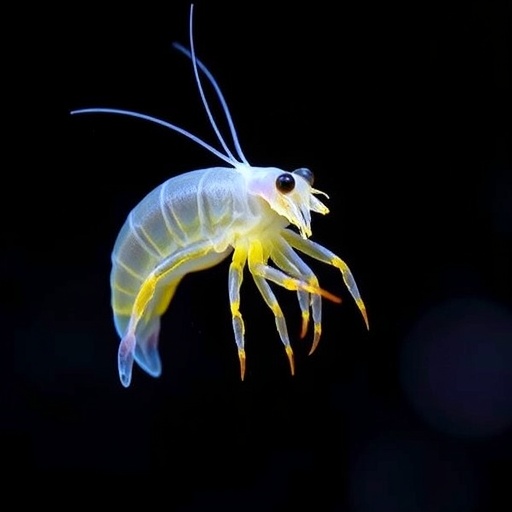
In a groundbreaking revelation from the Marine Biological Laboratory (MBL) in Woods Hole, Massachusetts, researchers have unveiled vivid imagery and in-depth insights into a heritable bacterial symbiosis deeply embedded within the reproductive system of ostracods, minuscule crustaceans colloquially known as seed shrimp. This landmark study, orchestrated by MBL Whitman Scientist Isa Schön and MBL Research Scientist Scott Chimileski, is published in the prestigious Proceedings of the Royal Society B, illuminating a new frontier in the understanding of microbial interactions with aquatic arthropods.
Ostracods, typically measuring barely a millimeter and inhabiting a diverse array of aquatic habitats ranging from freshwater lakes to marine biomes, have long fascinated scientists for their resilience and ecological ubiquity. Utilizing advanced fluorescence microscopy techniques, the scientific team has pinpointed the presence of bacteria from the genus Cardinium residing intricately within the egg cells and somatic tissues of ostracod ovaries. This discovery signifies a definitive instance of endosymbiosis, wherein the bacterial inhabitants are vertically transmitted from mother to offspring, ensuring the perpetuation of this intimate biological partnership through generations.
The vertically inherited nature of these Cardinium bacteria suggests an evolutionary strategy that extends beyond mere coexistence, implicating these microbes in the manipulation of the host’s asexual reproductive mechanisms. Such symbiotic relationships have been extensively studied in terrestrial arthropods, especially insects, where endosymbionts like Wolbachia alter host reproduction for their propagation. However, this study marks the first definitive evidence of Cardinium acting as a reproductive manipulator within a fully aquatic arthropod system, positioning ostracods as vital models for evolutionary and ecological research.
Drawing a compelling parallel to the role of Wolbachia in mosquitoes, where bacterial symbionts influence reproductive outcomes sufficiently to be employed as biocontrol agents against vector-borne diseases, the investigators propose that Cardinium’s interaction with ostracods could similarly reveal mechanisms to modulate ecological dynamics in aquatic ecosystems. Ostracods form a crucial trophic link in aquatic food webs, and understanding their microbial associates opens avenues for exploring microbial influences on aquatic biodiversity and ecosystem functioning with profound implications.
This revelation is the outcome of a dedicated, multi-year, multi-institutional collaboration integrating expertise in microscopy, evolutionary biology, and microbial ecology. Isa Schön, affiliated with the Royal Belgian Institute of Natural Sciences, initiated this line of research during her Whitman Fellowship at MBL in 2022, aiming to establish ostracods as a novel research organism to diversify biological inquiry beyond traditional models such as Drosophila and Mus musculus. Such diversification is crucial as it broadens the biological questions addressable by contemporary science and taps into the vast, yet understudied, diversity of life.
The investigative team harnessed the capabilities of MBL’s Central Microscopy Facility, employing confocal microscopy to achieve high-resolution, spatially precise images of the bacteria within the microscopic confines of ostracod ovarian tissue. Collaborators Koen Martens of the Royal Belgian Institute of Natural Sciences and Jessica Mark Welch of the ADA Forsyth Institute brought complementary expertise in evolutionary biology and microbiome visualization, respectively. Their combined efforts adapted sophisticated microbial labeling and imaging techniques typically used to study human microbiota for application in these aquatic crustaceans, setting a new technical benchmark in symbiosis imaging.
This investigation not only establishes non-marine ostracods as the inaugural fully aquatic host system for Cardinium bacteria but also underscores the broader significance of endosymbiosis as a driving force in evolution. Cardinium’s capacity to manipulate parthenogenetic reproduction in ostracods insinuates a co-evolutionary arms race that modulates host reproductive strategies, with attendant effects on population genetics and species fitness, reflective of dynamic microbial-host interactions shaping evolutionary trajectories.
Moreover, the implications transcend basic scientific curiosity, opening possibilities for applied research pertaining to environmental management and control of aquatic invertebrate populations. As endosymbiont-mediated reproductive manipulation alters population dynamics, understanding these mechanisms in ostracods could inform future ecological interventions aimed at preserving or restoring aquatic habitats, especially in the context of anthropogenic environmental stressors.
The study’s employment of sophisticated fluorescence microscopy to visualize the Cardinium within ova represents both a technical tour de force and a conceptual leap, advancing our grasp of intracellular bacterial communities embedded within their hosts at microscale resolutions. These imaging advances provide unprecedented clarity in mapping symbiont distributions in host tissues, facilitating deeper exploration into the physiology, ecology, and evolutionary effects of microbial symbioses.
Furthermore, the confirmation that these bacteria are not mere transient colonizers but vertically transmitted endosymbionts confirms a stable and evolutionarily significant relationship. This characteristic demonstrates that Cardinium is an integral component of ostracod biology, capable of influencing host life history traits over evolutionary time scales, and may prompt a reevaluation of microbial roles in aquatic arthropod biology and ecology broadly.
In summary, this research pioneers a transformative understanding of ostracod biology, microbial symbiosis, and reproductive manipulation within an aquatic context. By elucidating the complexities of Cardinium-ostracod interactions, the study opens pathways for novel investigations into symbiosis-driven evolutionary processes, the molecular underpinnings of host-microbe dynamics, and the ecological consequences of microbial symbionts in aquatic ecosystems. As the scientific community assimilates these findings, the implications resonate across disciplines, from microbiology and evolutionary biology to environmental sciences and aquatic ecology, underscoring the profound interconnectedness of life’s smallest partners in shaping biological diversity.
News Publication Date: 12-Nov-2025
Web References:
– https://royalsocietypublishing.org/doi/10.1098/rspb.2025.1193
– https://www.mbl.edu/research/resources-research-facilities/central-microscopy-facility
– https://www.mbl.edu/research/strategic-initiatives/new-research-organisms
References:
Schön and Chimileski et al., Proceedings of the Royal Society B, 2025
Cite Scienmag News
Gavin Prescott. (November 12, 2025). Imaging Uncovers Bacterial Symbionts Within Ovaries of Tiny Aquatic Crustaceans. Scienmag. https://scienmag.com/imaging-uncovers-bacterial-symbionts-within-ovaries-of-tiny-aquatic-crustaceans/
Gavin Prescott. "Imaging Uncovers Bacterial Symbionts Within Ovaries of Tiny Aquatic Crustaceans." Scienmag, 12 November 2025, https://scienmag.com/imaging-uncovers-bacterial-symbionts-within-ovaries-of-tiny-aquatic-crustaceans/. Accessed 1 September 2026.
Gavin Prescott. "Imaging Uncovers Bacterial Symbionts Within Ovaries of Tiny Aquatic Crustaceans." Scienmag. November 12, 2025. https://scienmag.com/imaging-uncovers-bacterial-symbionts-within-ovaries-of-tiny-aquatic-crustaceans/


