


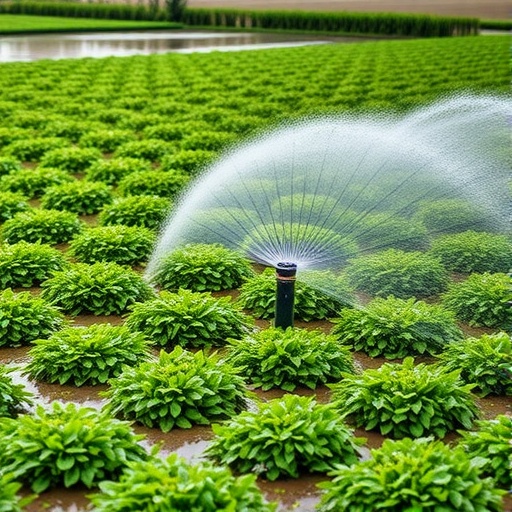
For decades, the narrative that irrigated agriculture is the backbone of global food security has pervaded scientific literature and policy discussions. Commonly cited statistics claim that irrigation is responsible for producing 40% of the world’s crops while consuming approximately 70% of freshwater resources. These figures have been entrenched in research articles, policy papers, and development plans, shaping priorities and investments across multiple sectors. However, a seminal new study published in PNAS Nexus by Arnald Puy and colleagues challenges the empirical validity of these widely accepted numbers, revealing a complex web of citation practices that have contributed to their propagation without rigorous substantiation.
The research team from the University of Birmingham meticulously traced the lineage of these irrigation-related statistics through nearly 3,700 scientific documents published between 1966 and 2024. Their citation network analysis exposed a startling reality: only a minuscule fraction—about 1.5%—of the documents cited as evidence actually contain original empirical data supporting the claims. Instead, the vast majority of citations lead to documents that do not provide data, do not make the claim explicitly, or rely on secondary sources with questionable methodological rigor.
One of the primary mechanisms driving the spread of these figures is what the authors describe as “amplification.” This process involves citing sources that themselves lack primary data, thereby amplifying unverified claims through a chain of references. Over time, the original uncertainty around these claims is obscured or lost—a phenomenon termed “transmutation”—where tentative or context-dependent estimates evolve into definitive statistics simply by virtue of repeated citation.
This investigation also highlights a major reliance on the Food and Agriculture Organization’s Aquastat database as a purported authoritative source for irrigation statistics. While Aquastat is widely accessed, the data it contains often depends on imputed figures and limited country-level coverage, rather than direct measurements. Such limitations raise critical questions about the robustness of the data underpinning global water and food security assessments and call for caution in interpreting aggregate statistics derived from it.
Beyond citation analysis, the study scrutinizes the empirical basis of irrigation’s contributions to crop production and freshwater use. The actual estimates for the proportion of global grain produced by irrigation span a wide range—from approximately 18% up to 50%. Similarly, estimates of irrigation’s share in freshwater withdrawals fluctuate significantly, between 45% and 90%. These broad ranges underscore the complexity of capturing irrigation’s global footprint accurately due to diverse agroclimatic conditions, varying farming practices, and differing water management regimes across regions.
Technically, measuring irrigation’s impact on crop productivity involves disentangling a constellation of factors, including cropping intensity, crop type, soil moisture conditions, and technological inputs such as precision irrigation systems. Remote sensing, hydrological modeling, and field surveys contribute pieces of this puzzle, but each comes with its own uncertainties and constraints. Integrating these multifaceted datasets to derive global-scale statistics remains an ongoing challenge.
Furthermore, the hydrological impact of irrigation is inherently context-specific. Irrigation methods vary from traditional surface flood techniques to advanced drip and sprinkler systems, each with distinct efficiencies and environmental footprints. In regions facing water scarcity, irrigation infrastructure choices, groundwater recharge rates, and return flow dynamics critically influence local water balances and ecosystem health. Hence, global aggregates risk masking critical local variabilities and trade-offs.
The implications of this analysis resonate strongly in policymaking spheres. Strategies aiming to improve water use efficiency or augment crop yields must be grounded in reliable evidence to avoid misallocation of resources or unintended environmental harms. Overreliance on unsubstantiated global averages could skew priorities away from locally appropriate solutions that acknowledge environmental, social, and economic complexities on the ground.
This study serves as a clarion call for the scientific community to revisit foundational assumptions in sustainability science and to cultivate a culture of rigorous data verification and transparency. The propagation of unverified statistics, no matter how well-intentioned, risks undermining the credibility of scientific outputs and their influence on critical policy decisions. Advancing irrigation research requires not only novel data collection technologies but also robust frameworks for evaluating and integrating evidence.
Despite the debunking of these specific numbers, the fundamental role of irrigation in enhancing agricultural productivity remains recognized. What this research underscores is the importance of nuanced, place-based understanding rather than simplistic global averages. Contextualized knowledge enables the design of adaptive management strategies tailored to local water availability, crop demands, and socio-economic conditions.
Moreover, emerging technologies such as satellite Earth observation, improved hydrological modeling, and participatory data collection hold promise for refining irrigation metrics. Coupling these advances with open data initiatives and interdisciplinary collaboration could improve the granularity and reliability of irrigation impact assessments at multiple scales.
In conclusion, the widely cited assertion that irrigation accounts for 40% of global crop production and 70% of freshwater use lacks a robust empirical foundation. This revelation prompts a re-examination of one of the cornerstones in the discourse on agricultural water management. While irrigation undeniably plays a critical role in feeding the world, the scientific and policy communities must critically assess the origins and validity of pervasive statistics to ensure informed decision-making—ultimately fostering sustainable food systems that are both productive and resilient.
News Publication Date: 11-Nov-2025
Cite Scienmag News
Gideon R. (November 11, 2025). Two Key Irrigation Statistics May Be Inaccurate, New Report Reveals. Scienmag. https://scienmag.com/two-key-irrigation-statistics-may-be-inaccurate-new-report-reveals/
Gideon R. "Two Key Irrigation Statistics May Be Inaccurate, New Report Reveals." Scienmag, 11 November 2025, https://scienmag.com/two-key-irrigation-statistics-may-be-inaccurate-new-report-reveals/. Accessed 29 August 2026.
Gideon R. "Two Key Irrigation Statistics May Be Inaccurate, New Report Reveals." Scienmag. November 11, 2025. https://scienmag.com/two-key-irrigation-statistics-may-be-inaccurate-new-report-reveals/


