


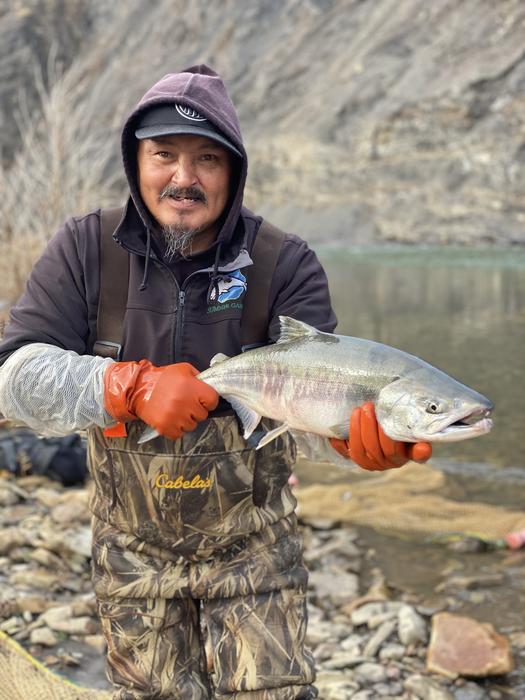
New research has connected warming ocean temperatures to higher Pacific salmon abundance in the Canadian Arctic, an indicator that climate change is creating new corridors for the fish to expand their range.

Credit: Photo by Colin Gallagher, DFO
New research has connected warming ocean temperatures to higher Pacific salmon abundance in the Canadian Arctic, an indicator that climate change is creating new corridors for the fish to expand their range.
Salmon haven’t historically been seen in large numbers in the Arctic Ocean and its watersheds, but in recent years incidental catches by subsistence fishermen have occasionally surged. Researchers at Fisheries and Oceans Canada and the University of Alaska Fairbanks, working together with communities in the western Canadian Arctic, connected those salmon booms with a sequence of warm, ice-free conditions in the Arctic Ocean north of Alaska.
The study, published today in the journal Global Change Biology, determined that a two-part mechanism was tied to the presence of salmon in the Canadian Arctic. Warm late-spring conditions in the Chukchi Sea, northwest of Alaska, drew salmon into the Arctic. When those warm conditions persisted in the summertime Beaufort Sea, northeast of Alaska, salmon could continue to Canada.
By comparing National Oceanic and Atmospheric Administration satellite data since 2000 to salmon catch rates, researchers found a correlation between salmon abundance and the ocean conditions that favored their movement into the Arctic.
“You need both gates to be open, which is fascinating in itself,” said Curry Cunningham, an associate professor at UAF’s College of Fisheries and Ocean Sciences. “If they don’t align in terms of having open, ice-free water, salmon don’t turn that corner.”
Indigenous communities in the Canadian Arctic have been tracking incidental salmon catches with Fisheries and Oceans Canada as part of the Arctic Salmon Program. For more than 20 years, salmon caught outside their typical range have been recorded by subsistence harvesters who target other Arctic species, including Dolly Varden and Arctic char.
Chum and sockeye salmon have been the most frequently caught salmon species, followed by pink salmon. Those catches are largely consistent with previous research showing that chum and sockeye have more tolerance for cold temperatures than other salmon, allowing them to more easily transition into Arctic waters.
Karen Dunmall, a research scientist at Fisheries and Oceans Canada, said such range expansion concerns many people in the region.
“It really helps to address some questions from community members about biodiversity change and subsistence and how they feed their families,” said Dunmall, the co-lead author of the study. “Some years there were salmon, some years there were no salmon. No one really wanted the salmon, but they wanted to know what was going on.”
Frankie Dillon, an Indigenous fisherman who helps conduct fish surveys for Fisheries and Oceans Canada, remembered seeing his first salmon in about 2010 on the Big Fish River in the northern Yukon while tagging Dolly Varden. At that time, salmon were so rare in the region that he didn’t know what he was looking at.
“I had to ask, ‘What kind of fish was that?’” Dillon said of the chum salmon. “It’s the first time I’d seen it in my life. I’d only seen them on TV before.”
Salmon sightings have become more frequent in the years since then, and climate models predict the conditions that allow salmon to migrate through the Chukchi and Beaufort seas will become common as early as the 2040s.
Although the study focused on western Canada, those changing conditions are surely causing range expansion throughout the region, researchers said.
“It’s not as if these fish are all skipping Alaska and heading to Canada,” said Joe Langan, who co-led the project as a UAF postdoctoral fellow. “Some of these salmon are ending up on Alaska’s North Slope too.”
Journal
Global Change Biology
Subject of Research
Animals
Article Title
Pacific salmon in the Canadian Arctic highlight a range-expansion pathway for sub-Arctic fishes
Article Publication Date
5-Jun-2024
Cite Scienmag News
Drew Townsend. (June 5, 2024). ‘Open gates’ in warming Arctic are expanding salmon range. Scienmag. https://scienmag.com/open-gates-in-warming-arctic-are-expanding-salmon-range/
Drew Townsend. "‘Open gates’ in warming Arctic are expanding salmon range." Scienmag, 5 June 2024, https://scienmag.com/open-gates-in-warming-arctic-are-expanding-salmon-range/. Accessed 5 September 2026.
Drew Townsend. "‘Open gates’ in warming Arctic are expanding salmon range." Scienmag. June 5, 2024. https://scienmag.com/open-gates-in-warming-arctic-are-expanding-salmon-range/

