


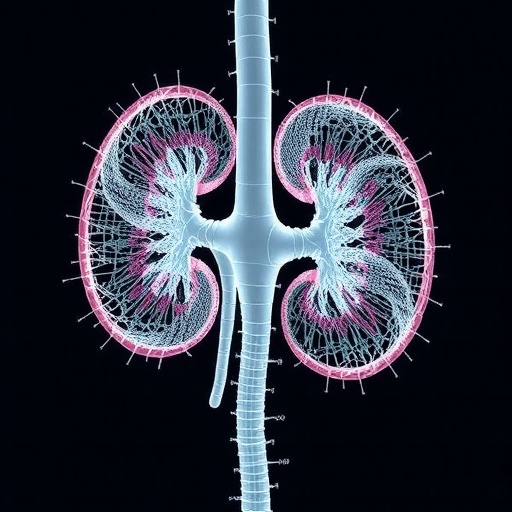
In a groundbreaking leap for renal biology and medical imaging, researchers have unveiled an unprecedented three-dimensional multiscalar map detailing the neurovascular and nephron connectivity within the human kidney across the entire human lifespan. This monumental achievement, published recently in Nature Communications, offers an intricate visualization of the kidney’s functional architecture that promises to revolutionize both the scientific understanding of renal physiology and the diagnosis and treatment of kidney diseases.
The kidney, as a vital organ responsible for filtering blood, regulating electrolytes, and maintaining homeostasis, relies on a complex network of nephrons and vascular components intricately coordinated by neural inputs. Until now, the comprehensive spatial and functional integration of these systems had eluded scientists due to the organ’s structural complexity and the limitations inherent in imaging technologies. The new study transcends these barriers by combining state-of-the-art multiscalar imaging techniques with advanced computational modeling to assemble a complete 3D connectivity atlas.
This atlas offers a synchronized view of the kidney’s microanatomy at multiple scales: from the cellular architecture of individual nephrons to the expansive vascular networks and the neurogenic elements that regulate function dynamically. By integrating data across such scales and spanning a diverse collection of human specimens from infancy to old age, the researchers have crafted a dynamic portrait of kidney development, maturation, and age-related transformation.
The methodology underlying this study is exceptionally sophisticated. The team employed high-resolution confocal microscopy alongside novel optical clearing methods to visualize the kidney in unparalleled clarity. These approaches permitted the retention of delicate structures while rendering the opaque tissue nearly transparent, thereby enabling deep volumetric scanning without destructive sectioning. Coupled with multiplexed immunolabeling, they could distinguish neural, vascular, and tubular segments simultaneously.
Subsequent advanced image processing algorithms stitched together thousands of captured images, reconstructing them within a unified 3D framework. Machine learning models further enhanced segmentation precision, identifying and classifying cellular and subcellular components across the entire organ. This integrative computational pipeline represents a significant advancement over previous discrete or partial mapping efforts.
Functionally, the map elucidates how neurovascular units interact spatially with the nephrons—the kidney’s fundamental filtration units. The revelation of intimate neurovascular coupling provides new insights into how blood flow is regulated within different nephron segments in real time. This neurovascular synergy is vital for maintaining glomerular filtration rate and responding to systemic physiological changes, including blood pressure fluctuations and hormonal signals.
The lifespan aspect of the study is particularly compelling. By comparing kidneys from neonatal, adult, and aged donors, the researchers highlighted structural remodeling and connectivity shifts that likely underpin susceptibility to chronic kidney diseases in elderly populations. Age-related variability in vascular density, neural innervation, and nephron morphology may explain why renal function progressively declines over decades in many individuals.
Furthermore, this map is poised to impact regenerative medicine profoundly. Understanding the precise spatial relationships among nephrons, vessels, and nerves could accelerate bioengineering of kidney tissue and the development of artificial organs. Embryonic stem-cell-derived kidney organoids, a burgeoning field, may benefit from guidance provided by this anatomical blueprint, improving organoid maturation and functionality.
Clinically, the atlas paves the way for novel diagnostic and therapeutic strategies. Enhanced imaging protocols could integrate these findings to identify early microstructural anomalies in kidney biopsies or noninvasive scans, revolutionizing the detection of diseases like diabetic nephropathy or hypertensive nephrosclerosis. Additionally, the neurovascular insights inspire targeted neuromodulation approaches to restore or augment kidney function.
Importantly, while this comprehensive study focuses on human kidneys, the methodologies developed hold promise for mapping other organs where neurovascular and cellular interplay is critical. The successful fusion of multiscale imaging and computational analysis sets a new standard for organ mapping, with translational potential extending into neuroscience, vascular biology, and systems physiology.
Despite the technical complexity, the study bridges a critical gap between anatomical structure and physiological function, addressing longstanding questions about how kidney architecture varies over time and impacts systemic health. It also offers a resource for the broader scientific community, with data made openly accessible to spur collaboration across disciplines.
Experts in nephrology have hailed this work as a tour de force, highlighting its capacity to transform understanding of kidney aging and disease. By moving beyond traditional two-dimensional histology toward a holistic 3D paradigm, it captures the dynamic interplay of kidney components previously invisible in conventional investigations.
Looking forward, the team envisions integrating this anatomical atlas with functional imaging modalities such as multiphoton microscopy and fluorescent biosensors to monitor real-time physiological processes in living tissue. This dynamic dimension would further enhance mechanistic insights and refine therapeutic interventions.
In sum, this landmark publication presents a richly detailed, lifespan-spanning 3D neurovascular nephron connectivity map that exemplifies the fusion of cutting-edge imaging, computational science, and clinical vision. It epitomizes how comprehensive organ mapping can unlock new horizons in biomedicine, offering a pivotal foundation for future kidney research and healthcare innovation.
Cite Scienmag News
Ophelia Keating. (June 3, 2025). 3D Multiscale Map Reveals Human Kidney Connectivity. Scienmag. https://scienmag.com/3d-multiscale-map-reveals-human-kidney-connectivity/
Ophelia Keating. "3D Multiscale Map Reveals Human Kidney Connectivity." Scienmag, 3 June 2025, https://scienmag.com/3d-multiscale-map-reveals-human-kidney-connectivity/. Accessed 3 September 2026.
Ophelia Keating. "3D Multiscale Map Reveals Human Kidney Connectivity." Scienmag. June 3, 2025. https://scienmag.com/3d-multiscale-map-reveals-human-kidney-connectivity/


