

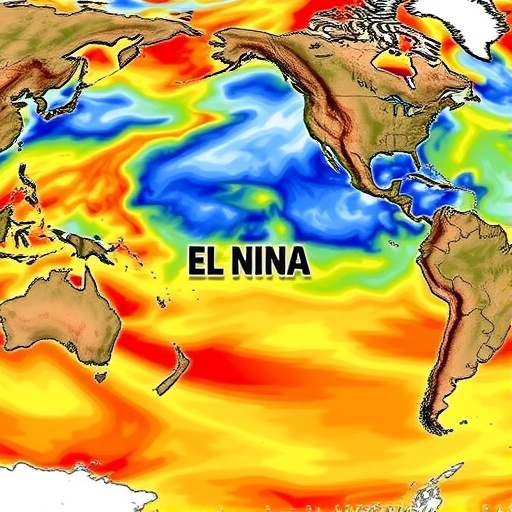
In a groundbreaking study published in Communications Earth & Environment, scientists have revealed how the extreme 2016 El Niño event fundamentally altered critical biogeochemical processes in the Equatorial Pacific Ocean, leading to a marked weakening in carbon export and respiration. This research sheds light on how anomalous heatwaves can disrupt the delicate balance of oceanic carbon cycling—one of the Earth’s primary mechanisms for regulating atmospheric carbon dioxide. As the world anticipates more frequent and intense El Niño events driven by climate change, understanding these disturbances is crucial for predicting future global carbon dynamics.
The Equatorial Pacific is a vital region in the global carbon cycle, acting as a massive sink and source regulator for atmospheric CO2 through complex interactions involving biological productivity, organic matter export, and microbial respiration. During typical conditions, phytoplankton flourish in these nutrient-rich waters, converting CO2 into organic matter, which then sinks to deeper ocean layers—a process known as the biological carbon pump. This export of carbon from the surface ocean to the deep ocean sequesters carbon for extended periods, mitigating the rate of atmospheric carbon accumulation.
However, the 2016 El Niño event, widely recognized as one of the most intense on record, generated an unprecedented heatwave that significantly impacted this balance. Arteaga and colleagues conducted extensive field measurements and employed advanced oceanographic modeling to uncover how these elevated surface temperatures, coupled with altered ocean circulation patterns, suppressed the export of carbon-rich organic material to the deep ocean. The researchers discovered a remarkable downshift in the flux of particulate organic carbon (POC), a key component of the biological carbon pump, coinciding with the heatwave’s peak.
Central to this disruption was the weakening of primary productivity driven by phytoplankton. Elevated surface temperatures and stratification impaired the upwelling of nutrient-laden waters, which normally sustain high levels of photosynthetic activity. As nutrient availability dwindled, phytoplankton biomass decreased, curtailing the synthesis of organic carbon and consequently reducing carbon export. Furthermore, the team documented a notable decline in the respiration rates of heterotrophic microbes responsible for remineralizing organic carbon in the water column.
The attenuation of microbial respiration poses complex implications for carbon cycling. Typically, heterotrophic bacteria consume sinking organic material, respiring some of it back as CO2, while the remainder sinks to the deep ocean. The observed suppression of respiration rates during and after the 2016 event suggests a slowdown in carbon recycling processes, potentially prolonging the residence time of organic carbon in surface waters but simultaneously diminishing the efficiency of nutrient turnover necessary to sustain new production.
Additionally, the study highlights a decoupling between carbon export and respiration during the El Niño heatwave, a phenomenon rarely observed with such clarity. This uncoupling underscores the sensitivity of ocean biogeochemical processes to extreme climate anomalies. The reduced export, combined with suppressed respiration, may impose feedbacks on atmospheric CO2 variability, given the Equatorial Pacific’s outsized role in global carbon exchange.
In synthesizing in situ observations with satellite data and biogeochemical models, the research team traced how the 2016 El Niño’s thermal anomalies altered the physical environment—primarily via weakened upwelling intensity and augmented stratification—thereby reshaping ecosystem structure and function. These physicochemical changes disrupted the coupling between autotrophic production and heterotrophic degradation processes, both pivotal to maintaining ocean productivity and carbon cycling efficiency.
This disruption has profound implications in the context of climate change. As El Niño events intensify or occur more frequently, the Equatorial Pacific’s capacity to sequester carbon could be compromised, ultimately influencing the global carbon budget and climate trajectories. The research represents a clarion call for integrating extreme episodic events into climate and carbon cycle models to improve the accuracy of future projections.
Moreover, the study elucidates mechanisms by which heatwaves can induce biogeochemical regime shifts in marine systems. The attenuation of the biological pump reduces oceanic carbon uptake, potentially accelerating atmospheric CO2 accumulation. Concurrently, impaired microbial respiration complicates predictions of carbon remineralization and nutrient recycling dynamics, highlighting the need for enhanced microbial process measurements in ocean monitoring programs.
This investigation also underscores the importance of interdisciplinary approaches combining oceanography, ecology, and biogeochemistry to unravel complex climate-ecosystem interactions. The synthesis of high-resolution time series data with mechanistic modeling allowed the authors to quantify the temporal dynamics of carbon cycling processes during and after the heatwave event with unprecedented detail.
Furthermore, the Equatorial Pacific heatwave had cascading effects beyond carbon fluxes. As the base of the marine food web was weakened, implications for higher trophic levels and fisheries emerged, potentially influencing biodiversity and regional economies dependent on these ecosystems. Such disruptions reveal how climate extremes propagate through multiple ecological scales, necessitating holistic management strategies.
Future research directions prompted by this study include exploring how repeated heatwaves might engender longer-term shifts in microbial community composition and metabolic function, which could alter ecosystem resilience. Understanding these biological responses will be fundamental for forecasting the ocean’s role in mediating climate feedbacks under increasingly variable and extreme conditions.
Importantly, the findings have significant policy relevance. They emphasize the urgency of mitigating greenhouse gas emissions to reduce the likelihood and intensity of climate extremes. Simultaneously, they advocate for enhanced oceanographic monitoring networks capable of detecting early signs of biogeochemical disruption to inform adaptive management and conservation efforts.
In light of these insights, the 2016 El Niño event stands as a sentinel event demonstrating how climate-induced ocean warming can cascade into altered ecosystem function and carbon cycling, with profound consequences for Earth’s climate system. This research contributes a critical piece to the puzzle of how ocean-atmosphere interactions will evolve in a warming world—raising vital questions about the resilience of nature’s carbon sink and the feedbacks that may accelerate global change.
As climate scientists and oceanographers continue to unveil the intricacies of such extreme marine phenomena, this study offers a compelling case for the interconnectedness of physical, chemical, and biological processes governing the Earth system. The weakening of carbon export and respiration caused by the 2016 Equatorial Pacific heatwave serves as a stark reminder of the ocean’s vulnerability to climate variability and the pressing need to deepen our understanding of these dynamics.
Subject of Research: Impact of the 2016 El Niño heatwave on carbon export and respiration in the Equatorial Pacific Ocean.
Article Title: Extreme 2016 El Niño heatwave weakened carbon export and respiration in the Equatorial Pacific.
Article References:
Arteaga, L.A., Rousseaux, C.S., Cetinić, I. et al. Extreme 2016 El Niño heatwave weakened carbon export and respiration in the Equatorial Pacific. Commun Earth Environ (2026). https://doi.org/10.1038/s43247-026-03441-y
Image Credits: AI Generated


