


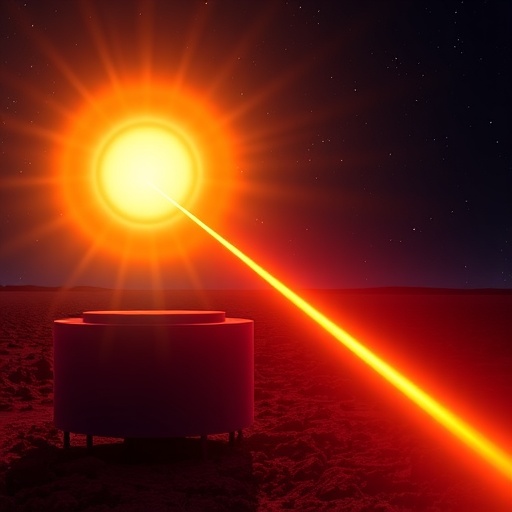
In an era where renewable energy technologies are at the forefront of combating climate change, a remarkable breakthrough has been achieved in the field of solar thermoelectric generators (STEGs). Researchers led by Xu, T., Wei, R., and Singh, S.C. have reported a striking 15-fold enhancement in the performance of STEGs by innovatively employing femtosecond-laser spectral engineering combined with advanced thermal management techniques. Published in Light: Science & Applications, this groundbreaking study paves the way for highly efficient, sustainable, and scalable energy conversion devices that could revolutionize solar power harvesting.
Solar thermoelectric generators operate by directly converting solar heat into electrical energy using thermoelectric materials, which harness temperature gradients to generate voltage via the Seebeck effect. However, the practical efficiency of STEGs has traditionally been limited by challenges such as insufficient spectral absorption of solar radiation, poor thermal gradients due to heat dissipation, and intrinsic material constraints. The recent work by Xu et al. addresses these limitations head-on through an ingenious combination of spectral and thermal engineering at the micro and nanoscale.
Central to the advancement is the use of femtosecond-laser processing technology — a method that utilizes ultrafast laser pulses in the femtosecond range (10⁻¹⁵ seconds) to precisely sculpt micro- and nanostructures on the surface of the thermoelectric materials. This spectral engineering approach modifies the optical properties of the device significantly, optimizing the absorption spectrum to match the solar irradiance profile while minimizing reflective losses. The tailored surface nanostructures enable the device to trap and convert a broader range of sunlight frequencies with exceptional efficiency.
Moreover, the research introduces a nuanced thermal management scheme that strategically controls heat flow within the STEG system. Conventional setups often suffer from rapid heat dissipation that flattens the thermal gradients necessary for continuous electricity generation. The team developed a multilayered architecture incorporating thermally insulating materials and heat localization strategies to sustain steep temperature differences across the thermoelectric elements. These optimizations are crucial for maintaining high Seebeck voltages and maximizing power output.
Comprehensive experimental characterization and simulation analyses corroborate the substantial performance gains. The femtosecond-laser engineered device exhibits a remarkable 15-fold increase in power conversion efficiency compared to baseline STEGs. This unprecedented improvement is attributed to the synergistic effects of enhanced solar spectrum absorption and sustained thermal gradients, marking a paradigm shift in how STEGs can be designed for real-world applications.
Importantly, the femtosecond laser technique offers exceptional versatility and precision without compromising the underlying material properties. Unlike other surface modification methods, such as chemical etching or physical texturing, laser processing enables non-contact, contamination-free, and highly reproducible patterning. This aspect is vital for scalability and integration into existing fabrication workflows for thermoelectric modules and solar harvesting systems.
Beyond the intrinsic performance gains, the researchers highlight the potential environmental and economic impacts of their innovation. The improved STEGs require no moving parts or toxic components, are robust under various operating conditions, and can be deployed in remote or off-grid locations where photovoltaic panels may be less practical. By harnessing the full solar spectrum more effectively and producing higher power densities, these devices could significantly enhance the viability of solar thermal energy as a clean alternative.
Another notable feature is the device’s capability to operate efficiently under diffuse light conditions, expanding operational latitude beyond direct sunlight scenarios. This adaptability is especially important for geographical regions subject to variable weather, enabling more consistent energy generation throughout the day. The integration of spectral and thermal design ensures that even scattered sunlight is captured and converted, minimizing downtime and improving overall energy yield.
From a materials science perspective, the study provides valuable insights into the interplay between nanoscale morphology, optical behavior, and thermoelectric performance. By correlating laser-induced surface modifications with changes in absorptivity and thermal conductivity, the researchers open new avenues for tailoring other energy materials using similar ultrafast laser processings. The methodology could be extended to a broad range of energy conversion and sensing devices that rely on finely tuned optical and thermal properties.
The implications for future research are vast. Potential refinements include optimizing the geometric parameters of laser patterns, exploring hybrid nanocomposites that combine thermoelectric semiconductors with plasmonic nanoparticles for enhanced light trapping, and integrating intelligent thermal regulation systems. These directions hold promise for pushing STEG efficiencies closer to thermodynamic limits while reducing manufacturing costs and complexity.
Field deployment and durability testing are critical next steps to translate laboratory success into commercial products. The authors emphasize ongoing work to evaluate long-term stability under fluctuating temperature cycles, environmental exposure, and mechanical stress. Initial results suggest that femtosecond-laser patterned STEGs exhibit excellent structural integrity and stable electrical output over prolonged operation, reinforcing their practical potential.
This advancement also aligns with global energy policies emphasizing decentralized and resilient renewable energy infrastructures. As the world accelerates toward carbon neutrality, technologies like femtosecond-laser engineered STEGs could complement traditional photovoltaics, wind, and storage solutions by offering reliable off-grid power generation without dependence on scarce materials or complex maintenance.
Furthermore, the interdisciplinary nature of this research underscores the synergy between ultrafast photonics, nanofabrication, and thermoelectric science—a convergence that is likely to inspire novel device concepts across energy sectors. The collaborative efforts of physicists, engineers, and materials scientists in this study exemplify how cross-disciplinary innovation is key to overcoming long-standing energy conversion challenges.
In conclusion, the 15-fold increase in STEG performance reported by Xu and colleagues marks a significant milestone in solar energy technology. By leveraging femtosecond-laser spectral engineering alongside sophisticated thermal management, this study sets a new benchmark for thermoelectric energy conversion efficiency. The scalable and environmentally benign nature of the approach promises broad applicability, fostering new pathways toward sustainable and efficient solar power harvesting.
As renewable energy technologies continue to evolve, breakthroughs like these underscore the critical role of advanced manufacturing techniques and fundamental materials control in shaping the future energy landscape. It is anticipated that further optimization and integration of such laser-engineered thermoelectric generators will accelerate the transition to a low-carbon economy and empower communities worldwide with clean, accessible energy solutions.
Cite Scienmag News
Denise Maddox. (August 12, 2025). 15x Boost in Solar Thermoelectric Power via Laser Engineering. Scienmag. https://scienmag.com/15x-boost-in-solar-thermoelectric-power-via-laser-engineering/
Denise Maddox. "15x Boost in Solar Thermoelectric Power via Laser Engineering." Scienmag, 12 August 2025, https://scienmag.com/15x-boost-in-solar-thermoelectric-power-via-laser-engineering/. Accessed 3 September 2026.
Denise Maddox. "15x Boost in Solar Thermoelectric Power via Laser Engineering." Scienmag. August 12, 2025. https://scienmag.com/15x-boost-in-solar-thermoelectric-power-via-laser-engineering/


