

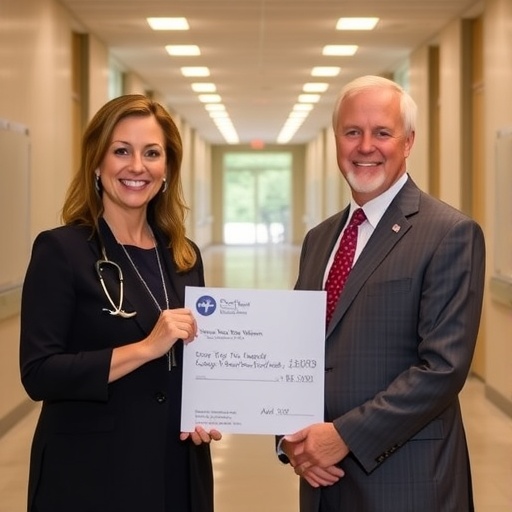
In a pioneering move that promises to reshape cardiovascular care for women in midlife, the American Heart Association (AHA) has unveiled a groundbreaking initiative fueled by a $1 million endowment from Jennifer Ashton, M.D., M.S., FACOG, ABOM, and her husband Tom Werner. Dr. Ashton, a renowned expert in women’s health, award-winning medical journalist, and esteemed AHA board member, alongside Werner, a distinguished television producer and chairman of Fenway Sports Group, bring not only substantial financial support but also fervent dedication to the cause of advancing women’s cardiovascular well-being.
This initiative ventures into uncharted territory by aiming to dissolve silos between cardiology and obstetrics-gynecology, fostering an integrated professional education program. The goal is to empower clinicians to identify and mitigate cardiovascular risks unique to women navigating menopause—an often overlooked yet critical period marked by heightened cardiometabolic vulnerability. This collaborative approach acknowledges the complexity of physiological changes during menopause and seeks to imbue healthcare providers with nuanced, evidence-based tools essential for proactive intervention.
Menopause represents a pivotal biological milestone, characterized by fluctuating and ultimately declining estrogen levels, which precipitates a cascade of adverse cardiovascular changes. These include altered lipid metabolism, increased central adiposity, vascular stiffness, and escalating blood pressure—all factors conspiring to elevate cardiovascular disease (CVD) incidence in postmenopausal women. Despite CVD’s status as the leading cause of death among women, responsible for one in every three female deaths annually, its manifestation during the menopause transition remains insufficiently recognized in routine clinical practice.
The American Heart Association stresses that the medical community’s urgency in addressing this gap cannot be overstated, given projections that the burden of cardiovascular disease in the U.S. will exacerbate dramatically in the coming decades. Foreseeing this trend, the AHA’s educational campaign will equip both cardiologists and OB-GYNs with practical, interdisciplinary competencies, thereby closing existing treatment gaps and fostering an anticipatory, rather than reactive, model of care.
Central to this campaign is the development of a Continuing Education (CE) curriculum, co-created with leading professional societies spanning cardiovascular and women’s health domains. This curriculum targets enhancement of clinician knowledge, competence, and clinical performance, specifically addressing cardiovascular risk stratification and management intricacies in midlife women, particularly during the menopause transition. The program’s interdisciplinary coalescence is designed to stimulate collaborative practice, optimize patient outcomes, and reduce cardiovascular morbidity in this vulnerable population.
Amy Young, M.D., CEO of the American Board of Obstetrics and Gynecology, underscored the critical juncture that menopause represents in women’s cardiovascular health. She emphasized the OB-GYN community’s commitment to elevating care standards during this phase and highlighted the certifying body’s intention to actively contribute to interdisciplinary dialogue and initiatives that guarantee compassionate, evidence-driven, and synchronized care delivery.
Dr. Ashton, uniquely positioned as an OB-GYN, daughter of a cardiologist, and fervent advocate for women’s health, articulated the pervasive disconnection between cardiology and gynecology specializations in addressing menopausal cardiovascular risks. This bi-directional knowledge gap leaves women without the integrated care they urgently require. The initiative’s tailored curricula aim to bridge this divide, furnishing clinicians with the latest scientific insights and clinical practices requisite for safeguarding women’s heart and brain health earlier in life’s trajectory.
The initial series of courses is slated for launch in Fall 2026, with subsequent modules rolling out through Spring 2027, marking a significant step toward fostering a new paradigm of care for middle-aged women. This initiative represents not merely an educational endeavor but a strategic realignment of clinical priorities that recognizes menopause as a sentinel event necessitating focused cardiovascular risk mitigation.
Scientific evidence underscores that menopause provokes pronounced exacerbations in traditional cardiovascular risk factors independent of chronological aging. Common menopausal symptoms such as hot flashes and night sweats correlate with deteriorating cardiometabolic profiles. Moreover, lipid abnormalities and metabolic syndrome prevalence surge during this stage, intensifying cardiovascular risk substantially. These pathophysiological transformations underscore the inadequacy of one-dimensional approaches and call for comprehensive, interdisciplinary strategies.
Compounding these risks are lifestyle factors prevalent among midlife women transitioning through menopause. Alarmingly, only a small fraction meet established physical activity guidelines, and a majority fail to maintain optimal dietary patterns that could mitigate their cardiovascular vulnerability. This trend exacerbates the biological underpinnings of CVD, highlighting the imperative for healthcare providers to address behavioral determinants alongside clinical risk factors.
Atrial fibrillation (AFib), an arrhythmia strongly linked with stroke, manifests with increased frequency post-menopause, affecting approximately one in four women during this stage. This surge in cardiac electrical disturbances further complicates the cardiovascular risk landscape and underscores the necessity of early detection and integrated care modalities that encompass rhythm monitoring and stroke prevention strategies tailored for women.
The AHA’s commitment to this initiative extends beyond education and embraces a mission to transform clinical practice fundamentally, bridging cardiology and gynecology with shared knowledge and coordinated patient management. By doing so, it leverages Dr. Ashton and Mr. Werner’s visionary philanthropy to initiate systemic change that could save innumerable women from premature morbidity and mortality caused by cardiovascular diseases.
This program also aligns with broader public health imperatives by addressing social determinants of health and non-biological factors that influence cardiovascular outcomes among women. It envisions a future where interdisciplinary teams apply a holistic lens, incorporating social and behavioral contexts into personalized cardiovascular preventive care during the sensitive midlife transition.
With cardiovascular disease poised to escalate in prevalence and impact, especially among women approaching and beyond menopause, the initiative serves as a timely beacon of innovation. It acknowledges the multifactorial roots of cardiovascular risk and champions education as the fulcrum for clinical transformation, fostering a generation of healthcare providers equipped to deliver anticipatory, connected, and evidence-based care.
In the evolving landscape of women’s health, this visionary endeavor signals a paradigm shift—from fragmented, specialty-isolated care to a concerted, patient-centered approach—promising profound implications for the longevity and quality of life of millions of women navigating the challenges of midlife and beyond.
Subject of Research:
Cardiovascular risk assessment and management in midlife women during the menopause transition, focused on interdisciplinary medical education integrating cardiology and obstetrics-gynecology.
Article Title:
American Heart Association Launches $1 Million Initiative to Integrate Cardiovascular and Menopause Care for Midlife Women
News Publication Date:
February 23, 2026
Web References:
https://www.goredforwomen.org/en/know-your-risk/menopause/what-is-menopause
https://www.goredforwomen.org/en/about-heart-disease-in-women/facts
https://newsroom.heart.org/news/population-shifts-risk-factors-may-triple-u-s-cardiovascular-disease-costs-by-2050
https://www.heart.org/en/health-topics/metabolic-syndrome
https://newsroom.heart.org/news/heart-disease-risk-in-women-increases-leading-up-to-menopause-early-intervention-is-key
https://newsroom.heart.org/news/new-cardiology-ob-gyn-continuing-education-to-launch-with-1-million-gift-from-leading-media-voice-on-health-dr-jennifer-ashton-and-husband-tom-werner?preview=7d38fdd9de5f127f6597fbc0f3ed655c
https://www.ahajournals.org/doi/10.1161/CIR.0000000000000912
https://newsroom.heart.org/news/non-biological-factors-and-social-determinants-of-health-important-in-womens-cvd-risk-assessment?utm_campaign=sciencenews22-23&utm_source=science-news&utm_medium=phd-link&utm_content=phd-04-10-23
Keywords:
Menopause, Cardiovascular disease, Midlife women, Cardiometabolic risk, Interdisciplinary education, OB-GYN, Cardiology, Atrial fibrillation, Preventive cardiology, Women’s health, Metabolic syndrome, Heart disease


