

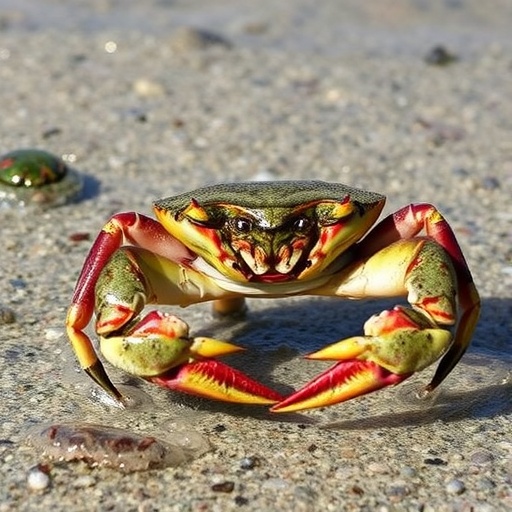
The blue crab, an iconic inhabitant of the Chesapeake Bay, harbors a stark and ruthless aspect of its existence that has profound implications for its survival and management. Recent pioneering research from the Smithsonian Environmental Research Center (SERC) reveals that cannibalism, predominantly by adult blue crabs on their juvenile counterparts, emerges as the principal cause of juvenile blue crab mortality in mid-salinity waters. This startling finding, derived from an exhaustive 37-year study published in the Proceedings of the National Academy of Sciences, challenges traditional understandings of juvenile crab predation and emphasizes the critical role of shallow-water refuges in sustaining blue crab populations.
Upon hatching, blue crabs embark on a perilous journey. They initially spend nearly two months as planktonic larvae in oceanic waters before being transported back to lower Chesapeake Bay regions. It is here that they undergo metamorphosis into juvenile crabs, where dense beds of seagrass provide necessary shelter from visual predators such as striped bass. However, this early sanctuary offers scant protection once the juveniles surpass approximately one inch in size and migrate toward areas of mid-salinity. These regions, characterized by reduced vegetation and fewer piscivorous fish, pose a new form of threat—cannibalistic predation by larger blue crabs in their midst.
Tuck Hines, marine biologist and director emeritus at SERC, underscores the significance of this predator-prey dynamic within blue crab ecology. While cannibalism is a known widespread phenomenon across many aquatic systems, its quantification in blue crabs over long durations had remained elusive. Hines and his team sought to unravel the complexity of juvenile mortality to inform sustainable fisheries management by meticulously testing predation pressures through an innovative tethering technique.
This technique involved securing juvenile crabs with a 1-meter tether anchored by a small metallic spike embedded in the river sediment. This allowed juvenile crabs to execute natural behaviors such as burying themselves within the sediment, a known anti-predatory strategy against visually hunting fish. Despite such defensive tactics, juvenile crabs remained highly vulnerable to predators relying on non-visual cues, specifically, the larger conspecific blue crabs capable of detecting prey chemically or through tactile means. Upon revisiting the study sites after 24 hours, the research team documented survival rates and injury patterns to decode predator identity and predation intensity.
Remarkably, their findings revealed that roughly 74% of tethered juvenile crabs survived the trial period, with more than half emerging without injury and subsequently released back into the bay. However, a striking 42% of individuals bore unmistakable evidence of cannibalism—either as live crabs with significant wounds or as partially consumed remains. Crucially, the team found no traces of fish predation in mid-salinity zones, corroborating the hypothesis that these waters serve as effective refuges from common piscine predators but simultaneously expose juveniles to intra-species predation.
This exclusive domination of predation by larger blue crabs over 37 years is an unprecedented revelation in marine ecology, highlighting a highly specific trophic bottleneck within the Chesapeake Bay blue crab population. Coauthor Matt Ogburn further substantiated these findings using cutting-edge high-resolution sonar imaging, which vividly captured adult crabs actively targeting the tethered juveniles, while fish displayed negligible interest. These observations suggest a complex behavioral hierarchy where cannibalistic tendencies manifest under conditions of limited alternative prey and habitat constraints.
Age and size emerged as critical determinants of vulnerability. The smallest juveniles faced the greatest risk, experiencing over twice the likelihood of being consumed compared to their larger counterparts. The spatial complexity of the habitat further modulated predation pressure—shallow water depths offered a pronounced survival benefit. Juveniles inhabiting waters as shallow as 15 centimeters displayed a cannibalism risk reduced by nearly half compared to those in 1.3 to 2.5 feet depths. This depth-dependent refuge effect likely arises from physical impediments restricting predator mobility, alongside altered chemical cue dispersal dynamics in shallow substrates.
These insights bear significant ramifications for blue crab stock assessment, currently undergoing modernization with models spearheaded by SERC ecologists including Ogburn and collaborator Rob Aguilar. The integration of cannibalism-driven mortality data invites a refined understanding of juvenile survival rates and population recruitment dynamics, allowing for predictive models that better align with ecological realities.
Furthermore, the ongoing degradation of shallow-water refuges due to shoreline hardening methods such as seawalls and riprap installations poses a direct threat to these juvenile sanctuaries. This habitat loss, coupled with rising predation pressures from invasive species like blue catfish, compounds risks to juvenile blue crab survivorship. Ecological stewardship thus mandates concerted efforts to preserve and restore nearshore shallows within mid-salinity zones to mitigate cannibalism-induced population declines.
The research conclusively delineates that juvenile blue crabs depend heavily on the intricate balance between refuge availability and predator presence, with cannibalism by adult crabs as the dominant mortality agent in mid-salinity waters. This phenomenon underscores the nuanced intraspecific interactions that govern marine population structures and illuminates previously underappreciated complexities in fisheries ecology.
For the Chesapeake Bay’s blue crab fishery, a linchpin of the regional economy and cultural heritage, these findings are a clarion call. Protecting and rehabilitating the ecologically vital, shallow nearshore habitats is paramount to ensuring the sustainability of this species. Encouragingly, the long-term data generated herein provide a robust scientific foundation for devising management strategies that accommodate the natural dynamics of cannibalism and habitat dependency, ultimately securing the future of blue crabs in the bay.
This seminal work, conducted cooperatively with Smith College and the University of North Florida, marks a critical advance in marine ecological research and fisheries conservation. It exemplifies the power of longitudinal studies to unravel complex ecological interactions and generate actionable knowledge for ecosystem-based management.
Subject of Research: Animals
Article Title: Not explicitly provided
News Publication Date: Embargo lifted March 16 (year not specified)
Web References: https://serc.si.edu
References: Published in Proceedings of the National Academy of Sciences
Image Credits: Fisheries Conservation Lab / Smithsonian Environmental Research Center
Keywords: Cannibalism, Fisheries, Fisheries management, Marine biology, Marine ecology, Food webs, Predation, Crustaceans, Aquatic ecology, Marine conservation, Marine food webs


