

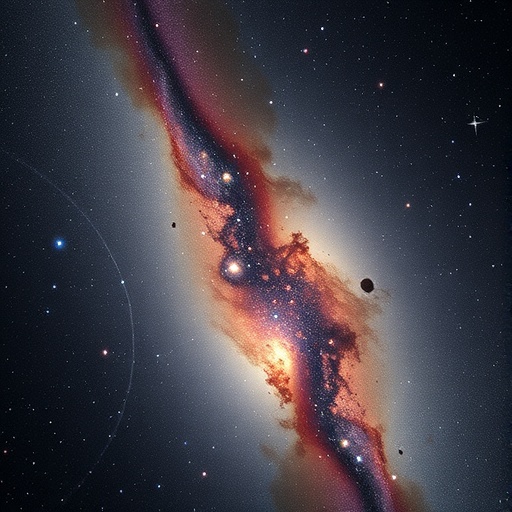
A groundbreaking leap in understanding the formation and evolution of galaxies has been unveiled through the COLIBRE simulations—a suite of high-fidelity cosmological hydrodynamic models that faithfully replicate the universe’s galactic tapestry from its nascent stages to the contemporary cosmic landscape. These simulations, heralded as the most detailed of their kind to date, merge cutting-edge physical modeling with immense computational power, revealing how cold gas and cosmic dust orchestrate the birthing and maturing of galaxies across billions of years.
The strength of COLIBRE lies in its departure from earlier galaxy formation simulations, which largely neglected or oversimplified the cold interstellar medium—the dense, frigid gas clouds and microscopic dust grains critical for star formation. Traditionally, simulations imposed a lower temperature bound of approximately 10,000 degrees Fahrenheit, effectively excluding gas at temperatures where stars actually condense. By integrating the complex physics governing cold gas cooling, molecular hydrogen formation, and dust grain interactions, COLIBRE offers an unprecedentedly authentic depiction of galactic ecosystems that align strikingly well with observational data.
One of the pivotal breakthroughs in COLIBRE is its explicit modeling of cosmic dust grains within galaxies. Dust acts as a multifaceted agent influencing galaxy evolution; by catalyzing molecular hydrogen formation and providing a shield against destructive ultraviolet light, dust facilitates the survival and densification of cold gas essential for star production. Moreover, the dust grains alter the galaxies’ radiative signatures, absorbing ultraviolet and visible light and re-emitting it in the infrared spectrum, thereby significantly shaping the galaxies’ observable characteristics. The inclusion of this dusty component provides astrophysicists with a new lens through which to cross-reference simulations with telescope data, including the stunning, high-resolution infrared observations made possible by the James Webb Space Telescope (JWST).
COLIBRE leverages up to twentyfold more computational elements—resolution elements—that empower it to simulate galaxy formation with finer granularity and over larger cosmological volumes than any predecessor. This advancement not only enriches the statistical robustness of the simulated data but also brings nuance to phenomena such as star formation feedback and black hole-driven outflows, both of which regulate galactic growth and morphology. These feedback mechanisms are crucial: they govern the energy and matter exchanges between stars, black holes, and the surrounding interstellar medium, thereby dictating a galaxy’s evolutionary trajectory.
The simulations have demonstrated remarkable congruence with observed galaxy populations across cosmic time, from the earliest epochs following the Big Bang to the current universally observed galaxy distribution. For instance, the model aligns with the mass and luminosity profiles of galaxies identified by JWST, effectively resolving tensions that previously called the standard cosmological model, ΛCDM, into question. This vindicates the model’s explanatory power when augmented by a realistic treatment of gas cooling, dust, and astrophysical feedback, underscoring the importance of microphysical processes in shaping large-scale cosmic structure.
Nevertheless, some cosmic mysteries remain beyond COLIBRE’s current scope. Notably, the simulated universes do not produce the so-called ‘Little Red Dots’ discovered by JWST—compact, luminous sources speculated to be progenitors of supermassive black holes. Since COLIBRE presumes pre-existing black hole seeds, it does not yet capture the initial formation pathways for these enigmatic objects. Addressing this challenge will require even higher resolution simulations, refined physical models, and perhaps new theoretical paradigms to elucidate the origins of these primordial black hole seeds.
Running the COLIBRE simulations demanded staggering computational resources, utilizing the SWIFT simulation software on the COSMA8 supercomputer at Durham University’s Institute for Computational Cosmology. The largest individual simulation consumed approximately 72 million CPU hours, a testament to the team’s dedication and the multidisciplinary collaboration spanning institutions across Europe, Australia, and the United States. The entire project unfolded over nearly a decade of development, encompassing advances in numerical algorithms, physical modeling, and data analysis techniques.
Beyond the conventional outputs of scientific data sets, the COLIBRE collaboration has innovated new modalities for exploring and interpreting their virtual universes. Sonified videos translate physical properties into auditory signals, providing an alternative sensory dimension to galaxy evolution studies. Interactive maps invite researchers and the public alike to traverse simulated cosmic landscapes, gaining intuitive understanding through dynamic visual and auditory experiences. These tools aim not only to facilitate deeper scientific insights but also to democratize access to cutting-edge astrophysical research by making it more immersive and engaging.
The successful integration of cold gas and dust physics into cosmological simulations in COLIBRE marks a paradigm shift, enabling astrophysicists to generate synthetic universes that are pristine facsimiles of reality in both form and function. As Professor Juan Schaye of Leiden University, the project lead, underscores, representing these critical but previously elusive components brings the simulation’s fidelity to new heights, highlighting that the complex interplay of micro to macro physical processes is vital for an accurate narrative of galaxy evolution.
These simulations provide an enhanced “laboratory” setting where theories of galaxy formation can be rigorously tested and refined. Researchers can produce “virtual observations” from these models to validate and compare with real astronomical datasets, thereby improving the interpretation accuracy of galaxies captured by telescopes. As such, COLIBRE creates vital bridges between theory, computation, and empirical observations, bolstering confidence in the standard cosmological model while equipping astronomers with novel tools to uncover the universe’s secrets.
Carlos Frenk, a leading figure in computational cosmology at Durham University and a key member of COLIBRE, expressed exhilaration at seeing galaxies emerge from computational equations that mirror the multifaceted complexity of those observed in the night sky. This achievement underscores the power of physics-based simulations to recreate the cosmos, affirming that the laws governing the universe can indeed be solved numerically to yield astonishingly lifelike cosmic structures.
The journey of COLIBRE is far from over; many simulations are still running, particularly those demanding the highest resolution, promising even more detailed insights as they conclude. The vast data generated is poised for years of analysis, laying the groundwork for future explorations into unresolved questions, including the early black hole seeds and further refinement of galaxy feedback processes.
Ultimately, the COLIBRE project exemplifies the marriage of sophisticated physics, computational prowess, and creative data visualization, heralding a new era in cosmic simulations. Its comprehensive treatment of cold gas and dust not only authenticates the standard cosmological paradigm but also cements the path forward toward deeper understanding and stunningly realistic explorations of our universe’s evolution.
Subject of Research: Cosmological hydrodynamical simulations of galaxy formation and evolution incorporating cold gas and dust physics.
Article Title: ‘The COLIBRE project: cosmological hydrodynamical simulations of galaxy formation and evolution’
News Publication Date: 13-Apr-2026
Web References:
- Main article DOI: 10.1093/mnras/stag375
- Accompanying paper on subgrid feedback calibration DOI: 10.1093/mnras/stag300
- COLIBRE media resources: sonified videos, interactive sliders, interactive maps
References:
Schaye et al., 2026. ‘The COLIBRE project: cosmological hydrodynamical simulations of galaxy formation and evolution.’ Monthly Notices of the Royal Astronomical Society. DOI: 10.1093/mnras/stag375
Chaikin et al., 2026. ‘COLIBRE: calibrating subgrid feedback in cosmological simulations that include a cold gas phase.’ Monthly Notices of the Royal Astronomical Society. DOI: 10.1093/mnras/stag300
Image Credits: Schaye et al. (2026)
Keywords
COLIBRE, galaxy formation, hydrodynamical simulations, cold gas, cosmic dust, star formation, cosmology, cosmological simulations, James Webb Space Telescope, ΛCDM, computational astrophysics, cosmic dust modeling


