

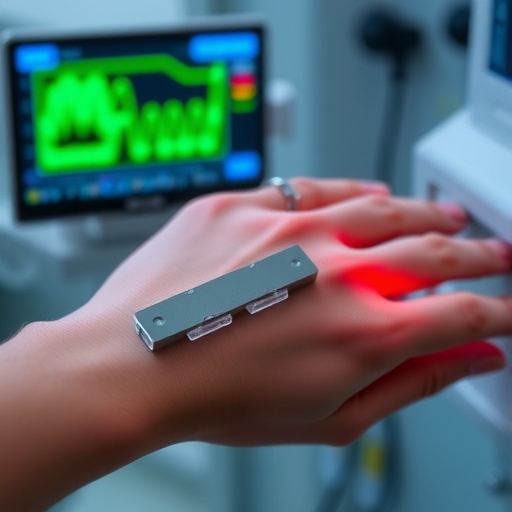
In a groundbreaking development poised to transform the management of vascular access in hemodialysis patients, researchers led by Wang, Y., Wang, J., and Tian, Y. have introduced a wireless, non-invasive, high-resolution thrill sensor. Published in Nature Communications in 2026, this technology heralds a new era of continuous monitoring that could drastically reduce complications associated with hemodialysis, offering a safer and more effective patient experience.
Hemodialysis, a lifesaving treatment for patients with end-stage renal disease, depends heavily on the patency and functionality of vascular access points, typically arteriovenous fistulas or grafts. Despite advances, thrombosis and stenosis remain significant threats, often leading to repeated interventions, hospitalizations, and increased healthcare costs. Traditional monitoring methods commonly require clinical visits and are often intermittent, delaying timely detection of access deterioration. Addressing these challenges head-on, the new thrill sensor system delivers real-time, high-fidelity vascular access surveillance without the need for invasive probes or cumbersome hardware.
At the heart of the technology lies a miniaturized sensor array, engineered with cutting-edge materials science to achieve exceptional sensitivity to the subtle physical vibrations—known as “thrills”—generated by turbulent blood flow within the vascular access. These thrills represent a critical biomarker of both normal and pathological flow states. By capturing these subtle signals wirelessly and continuously, the device enables clinicians to monitor vascular health outside of clinical settings, empowering proactive interventions before catastrophic access failure occurs.
The sensor exploits advanced piezoelectric and piezoresistive composite materials, which convert mechanical stimuli from blood flow-induced vessel wall movements directly into electrical signals. Integrated circuitry processes these signals at high resolution, filtering noise and isolating clinically relevant vibrations. This signal fidelity surpasses that of traditional Doppler ultrasound methods, providing a comprehensive profile of flow dynamics with unprecedented temporal granularity. Importantly, this is achieved without skin penetration or direct vessel contact, dramatically reducing patient discomfort and infection risk.
Incorporating wireless communication protocols consistent with near-field telemetry, the sensor transmits data securely to a portable hub or a patient’s smartphone. This accessibility facilitates remote monitoring and telemedicine consultations, aligning with the broader healthcare trend toward decentralized care models. Furthermore, robust encryption standards ensure patient data privacy and security, addressing a critical concern in medical device technology deployment.
Clinical validation cohorts included dozens of hemodialysis patients followed over multiple months, during which sensor readings were continuously correlated with gold-standard vascular ultrasound and angiographic assessments. Results displayed remarkable concordance, with the sensor detecting early signs of stenosis formation days to weeks before clinical symptoms or standard imaging identified abnormal flow. This temporal advantage is critical for timely clinical responses aiming to preserve access patency.
Beyond hemodialysis, the design principles underpinning the wireless thrill sensor suggest broad applicability across cardiovascular medicine. Continuous monitoring of vessel integrity and flow dynamics can benefit post-operative surveillance of bypass grafts, peripheral artery disease management, and even heart failure patients through the detection of venous congestion changes. Its flexibility and low power requirements support integration into wearable formats, expanding chronic disease management beyond the clinic.
The research team also addressed the critical challenge of power autonomy, employing energy-efficient microelectronics supported by innovative energy harvesting techniques. The device harnesses biomechanical energy from the pulsatile vessel wall motion, supplementing battery life and enabling prolonged operation without frequent recharging. This autonomy is essential for maintaining patient compliance and ensuring uninterrupted data collection in real-world conditions.
Further technical innovation includes an adaptive calibration algorithm that compensates for individual patient anatomical variability and motion artifacts. Utilizing machine learning techniques, the sensor dynamically adjusts its sensitivity parameters, enhancing accuracy in diverse patient populations and varied clinical conditions. This level of customization represents a significant leap in personalized medical device technology.
From a healthcare economics perspective, the implementation of this wireless thrill sensor promises substantial cost savings by reducing hospital admissions related to access failure, lowering intervention rates, and enabling streamlined outpatient management. Early detection and intervention inherently reduce complications, translating into improved patient quality of life and decreased burden on healthcare systems worldwide.
Regulatory considerations have been proactively addressed, with the device already initiating pivotal clinical trials under international standards. Preliminary feedback from regulatory bodies underscores the potential for fast-tracking approval pathways given the compelling clinical need and the sensor’s risk mitigation profile relative to existing invasive procedures.
In summary, this wireless, non-invasive, high-resolution thrill sensor stands at the convergence of material science, biomedical engineering, and clinical nephrology, epitomizing the future of patient-centric monitoring. By seamlessly integrating into daily life and healthcare workflows, it empowers patients and clinicians to maintain vascular access health proactively and efficiently, reducing complications and enhancing therapeutic outcomes.
As healthcare increasingly embraces digital transformation and personalized medicine, innovations such as this thrill sensor embody the transformative power of technology to solve complex clinical challenges. The ongoing research and development inspired by this breakthrough will undoubtedly catalyze further advances across multiple medical disciplines, underscoring a decisive step forward in chronic disease management.
This achievement is a testament to interdisciplinary collaboration, fusing expertise from engineering, material science, data analytics, and clinical nephrology—a model for future biomedical breakthroughs. It promises to shift the paradigm from reactive to predictive care, where continuous, high-resolution biosensing redefines what is possible in patient monitoring.
The advent of this wireless thrill sensor reflects a broader trend toward non-invasive, continuous monitoring devices that prioritize patient comfort without compromising diagnostic precision. As more such technologies enter clinical practice, they will collectively enhance the ability to manage chronic conditions in real time, improving outcomes and reducing healthcare disparities worldwide.
Ultimately, the full impact of this innovation will unfold as adoption expands and data accrues from diverse populations, cementing its role in improving hemodialysis care and potentially revolutionizing vascular health monitoring globally. The scientific community eagerly anticipates ongoing results from larger trials and real-world implementations that will define its long-term clinical impact.
Subject of Research: Continuous vascular access monitoring in hemodialysis patients using a wireless, non-invasive thrill sensor.
Article Title: Wireless, non-invasive, high-resolution thrill sensor for continuous vascular access monitoring of hemodialysis patients.
Article References:
Wang, Y., Wang, J., Tian, Y. et al. Wireless, non-invasive, high-resolution thrill sensor for continuous vascular access monitoring of hemodialysis patients. Nat Commun (2026). https://doi.org/10.1038/s41467-026-70687-7
Image Credits: AI Generated


