

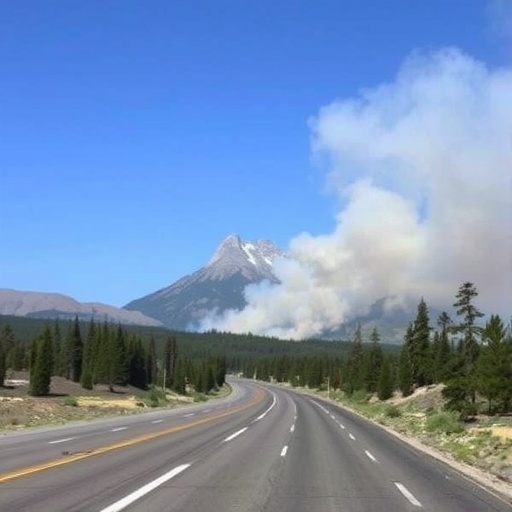
In recent years, the escalating frequency and severity of wildfires worldwide have sparked mounting concerns about their impact not only on the environment but also on human health. While the physical consequences of wildfire smoke exposure have been extensively studied, a groundbreaking international study reveals that the mental health of children and adolescents is profoundly affected by exposure to wildfire-specific fine particulate matter (PM₂.₅). This research offers the first comprehensive examination of the associations between wildfire-sourced PM₂.₅ and emergency department (ED) visits for mental health disorders among individuals aged 19 years and under across three diverse countries—Australia, Brazil, and Canada—over a 15-year period.
Wildfire smoke is a complex mixture of gases and particles, with fine particulate matter (PM₂.₅) being particularly harmful due to its ability to penetrate deep into the lungs and even enter the bloodstream. Of note, particulate matter emanating specifically from wildfires contains a higher concentration of toxic components compared to PM₂.₅ from other sources such as traffic or industrial emissions. This increased toxicity arises from the combustion of organic materials like vegetation, which releases polycyclic aromatic hydrocarbons (PAHs), heavy metals, and other reactive compounds that can induce oxidative stress and inflammation upon inhalation.
This extensive multinational study evaluated daily PM₂.₅ levels derived from wildfire emissions, distinguishing it from background non-wildfire PM₂.₅, and correlated these environmental data with healthcare utilization records pertaining to mental health-related ED visits in 845 communities across the three countries. A robust and statistically significant association was found: for every 1 microgram per cubic meter (µg/m³) increase in daily wildfire-specific PM₂.₅, there was an average increase of 1.4% in ED visits for child and adolescent mental health disorders, appearing approximately six days after exposure. This lag suggests a temporal relationship indicative of causality rather than mere coincidence.
Digging deeper into the data, the researchers identified that certain mental health conditions displayed heightened sensitivity to wildfire smoke exposure. Schizophrenia, a severe and chronic mental disorder characterized by psychosis and cognitive disturbances, exhibited stronger associations compared to other disorders. Additionally, disorders relating to substance abuse, bipolar affective disorder, depression, and anxiety were disproportionately affected, highlighting not only the immediate but potentially chronic effects of environmental stressors linked to wildfire smoke.
Interestingly, demographic and socioeconomic factors modulated the observed effects. Boys demonstrated a greater vulnerability than girls to wildfire PM₂.₅ exposure. Furthermore, children under the age of five appeared particularly susceptible, raising alarms about the developmental consequences of early-life exposure to toxic airborne particles. The findings also indicated that children residing in low-income or highly urbanized communities experienced amplified mental health risks. Urban settings, with their higher baseline pollution, may compound the toxic effects of wildfire smoke. Similarly, communities with elevated levels of non-wildfire PM₂.₅ exposure also experienced intensified effects, suggesting an additive or even synergistic impact on mental health outcomes.
Geographically, Brazil emerged as the region with some of the most pronounced associations between wildfire PM₂.₅ and pediatric mental health disorders. This could be attributable to the vast Amazon rainforest fires, whose smoke plumes frequently blanket large population centers, combined with underlying vulnerabilities such as healthcare resource limitations and social inequalities. Canada and Australia, with their own wildfire-prone zones, also manifested significant associations, underscoring the global nature of this emergent public health crisis.
Beyond elucidating associations, the researchers quantified the public health burden attributable to wildfire-specific fine particulate matter. They estimated that annually, wildfire PM₂.₅ exposure was responsible for approximately 22,459 ED visits related to mental health disorders among children and adolescents in the studied countries. This staggering figure highlights an overlooked dimension of wildfire consequences, expanding the narrative from respiratory and cardiovascular implications to encompass profound neuropsychiatric effects.
From a mechanistic perspective, the study offers important insights into how wildfire PM₂.₅ might influence mental health. Fine particulates inhaled into the lungs can initiate systemic inflammatory responses that propagate to the central nervous system, potentially disrupting neurotransmitter systems and brain signaling pathways. Oxidative stress induced by the toxic cocktail of chemicals in wildfire smoke may also impair neurodevelopment, especially in young children whose brains remain highly plastic. This inflammation and neurotoxicity could exacerbate pre-existing mental health conditions or precipitate new-onset disorders.
The lag of six days between exposure and increased mental health-related ED visits prompts further inquiry into the temporal dynamics and progression of symptoms following wildfire smoke exposure. This delay likely represents the time required for inflammatory and neurochemical cascades to manifest clinically observable changes compelling enough for emergency consultation. It also suggests a therapeutic window where early interventions could potentially mitigate the worsening of symptoms if identified promptly.
The socio-environmental disparities revealed by the study call for targeted public health policies and resource allocation. Vulnerable communities, characterized by lower socioeconomic status or residing in urbanized regions with elevated background pollution, require particular attention to shield children from the compounded effects of wildfire smoke. Protective measures might include improving air filtration in schools and homes, issuing timely health advisories during wildfire events, and enhancing mental health support services during and after wildfire seasons.
Moreover, the differential susceptibility of mental health conditions to wildfire PM₂.₅ exposure underscores the need for clinicians to be vigilant in assessing environmental factors as contributory or exacerbating elements in pediatric psychiatric presentations. Awareness campaigns and training modules for healthcare providers could augment early detection and intervention strategies tailored to at-risk populations during wildfire episodes.
As climate change continues to intensify wildfire frequency and magnitude, the mental health ramifications illustrated by this research portend an escalating challenge for global healthcare systems. The cumulative, chronic effects of repeated exposures may fuel increasing rates of mental disorders in younger populations, with lifelong consequences for affected individuals and substantial societal costs. This study represents a clarion call for integrating environmental health considerations into mental health frameworks and emphasizes the urgency of mitigating wildfire emissions.
Finally, these findings inspire a multidisciplinary approach harnessing atmospheric science, epidemiology, mental health, and social policy to confront what has become a complex environmental and public health nexus. Future research should explore longitudinal impacts, identify biological markers of exposure and susceptibility, and develop community-level interventions to reduce the mental health burden of wildfire PM₂.₅. Continued surveillance and international collaboration will be pivotal in devising effective strategies to safeguard the well-being of children worldwide amid the growing threat of wildfires.
In conclusion, the work by Zhang et al. constitutes a seminal contribution to understanding the underappreciated mental health consequences of wildfire-associated fine particulate matter exposure in children and adolescents. It unequivocally establishes that beyond the well-documented respiratory hazards, wildfire smoke carries a tangible risk to young individuals’ neuropsychiatric health. Policymakers, healthcare providers, and communities alike must heed these findings and implement measures to protect vulnerable populations as wildfires increasingly become a global environmental challenge.
Subject of Research:
The study investigates the impact of wildfire-specific fine particulate matter (PM₂.₅) on mental health disorders among children and adolescents (≤19 years), analyzing emergency department visits related to these conditions in Australia, Brazil, and Canada during 2004–2019.
Article Title:
Wildfire-sourced fine particulate matter and mental disorders in children and adolescents.
Article References:
Zhang, Y., Zhou, S., Xu, R. et al. Wildfire-sourced fine particulate matter and mental disorders in children and adolescents. Nat. Mental Health (2026). https://doi.org/10.1038/s44220-025-00571-8
Image Credits:
AI Generated


