

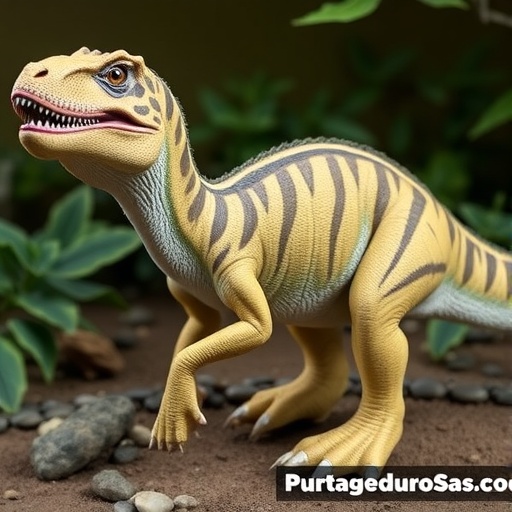
In a groundbreaking study published recently in SCIENCE CHINA Earth Sciences, a collaborative effort by the Dinosaur Evolution Research Center of Jilin University and the University of Toronto Mississauga has unveiled new insights into the life history and feeding behavior of the Early Cretaceous dinosaur genus Psittacosaurus. This research, centered on the analysis of juvenile fossils discovered within a single nest, offers unprecedented detail on the ontogenetic dietary habits of these ancient herbivores, challenging long-held assumptions about their developmental ecology.
Psittacosaurus, a genus of ceratopsian dinosaurs first identified over a century ago in Mongolia, has long intrigued paleontologists due to its relatively abundant fossil record and well-preserved specimens. To date, paleontologists recognize at least 12 valid species within this genus, characterized by their beak-like jaws and herbivorous diets. The genus has served as a valuable model for studying dinosaur ontogeny, evolution, and paleoecology, given the rich diversity of fossils representing various growth stages from hatchlings to fully mature adults.
The recent discovery of 13 juvenile Psittacosaurus fossils within a single nest provides an extraordinarily rare window into the earliest stages of ceratopsian life. These specimens, all under one year old, were meticulously analyzed using advanced paleontological and lithological methods to investigate their feeding strategies. A remarkable and previously underappreciated aspect of their biology was revealed: these juveniles ingested gastroliths—small stones that aid in the mechanical breakdown of tough plant material within the digestive system.
Gastroliths are known in many modern herbivores, such as birds and crocodilians, as an adaptive mechanism to compensate for the lack of suitable chewing apparatus. The presence of gastroliths in juvenile Psittacosaurus fossils implies that even at a very young age, these animals employed a similar physiological strategy to facilitate digestion. This finding confronts earlier hypotheses that suggested juveniles relied solely on softer, more easily digestible vegetation and lacked the digestive adaptations seen in adults.
Lithological analysis of the gastroliths was performed to ascertain their provenance, confirming that the stones were locally sourced from the western Liaoning region, where the fossils were discovered. This evidence indicates a highly localized range for these juveniles during their earliest life stages. The absence of signs for long-distance migration suggests these dinosaurs had a stable and regionally confined territory, which has broad implications for understanding their life history strategies and habitat preferences.
This research further reveals that the feeding strategy of Psittacosaurus was surprisingly consistent throughout its life cycle. Contrary to the notion that juveniles and adults might employ distinct dietary adaptations at different growth stages, the utilization of gastroliths from infancy points to an evolutionary stable feeding behavior pattern. This stability is crucial for reconstructing the ecological niches occupied by early ceratopsians and assessing how these roles evolved over time.
The study leveraged high-resolution imaging techniques alongside sedimentological and mineralogical analyses to dissect the fossilized remains meticulously. Such interdisciplinary methodologies not only enhance the precision of dietary reconstructions but also enable researchers to contextualize the gastroliths within the broader paleoenvironmental framework, highlighting the dynamic interactions between Psittacosaurus and its habitat.
These findings also open new avenues for comparative research into the digestive adaptations of other ornithischian dinosaurs and early herbivorous reptiles. By establishing a well-documented case of juvenile gastrolith ingestion, paleontologists can better explore the evolutionary pressures that shaped digestive efficiency and foraging behavior among diverse Mesozoic herbivores.
Moreover, the research underscores the importance of juvenile specimens in paleobiological studies. Juveniles, often underrepresented in fossil collections, carry critical information about developmental stages and life history strategies that can dramatically reshape our understanding of extinct species. This nest’s exceptional fossil preservation offers a snapshot of Psittacosaurus family life and feeding ecology that is rarely accessible in the fossil record.
Beyond feeding behavior, this study’s data hint at social or nesting behaviors in Psittacosaurus populations, as the clustering of multiple juveniles in a single nest site suggests some degree of parental care or post-hatching group cohesion. These behaviors add complexity to the dinosaur’s life history and might have contributed to their evolutionary success in Early Cretaceous ecosystems.
The joint research team’s integrative approach—combining paleontological excavation, developmental morphology, and geochemical analysis—sets a benchmark for future studies aiming to unravel the intricate life cycles of extinct species. Their work enriches the broader scientific discourse on dinosaur ecology, evolution, and their adaptive responses to paleoenvironmental challenges.
In essence, the new evidence refines the narrative of Psittacosaurus‘s life, illustrating a dinosaur genus that possessed sophisticated physiological and ecological strategies beginning from their earliest days. The recognition that juvenile Psittacosaurus engaged in gastrolith ingestion invites a reevaluation of how early ceratopsians navigated their environment and processed food, adding a significant chapter to the story of dinosaur evolution.
The implications of this research extend to understanding the paleoecological evolution of early ceratopsians as a whole, providing a comparative framework for future fossil discoveries and theoretical models that seek to decode the ancient past with ever-increasing resolution. As paleontology continues to embrace multidisciplinary collaboration, studies like this illuminate the intricate tapestry of life that once flourished hundreds of millions of years ago.
Subject of Research: Early developmental feeding behavior and paleoecology of Psittacosaurus using juvenile fossils with gastrolith analysis.
Article Title: Juvenile Psittacosaurus fossils reveal early gastrolith ingestion and stable feeding strategies in ceratopsians.
News Publication Date: Not specified.
Web References: Not provided.
References: Published research in SCIENCE CHINA Earth Sciences.
Image Credits: Courtesy of the Dinosaur Evolution Research Center of Jilin University and the University of Toronto Mississauga.
Keywords: Psittacosaurus, Early Cretaceous, juvenile dinosaurs, gastroliths, feeding behavior, ceratopsians, paleoecology, lithological analysis, dinosaur ontogeny, paleontological discovery.


