

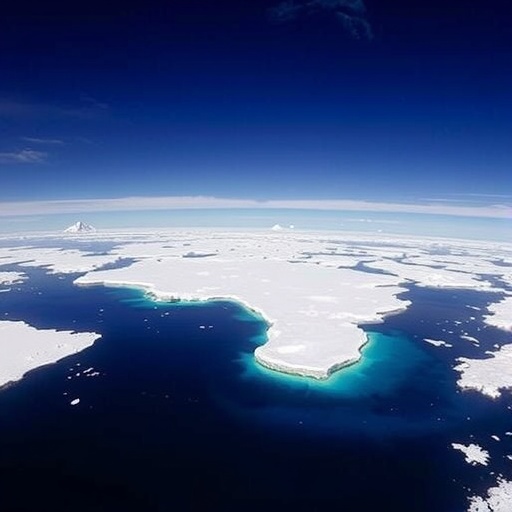
In the remote abyssal depths of the South Pacific, just south of the Antarctic Polar Front (APF), an extraordinary paleoclimate archive has unveiled remarkable insights into the intricate interplay between ocean carbon uptake and glacial ice sheet dynamics. Sediment cores recovered from a staggering depth of nearly 5,000 meters provide a compelling narrative of the carbon cycle shaped by the waxing and waning of the West Antarctic Ice Sheet over hundreds of thousands of years.
These sediment cores, designated PS58/270-1 and PS58/270-5, were extracted during the 2001 expedition of the research vessel Polarstern. The study site is distinguished by the absence of calcium carbonate due to its location beneath the carbonate compensation depth, eliminating complexities related to carbonate dissolution and providing a pure window into lithogenic and biogenic sediment components. The unique conditions here allow for a pristine record of sediment flux, mineralogical composition, and biogeochemical tracers, critical for reconstructing past ocean productivity and climate variability.
Advanced geochemical analyses employed at the Alfred Wegener Institute and Lamont-Doherty Earth Observatory have revealed the sediment’s comprehensive compositional fingerprint. The total organic carbon content, while low, remains consistent across the core, confirming minimal diagenetic alteration. Lithogenic components, traced through refractory elements such as thorium isotopes, establish a baseline for terrestrial input. This is complemented by opal and biogenic barium, proxies emblematic of export production, presenting a robust multifaceted view of past biological carbon cycling in this pivotal Southern Ocean region.
Central to the study’s high-resolution chronological framework are multifarious stratigraphic tie points, including diatom bloom markers and temperature reconstructions, meticulously correlated with established Antarctic ice core temperature proxies. This synchronization anchors the sedimentary record to a well-constrained temporal axis extending back approximately 400,000 years. This chronological precision underpins interpretations of sediment flux variability and paleoceanographic shifts in relation to glacial-interglacial cycles.
The application of uranium-thorium disequilibrium techniques stands as a cornerstone of this investigation, providing refined mass accumulation rates (MARs) through normalization to excess ^230Th activity in the sediment. This method circumvents confounding sediment focusing and redistribution effects traditionally encountered in sedimentation rate estimations, yielding unprecedented accuracy in quantifying sediment and trace element fluxes over glacial-interglacial timescales.
Complementary to uranium-thorium dating, excess ^210Pb measurements performed on the upper sections of the sediment sequence permit robust constraints on recent sedimentation rates, essential for anchoring the younger end of the chronology. These data verify sediment accumulation dynamics proximal to the present epoch, affirming the consistency and reliability of the integrated multi-proxy age model.
Detailed elemental analyses extend beyond dating, highlighting compositional fluctuations indicative of changing sediment provenance and weathering regimes. Ratios involving more soluble major elements such as potassium, calcium, magnesium, and strontium relative to refractory elements disclose shifts in mineralogical maturity and alteration processes. Such insights are crucial for deciphering the terrestrial and oceanic factors influencing sediment supply and composition.
The striking dominance of opal in the sediment (~30–90%) underscores the Southern Ocean’s prodigious diatom productivity during varied climatic intervals. This siliceous biogenic sedimentation, tightly coupled with export production proxies like non-lithogenic barium excess, forms the biogeochemical backbone of past carbon export reconstructions. Strong positive correlations among these proxies enforce their utility in depicting historic primary productivity pulses and carbon sequestration efficiency.
Throughout the depositional record, lithogenic fluxes remain a sensitive indicator of dust input and terrestrial erosion associated with ice sheet dynamics. By normalizing lithogenic particle fluxes with ^230Th_xs activity, the study disentangles local sediment focusing from true sediment supply changes, enabling a refined narrative of dust delivery modulated by glacial retreat and advance.
A pivotal aspect of the research is the demonstration that export production variations, as reconstructed from sediment proxies, are closely tied to West Antarctic Ice Sheet dynamics. This finding has profound implications on understanding the Southern Ocean’s role as a carbon sink during glacial periods, with ice sheet fluctuations modulating nutrient supply and biological productivity, hence influencing atmospheric CO_2 concentrations on millennial timescales.
The sedimentary archives’ multiproxy dataset demonstrates stability and coherence over long temporal scales, strengthening confidence in the interpretations. The congruence between independently derived age models, including ^230Th_xs normalization and diatom stratigraphy tuned to Antarctic temperature and dust records, testifies to the robustness of the paleorecord and the rigor of the analytical methodology.
Moreover, the exclusion of confounding factors such as hydrothermal and boundary scavenging effects ensures that the ^230Th-based sediment flux reconstructions reflect authentic depositional histories rather than ocean basin processes. The remote abyssal setting of the core site mitigates nepheloid layer disturbances, further attesting to the sediment record’s pristine nature.
These findings elucidate the profound feedback mechanisms coupling ice sheet evolution, ocean circulation, and carbon cycling in the high-latitude Southern Ocean. They emphasize the sensitivity of this vast oceanic carbon reservoir to cryospheric processes, offering critical empirical constraints for predictive models of future climate-carbon system responses.
Future investigations will likely build on this foundation, extending sediment core analysis to encompass complementary isotopic systems and expanding spatial coverage across the Southern Ocean to unravel the complexities of Southern Hemisphere paleoclimate drivers more comprehensively. Such work is vital for advancing our understanding of Earth’s natural climate variability in the context of ongoing anthropogenic change.
The meticulous integration of sedimentological, geochemical, and geochronological datasets presented here stands as a paradigm for paleoclimatic research, exemplifying how state-of-the-art analytical techniques can unlock Earth’s archival secrets from the ocean abyss. As glaciologists, oceanographers, and climate scientists converge, this work embodies the interdisciplinary spirit required to tackle the grand challenges posed by global climate science.
In sum, the sedimentary record from the South Pacific abyss encapsulates an eloquent testimony of the West Antarctic Ice Sheet’s commanding influence over carbon export dynamics, revealing the ocean’s dynamic response to shifting cryospheric boundaries. This research advances both the methodology and understanding of past climate-ocean interactions, spotlighting the Southern Ocean’s pivotal role in Earth’s carbon budget over glacial cycles.
Subject of Research:
Paleoceanography and sedimentary geochemistry revealing the influence of West Antarctic Ice Sheet dynamics on South Pacific carbon export and sediment fluxes.
Article Title:
South Pacific carbon uptake controlled by West Antarctic Ice Sheet dynamics
Article References:
Struve, T., Lamy, F., Gäng, F. et al. South Pacific carbon uptake controlled by West Antarctic Ice Sheet dynamics. Nat. Geosci. (2026). https://doi.org/10.1038/s41561-025-01911-0
Image Credits:
AI Generated


