
Saturday, February 7, 2026
Science
No Result
View All Result
  • Login
  • HOME
  • SCIENCE NEWS
  • CONTACT US
  • HOME
  • SCIENCE NEWS
  • CONTACT US
No Result
View All Result
Scienmag
No Result
View All Result
Home Science News Cancer

Welch Foundation supports UTA’s drug delivery innovations

July 2, 2024
in Cancer
Reading Time: 2 mins read
0
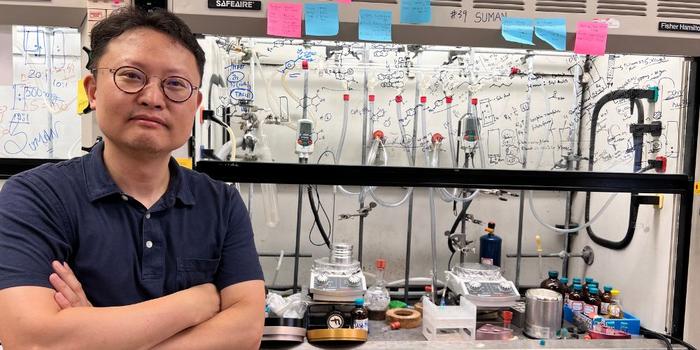
Junha Jeon, associate professor of chemistry and biochemistry at UT Arlington
66
SHARES
599
VIEWS
Share on FacebookShare on Twitter
ADVERTISEMENT

With a $300,000 grant, the Welch Foundation is supporting University of Texas at Arlington research into creating new materials to safely and effectively deliver medications to treat diseases such as cancer.

Junha Jeon, associate professor of chemistry and biochemistry at UT Arlington

Credit: Courtesy UT Arlington

With a $300,000 grant, the Welch Foundation is supporting University of Texas at Arlington research into creating new materials to safely and effectively deliver medications to treat diseases such as cancer.

Since its founding in 1954, the Houston-based Welch Foundation has contributed over $1.1 billion to the advancement of chemistry through research grants, departmental programs, endowed chairs and other special projects in Texas.

“As one of the nation’s largest private funding sources for chemical research, we are committed to supporting the field in a way that advances science while changing lives,” said Adam Kuspa, president of the foundation. “Medications can only be so effective at treating diseases if we can’t get them to the parts of the body that need them most. I look forward to seeing how Dr. Junha Jeon’s research can help advance and improve drug production so we can improve lives.”

Junha Jeon, associate professor of chemistry and biochemistry at UTA, is leading the project to study “arynes,” a chemical compound formed by removing two hydrogen atoms from benzene. Although scientists have known about arynes for more than 100 years, they only recently discovered that the compounds have a unique ability to deliver antibiotics and anti-tumor medications.

“I’m honored that the Welch Foundation sees the value in supporting our research,” Dr. Jeon said. “Worldwide, an estimated 2 million people are diagnosed with cancer each year, and about one in five people will develop cancer at some time during their lifetime. I’m proud we can research new ways to improve outcomes for people living with cancer and other diseases.”

The transition metal-catalyzed cross-coupling reaction is one of the most widely used and powerful tools in organic synthesis—the art and science of reconstructing substances in the lab. This technique is extensively used to establish crucial chemical bonds and produce biomedical molecules necessary in modern medicine. Currently, most drugs use transition metal catalysts to deliver medications. However, metals often leave impurities that can lead to side effects from otherwise beneficial medications.

Little is known about widely available transition metal-free cross-coupling, especially one that can be used to deliver medicines. The overarching goal of this project is to develop sustainable transition metal-free cross-coupling technologies using arynes. Chemically speaking, arynes are short-lived intermediates holding a functional group with an extremely strained triple bond into a small ring. The strain-driven reactivity of the arynes makes them very useful for the development of cross-coupling reactions.

“Uncovering this new sustainable aryne-forming strategy without using a transition metal catalyst will be valuable for various areas of research, including the production of drugs,” said Jeon. “I’m grateful to the support of the Welch Foundation for our research project.”



Share26Tweet17
Previous Post

Scientists develop silver nanoparticle sensor to detect genes causing hearing loss

Next Post

New MSU study finds systematic biases at play in clinical trials

Related Posts

blank
Cancer

Deep Learning Uncovers Tetrahydrocarbazoles as Potent Broad-Spectrum Antitumor Agents with Click-Activated Targeted Cancer Therapy Approach

February 7, 2026
blank
Cancer

Newly Discovered Limonoid DHL-11 from Munronia henryi Targets IMPDH2 to Combat Triple-Negative Breast Cancer

February 7, 2026
blank
Cancer

New Discovery Reveals Why Ovarian Cancer Spreads Rapidly in the Abdomen

February 6, 2026
blank
Cancer

New Study Finds Americans Favor In-Clinic Screening Over At-Home Tests for Cervical Cancer

February 6, 2026
blank
Cancer

Dual-Action Molecule Targets Tumor Cells to Enable Higher-Dose Cancer Therapy

February 6, 2026
blank
Cancer

Scientists Uncover How ABCA1 Protein Lifts Molecular Brakes to Boost Solid Tumor Immunotherapy

February 6, 2026
Next Post
New MSU study finds systematic biases at play in clinical trials

New MSU study finds systematic biases at play in clinical trials

  • Mothers who receive childcare support from maternal grandparents show more parental warmth, finds NTU Singapore study

    Mothers who receive childcare support from maternal grandparents show more parental warmth, finds NTU Singapore study

    27610 shares
    Share 11040 Tweet 6900
  • University of Seville Breaks 120-Year-Old Mystery, Revises a Key Einstein Concept

    1017 shares
    Share 407 Tweet 254
  • Bee body mass, pathogens and local climate influence heat tolerance

    662 shares
    Share 265 Tweet 166
  • Researchers record first-ever images and data of a shark experiencing a boat strike

    529 shares
    Share 212 Tweet 132
  • Groundbreaking Clinical Trial Reveals Lubiprostone Enhances Kidney Function

    515 shares
    Share 206 Tweet 129
Science

Embark on a thrilling journey of discovery with Scienmag.com—your ultimate source for cutting-edge breakthroughs. Immerse yourself in a world where curiosity knows no limits and tomorrow’s possibilities become today’s reality!

RECENT NEWS

  • Improving Dementia Care with Enhanced Activity Kits
  • TPMT Expression Predictions Linked to Azathioprine Side Effects
  • Evaluating Pediatric Emergency Care Quality in Ethiopia
  • Post-Stress Corticosterone Impacts Hippocampal Excitability via HCN1

Categories

  • Agriculture
  • Anthropology
  • Archaeology
  • Athmospheric
  • Biology
  • Biotechnology
  • Blog
  • Bussines
  • Cancer
  • Chemistry
  • Climate
  • Earth Science
  • Editorial Policy
  • Marine
  • Mathematics
  • Medicine
  • Pediatry
  • Policy
  • Psychology & Psychiatry
  • Science Education
  • Social Science
  • Space
  • Technology and Engineering

Subscribe to Blog via Email

Enter your email address to subscribe to this blog and receive notifications of new posts by email.

Join 5,190 other subscribers

© 2025 Scienmag - Science Magazine

Welcome Back!

Login to your account below

Forgotten Password?

Retrieve your password

Please enter your username or email address to reset your password.

Log In
No Result
View All Result
  • HOME
  • SCIENCE NEWS
  • CONTACT US

© 2025 Scienmag - Science Magazine

Discover more from Science

Subscribe now to keep reading and get access to the full archive.

Continue reading