

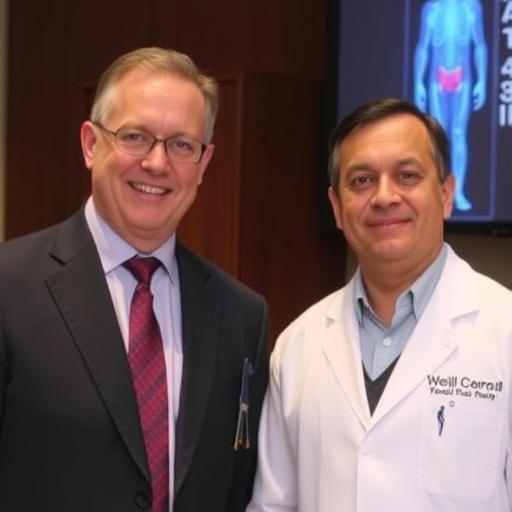
Dr. Ekta Khurana, an associate professor specializing in systems and computational biomedicine at Weill Cornell Medicine, has recently been awarded a prestigious two-year $1 million Challenge Award from the Prostate Cancer Foundation. This funding is earmarked for pioneering research aimed at developing an innovative artificial intelligence (AI)-based approach capable of early detection of treatment-resistant prostate tumor subtypes. The collaborative endeavor includes esteemed colleagues from Weill Cornell Medicine and Memorial Sloan Kettering Cancer Center, bringing together a multidisciplinary team with expertise spanning pathology, genomics, computational biology, and AI.
The Prostate Cancer Foundation Challenge Awards are specifically designed to provide financial support to bold, cross-disciplinary research efforts that otherwise might struggle to secure funding. Dr. Khurana’s team, which notably includes Dr. Iman Hajirasouliha—associate professor at Weill Cornell Medicine—and physician-scientist Dr. Yu Chen alongside pathologist Dr. Anuradha Gopalan from Memorial Sloan Kettering Cancer Center, exemplifies the power of integrating diverse scientific disciplines to tackle complex biomedical challenges. Their joint mission focuses on leveraging advanced computational methodologies to combat the growing challenge of treatment-resistant prostate cancer.
Prostate cancer remains one of the most commonly diagnosed malignancies among men in the United States, with approximately 300,000 new cases identified annually. The lifetime risk of developing this disease stands at nearly 12%. Tradition dictates that prostate tumor proliferation is largely driven by androgen receptor signaling pathways, which can be disrupted therapeutically through androgen deprivation therapy or direct androgen receptor inhibitors. Despite the initial efficacy of such treatments, a significant subset of tumors evolve into aggressive subtypes that bypass these signaling dependencies, resulting in treatment resistance. Unfortunately, current clinical diagnostic tools lack the precision necessary to detect these resistant tumor phenotypes during their early emergence.
Building on foundational work that identified key treatment-resistant prostate tumor subtypes, Dr. Khurana and her collaborators aim to address this critical diagnostic gap through AI-driven innovation. Their strategy centers on training machine learning models using extensive datasets comprising digitized pathology slides, tumor gene expression profiles, and associated clinical treatment outcomes. By assimilating these multidimensional data, the AI system aspires to classify individual tumors accurately, revealing their subtype composition and predicting therapeutic responsiveness before conventional methods would allow.
The technical challenge lies in designing algorithms that not only achieve high sensitivity—minimizing false negatives—but also maintain specificity to avoid false positives, thereby ensuring clinical reliability. The trained models must interpret complex histopathological features, integrate transcriptomic signatures, and correlate these with treatment trajectories to generate predictive insights. Such a sophisticated AI platform could revolutionize patient stratification, enabling clinicians to identify candidates for experimental therapies tailored to resistant subtypes and simultaneously avoid ineffective standard treatments.
If successful, the AI classifiers developed through this project will fill a significant unmet need in urologic oncology by enabling early, non-invasive detection of tumor heterogeneity and adaptive resistance mechanisms. This capability has profound implications for personalized medicine, allowing therapeutic interventions to be precisely targeted at subpopulations of cancer cells poised to evade current treatments. This would herald a shift from a one-size-fits-all approach toward highly customized clinical management in prostate cancer care.
Looking beyond algorithm development, Dr. Khurana’s team plans to advance the AI model toward clinical validation via prospective trials. This stage will test the practical application of their technology in real-world diagnostic workflows, evaluating performance in diverse patient cohorts to ensure robustness and reproducibility at scale. Successful translation from computational model to bedside tool could accelerate drug development by refining patient selection for clinical trials of novel therapeutics.
This research initiative exemplifies the convergence of cutting-edge computational science and clinical oncology, illustrating how data-driven AI tools can empower clinicians with unprecedented diagnostic precision. The integration of pathology imaging, genomics, and AI encapsulates a modern multidisciplinary approach crucial for overcoming the biological complexity inherent in prostate cancer progression and drug resistance.
In summary, Dr. Ekta Khurana’s groundbreaking project, supported by the Prostate Cancer Foundation’s substantial award, promises to transform the landscape of prostate cancer diagnosis and treatment. By harnessing artificial intelligence to detect treatment-resistant tumor subtypes early, this work could significantly improve clinical outcomes for thousands of men facing advanced prostate malignancies. The collaborative effort from leading institutions underscores a new era where computational innovation and biomedical expertise unite to tackle some of the most formidable challenges in cancer care.
Subject of Research: Prostate cancer; AI-based early detection of treatment-resistant tumor subtypes
Article Title: AI-Powered Early Detection of Treatment-Resistant Prostate Tumors: A Paradigm Shift in Cancer Care
News Publication Date: Not specified
Web References:
- Prostate Cancer Foundation
- Weill Cornell Medicine – Dr. Ekta Khurana
- Weill Cornell Medicine – Dr. Iman Hajirasouliha
- Memorial Sloan Kettering Research – Dr. Yu Chen
- Memorial Sloan Kettering – Dr. Anuradha Gopalan
Image Credits: Weill Cornell Medicine
Keywords: Prostate cancer, Prostate tumors, Artificial intelligence, Treatment resistance, Computational biomedicine, Machine learning, Pathology, Genomics, Clinical trials


