

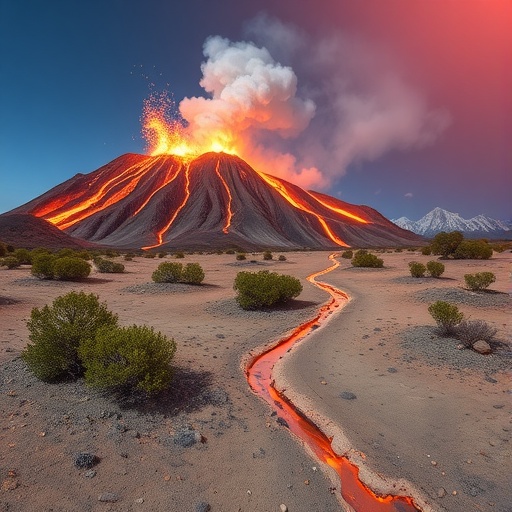
The recent publication by Saman, Roshan, Grab, and colleagues has unveiled groundbreaking insights into the complex interplay between volcanic eruptions and climate dynamics in semi-arid regions. Utilizing advanced machine learning techniques coupled with the comprehensive climate projections of CMIP6, their study focuses on the volcanic influences of two iconic eruptions: Krakatau and Santa Maria. This research marks a significant leap forward in understanding how volcanic activity can shape regional climate patterns, particularly in areas where water scarcity and fragile ecosystems are already pressing concerns.
Volcanic eruptions are known to inject vast quantities of aerosols and gases into the atmosphere, which can profoundly affect global and regional weather systems. Historically, large volcanic events have been linked to temporary climate cooling and disruptions in rainfall patterns. Yet, the specific impacts on semi-arid climates—regions characterized by limited precipitation and high variability—have remained ambiguous due to the scarcity of focused studies and the complexity of isolating volcanic signals from other climatic influences. The new study elegantly addresses this gap, offering an unprecedented multidimensional analysis that integrates observed data, climate model simulations, and state-of-the-art artificial intelligence.
Central to the investigation is the application of machine learning algorithms that sift through vast datasets to detect subtle patterns and anomalies associated with volcanic activity. These computational methods enable researchers to differentiate between natural variability and volcanic-forced changes in climate indicators such as temperature, precipitation, humidity, and atmospheric circulation. Importantly, the study employs CMIP6 models, representing the latest generation of climate projections that incorporate improved physical processes and aerosol-cloud interactions, thereby enhancing the reliability of simulations in capturing volcanic phenomena.
The choice of Krakatau and Santa Maria as case studies is particularly illuminating. Both volcanoes have distinct eruption characteristics and occurred in regions with complex climate regimes. Krakatau’s catastrophic 1883 eruption in Indonesia had a profound global impact, famously cooling temperatures worldwide. Santa Maria’s 1902 eruption in Guatemala, meanwhile, affected a semi-arid landscape with vulnerable agricultural systems. By analyzing these events, the team was able to unravel localized climate responses and their underlying mechanisms, offering valuable lessons for future risk assessments.
One of the pivotal findings of the study is the identification of pronounced alterations in precipitation patterns following eruptions. The researchers demonstrate that volcanic aerosols can suppress convective rainfall in semi-arid zones, exacerbating drought conditions for several years post-eruption. This effect is intricately linked to changes in atmospheric circulation induced by volcanic cooling, which modulates the distribution and intensity of moisture transport. These insights challenge previous assumptions that volcanic impacts on precipitation are predominantly uniform or short-lived, highlighting instead a nuanced temporal evolution.
Temperature responses also revealed complexity. Rather than a straightforward global cooling, the researchers detected spatial heterogeneities with semi-arid regions exhibiting varying degrees of temperature anomalies dependent on eruption magnitude, latitude, and seasonality. Machine learning models successfully captured these heterogeneous responses, underscoring the power of AI in clarifying climate system intricacies. Such temperature fluctuations have serious implications for water availability, ecosystem resilience, and human livelihoods in semi-arid countries.
Beyond immediate climate effects, the study delves into the cascading environmental and societal consequences. For example, prolonged drought triggered by volcanic aerosols can intensify soil degradation, reduce crop yields, and heighten food insecurity. Moreover, disrupted rainfall can impede groundwater recharge, a vital resource in semi-arid regions where surface water is often scarce. Understanding these links is crucial for policymakers aiming to develop adaptive strategies in the face of both natural disasters and ongoing climate change.
The integration of machine learning and CMIP6 data also revealed feedback mechanisms that could amplify or mitigate volcanic impacts. Aerosol-cloud interactions, in particular, emerged as a key factor influencing the magnitude of climate responses. The study highlights the need for further refinement of these processes in climate models to improve predictive capabilities. By demonstrating how data-driven approaches can illuminate complex feedbacks, this research sets a new standard for volcanic-climate studies.
Interestingly, the research team explored temporal shifts in post-eruption climate signals, noting that some impacts may persist for nearly a decade. This challenges prior models that often assumed rapid normalization post-eruption. Such persistence implies that volcanic forcing could contribute to prolonged periods of climatic stress in vulnerable regions, necessitating extended monitoring and response planning.
Analyses of satellite data complemented the model-based findings, validating key climatic changes and aerosol distributions post-eruption. Remote sensing proved invaluable in capturing real-time atmospheric conditions, reinforcing the conclusions drawn from simulations. This fusion of observational and computational techniques epitomizes modern climate research’s holistic approach.
The authors emphasize that their methodology can be extended to study other volcanoes and climatic zones, paving the way for a global appraisal of volcanic influences under different environmental contexts. This is especially timely given the heightened volatility in volcanic activity linked to tectonic and climatic feedbacks. As such, their results have broad ramifications for climate risk assessment, disaster preparedness, and the understanding of natural climate drivers.
Another highlight of the paper is its insightful discussion on uncertainties inherent in modeling volcanic impacts. The authors acknowledge gaps in aerosol characterization, eruption dynamics, and regional climatic responses, advocating for continued improvements in observational networks and model parametrizations. Their transparent treatment of uncertainty bolsters confidence in the robustness of their findings while charting directions for future research.
In conclusion, this study represents a pioneering effort to decode the multifaceted effects of volcanic eruptions in semi-arid climates through the synergistic use of cutting-edge machine learning and advanced climate models. It bridges longstanding knowledge gaps by revealing nuanced climatic alterations and their extended socio-environmental repercussions, ultimately contributing valuable intelligence to science and policy spheres. Given the centrality of semi-arid regions to global populations and ecosystems, these insights resonate deeply amid escalating climate challenges.
The work by Saman and colleagues thus constitutes a major stride forward in Earth system science, demonstrating the transformative potential of integrating AI and sophisticated climate simulations to unravel complex natural phenomena. As we confront an increasingly uncertain climate future, studies like this equip humanity with sharper tools and knowledge to anticipate, mitigate, and adapt to the diverse impacts emanating from Earth’s dynamic processes.
Article References:
Saman, A., Roshan, G., Grab, S.W. et al. Unraveling volcanic impacts in semi-arid climates: machine learning and CMIP6 insights from Krakatau and Santa Maria. Sci Rep (2026). https://doi.org/10.1038/s41598-026-45543-9
Image Credits: AI Generated


