

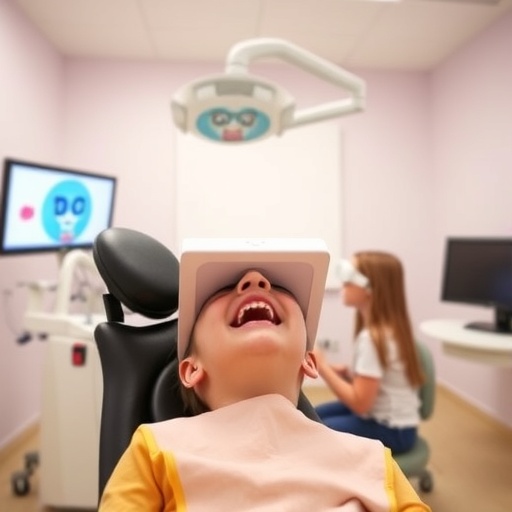
In an era where technology continues to reshape the landscape of education, virtual reality (VR) has emerged as an innovative tool for enhancing various learning experiences across disciplines. A recent study, spearheaded by Lautier et al., delves into the world of paediatric dentistry, exploring how VR can effectively bridge the critical transition from preclinical to clinical training. This pioneering research, set to be published in 2026 in BMC Medical Education, places a spotlight on the potential for immersive simulations to revolutionize dental education and prepare future practitioners more effectively.
The traditional path to mastering the complexities of paediatric dentistry often involves tedious and sometimes overwhelming learning processes. Students are typically required to grasp a wide range of clinical skills and knowledge, often transitioning from theoretical models to real-life patient interactions without adequate preparation. The study highlights that this gap in seamless learning can lead to increased anxiety and uncertainty for students when faced with actual patients. By integrating VR technology, students can practice procedures in a safe and controlled environment, where mistakes can be made without the detrimental consequences found in real-world scenarios.
One of the most significant advantages of using VR in educational settings is the ability to provide standardized experiences that can be replicated across various learning sessions. The authors point out that VR simulations can present students with realistic patient cases, allowing for repetitive practice of specific skills until mastery is achieved. This consistent exposure not only enhances confidence but also solidifies learning outcomes, which can significantly impact clinical performance after graduation.
Furthermore, the VR approach enables educators to gain insight into students’ learning behaviors and decision-making processes. As students navigate virtual scenarios, their interactions can be monitored and analyzed, providing valuable feedback that educators can use to tailor their instructional methods. This data-driven approach not only benefits students but also supports educators in refining their teaching styles and curricular designs for future cohorts.
The study meticulously discusses the technology behind these VR simulations, detailing how high-fidelity graphics and haptic feedback systems create an immersive experience that closely mimics clinical settings. With advancements in VR technology, developers have ensured that the user experience is not only engaging but also educationally beneficial. Students can virtually interact with anatomical models, conduct examinations, and even practice complex procedures using tools that respond realistically to their actions.
Moreover, Lautier and colleagues explore the psychological aspects of VR learning. They highlight that immersion in VR can lower stress levels and avert the fear of failure associated with real-life clinical encounters. In a safe virtual environment, students are more likely to experiment and explore various techniques, fostering a mindset of continuous improvement. The implications of this are profound, as reduced anxiety can lead to better learning outcomes and, ultimately, enhance the quality of patient care delivered by these future dentists.
The researchers also emphasize the importance of interdisciplinary collaboration in developing VR training modules. Engaging dental educators, psychologists, and VR developers in the creation of these simulations ensures that multiple perspectives are considered, leading to comprehensive educational resources that address cognitive, emotional, and technical skills. This collaborative effort aligns with a growing trend in educational methodologies that promotes teamwork and collective problem-solving in training contexts.
Despite these promising developments, the study also acknowledges potential challenges in implementing VR in dental education. The initial costs of VR equipment and software development can be a significant barrier for many institutions, particularly those with limited funding. Additionally, there may be resistance from faculty who are accustomed to traditional teaching methods and are hesitant to adopt new technologies. The authors argue that providing sufficient training and support for educators is crucial to overcoming these barriers and ensuring successful integration.
The current research certainly positions VR as a transformative tool in paediatric dentistry education, with implications that transcend this specific field. As the landscape of education continues to evolve, the integration of cutting-edge technology like VR is set to redefine traditional teaching paradigms. The ability to provide immersive, realistic training experiences not only prepares students for clinical practice but also potentially enhances patient care and outcomes in the healthcare system.
In conclusion, the comprehensive study led by Lautier et al. presents compelling evidence of VR’s potential to improve the transition from preclinical to clinical training in paediatric dentistry. By fostering an engaging and supportive learning environment, VR can help students become more adept practitioners, ultimately leading to better health outcomes for children in need of dental care. As the authors rightly underscore, embracing such innovative solutions is essential for the ongoing advancement of dental education.
In summary, this research is anticipated to make a significant impact in pedagogical strategies within dental training. The study’s unique approach to leveraging VR technology highlights the possibilities for innovative educational reform that prioritizes student needs and clinical competency. VR holds the promise of not just refining dental skills, but also of transforming the educational journey of students, leading to a brighter future for paediatric dentistry.
Through the integration of VR, educators can tailor their programs to better prepare students for the realities of the clinical environment, fostering a generation of dentists equipped with the confidence and competency to provide exceptional care. The future of medical education looks poised for a virtual transformation, where technology and innovation merge to meet the demands of today’s learners and, ultimately, the patients they will serve.
Subject of Research: Virtual reality in paediatric dentistry education.
Article Title: Using virtual reality to support the transition from preclinical to clinical training in paediatric dentistry.
Article References:
Lautier, M., Béal, F., Reibel Domergue, A. et al. Using virtual reality to support the transition from preclinical to clinical training in paediatric dentistry.
BMC Med Educ (2026). https://doi.org/10.1186/s12909-025-08502-y
Image Credits: AI Generated
DOI: 10.1186/s12909-025-08502-y
Keywords: Virtual reality, paediatric dentistry, dental education, clinical training, immersive learning, technology in education.


