

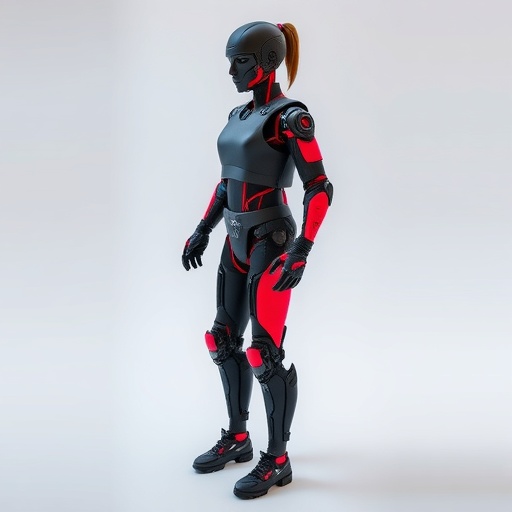
Advances in wearable robotics have ushered in an era where human augmentation is increasingly practical, sophisticated, and nuanced. Among the most intriguing innovations is the use of active exoskeletons that not only assist with physical tasks but also provide sensory feedback tailored to the user’s movements. Recent research by Gomes, Quesada, Berret, and colleagues, published in Communications Engineering in 2025, sheds light on how task-relevant vibratory feedback integrated into these exoskeletons can significantly promote ergonomic postures. Their pioneering study navigates the complex intersection of human motor control, robotic assistance, and sensory feedback, revealing new pathways to enhance workplace safety and user comfort in physically demanding environments.
The human musculoskeletal system, despite its remarkable adaptability, is prone to strain and injury when repetitive or unnatural postures are maintained during work. Traditional ergonomic interventions, such as workstation redesign or manual training, often hinge on conscious effort and external supervision, which may be limited in dynamic or unpredictable job contexts. Active exoskeletons—wearable robotic systems designed to support or augment movement—offer a promising solution by physically assisting users, yet until recently, the feedback mechanisms they employed were largely reactive or non-specific. This study ventures beyond mere robotic assistance, focusing on the crucial role of vibratory feedback that is not only tactile but contextually relevant to the task at hand.
Vibratory feedback works by delivering subtle tactile stimuli to the user’s body, which can influence proprioceptive awareness—the internal sense of body position and movement. By embedding sensors in an active exoskeleton, the system detects joint angles, muscle activation patterns, and external loads in real-time. The exoskeleton then translates these biomechanical parameters into targeted bursts of vibration that inform users about the appropriateness of their posture relative to ergonomic ideals. This closed-loop communication aims to guide users subconsciously toward safer, more sustainable movement patterns without constant cognitive effort or disruption of workflow.
In their experimental design, the research team outfitted participants with a state-of-the-art active exoskeleton equipped with an array of high-resolution inertial measurement units and force sensors. These instruments monitored crucial biomechanical variables as participants engaged in simulated manual labor tasks requiring lifting, reaching, and sustained holding. The exoskeleton delivered patterned vibratory feedback to muscle groups most implicated in posture correction, such as the lower back and shoulders. The protocol was carefully calibrated so that the intensity, frequency, and timing of vibrations were synchronized with deviations from optimal ergonomic postures, effectively serving as an intuitive alert system.
The findings revealed a statistically significant shift in how participants negotiated their postural strategies. With task-relevant vibratory feedback activated, users demonstrated reduced instances of lumbar hyperflexion and shoulder elevation compared to control conditions without feedback. Importantly, these postural improvements were maintained even after the feedback was removed, suggesting a form of motor learning was facilitated through the vibrotactile cues. This plasticity implies that exoskeletons embedded with optimized sensory feedback systems could fundamentally retrain workers’ neuromuscular habits, reducing injury risks over the long term.
While simple vibratory stimuli have been utilized in various rehabilitation and training contexts, the novelty here lies in the feedback’s tailored relevance to both the task and biomechanical state of the wearer. Gomes and colleagues emphasize that generic vibration often yields negligible benefits or can be ignored by users. By contrast, their approach harnesses the exoskeleton’s sophisticated sensing architecture to distinguish hazardous postures from benign ones and modulate feedback parameters accordingly, thereby enhancing user engagement and the saliency of haptic signals.
This research not only advances the field of ergonomics but also contributes fundamentally to our understanding of sensorimotor integration. The nervous system’s capacity to incorporate artificial feedback streams alongside natural proprioceptive inputs demonstrates remarkable adaptability and opens new doors for human-machine symbiosis. As feedback is delivered kinesthetically through vibration rather than visually or auditorily, it minimally intrudes upon other cognitive channels, allowing users to remain focused on their primary tasks while benefiting from subtle yet effective guidance.
The implications extend beyond industrial labor. Active exoskeletons employing task-specific vibratory feedback could revolutionize physical therapy for injury recovery, sports training to optimize technique, and even remote operation of robotic systems where direct tactile experience is limited. Moreover, by facilitating ergonomic postures dynamically and unobtrusively, these systems promise to reduce the staggering global burden of musculoskeletal disorders that cost billions in healthcare and lost productivity annually.
However, challenges remain in scaling and personalizing such systems for diverse work environments and individual anatomical differences. The design of feedback algorithms must adapt to fluctuating loads, variable task demands, and user preferences to maximize efficacy and comfort. Ensuring battery longevity, lightweight construction, and seamless integration into existing safety protocols are also critical engineering hurdles to address before widespread adoption is feasible.
Future investigations led by Gomes et al. are poised to explore these dimensions, combining machine learning techniques to personalize feedback patterns and integrating biofeedback from electromyography and neuroimaging. The goal is to create autonomous exoskeletons capable of real-time adaptation to unique user biomechanics, task complexity, and fatigue levels. Such evolution would accelerate the transition from assistive devices to collaborative robotic partners—an emblem of the next industrial revolution.
In summary, this landmark study demonstrates how embedding task-relevant vibratory feedback into active exoskeletons offers an elegant and effective means to promote ergonomic postures. By bridging the gap between robotic assistance and sensory augmentation, this approach enables subtle, continuous, and task-specific communication between human and machine. The resulting improvements in posture and movement quality not only mitigate injury risk but also foster a profound reconfiguration of how humans interact with wearable robotics.
As industrial and service sectors increasingly demand physical resilience and precision, the deployment of intelligent exoskeletons with advanced sensory feedback will become indispensable. The insight gained from this research signals a future in which wearable robots enhance human capabilities while safeguarding health—blurring the boundaries between biology and technology in unprecedented ways.
The path ahead invites a multidisciplinary convergence of robotic engineering, neuroscience, ergonomics, and occupational health to refine and implement these transformative technologies. Gomes, Quesada, Berret, and their team’s work sets a powerful precedent illustrating that the vibratory language of exoskeletons can speak directly to the body’s innate control systems, rewriting the narrative of physical work for generations to come.
Subject of Research: Human-machine interaction via sensory feedback in active exoskeletons to promote ergonomic postures.
Article Title: How task-relevant vibratory feedback from an active exoskeleton can lead to ergonomic postures.
Article References:
Gomes, W., Quesada, L., Berret, B. et al. How task-relevant vibratory feedback from an active exoskeleton can lead to ergonomic postures. Commun Eng (2025). https://doi.org/10.1038/s44172-025-00552-w
Image Credits: AI Generated


