

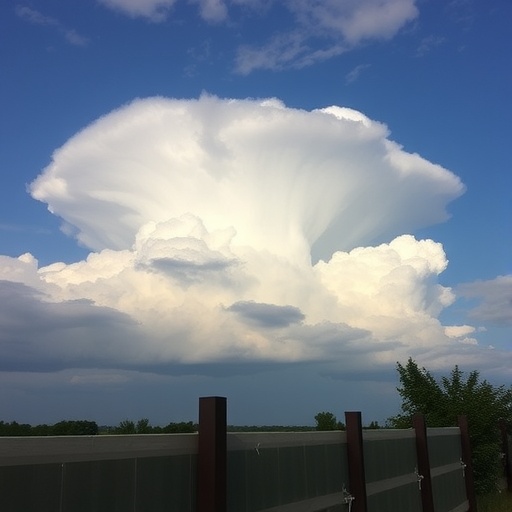
In the intricate dance of the Earth’s atmosphere, clouds play a pivotal role—not just as harbingers of weather, but as dynamic systems influencing climate processes at multiple scales. Recent breakthroughs reported by Barahona, Breen, Ngo, and colleagues in Nature Communications (2025) delve deeply into one of the most elusive aspects of atmospheric science: the variability of vertical wind velocity and its profound connection to cloud microphysical feedback mechanisms. This emerging research not only enhances our understanding of cloud dynamics but also promises to refine the predictive accuracy of climate models, which are fundamental to assessing weather patterns and global climate change.
Vertical wind velocity, or the speed at which air parcels ascend or descend, is a fundamental atmospheric variable driving cloud formation, growth, and dissipation. Traditionally, measuring and interpreting fluctuations in vertical wind velocity has been challenging due to the highly turbulent, three-dimensional nature of atmospheric flows and the intermittent, localized characteristics of cloud systems. The new study capitalizes on advanced observational techniques and sophisticated numerical simulations to unravel the temporal trends and variability inherent in vertical air movements associated with cloud development.
One of the standout revelations from this work is that variability in vertical wind velocity does not merely reflect random atmospheric turbulence or convective intensity but actually encodes feedback from microphysical processes within clouds themselves. Microphysics refer to the tiny particles within clouds—water droplets, ice crystals, and aerosols—that dictate cloud properties such as reflectivity, longevity, and precipitation potential. The interplay of latent heat release, phase changes, and hydrometeor interactions subtly alters local airflow patterns, creating feedback loops that either amplify or dampen vertical velocity fluctuations.
The study’s methodology involved comprehensive measurements using Doppler radar, LIDAR, and high-altitude balloon platforms in conjunction with cutting-edge cloud-resolving models. This multi-platform approach enabled the researchers to capture vertical wind profiles with unprecedented spatial and temporal resolution, revealing consistent trends in variability across a range of cloud types and atmospheric conditions. Importantly, by correlating vertical velocity metrics with detailed microphysical variables, it became evident that shifts in wind variability could be traced back to changes in droplet size distribution, phase partitioning between liquid and ice, and condensation/evaporation dynamics.
These insights carry significant implications for climate prediction. Currently, global climate models simplify cloud processes through parameterization schemes that often fail to capture the nuanced feedbacks illuminated by this new research. The documented variability trends suggest that ignoring these microphysical influences on vertical wind velocity may lead to systematic biases, particularly in quantifying cloud radiative effects and estimating precipitation patterns. Incorporation of these findings into next-generation models could reduce uncertainties in climate sensitivity estimates, thus refining projections of future climate states under varying greenhouse gas scenarios.
Furthermore, the feedback mechanisms identified have the potential to influence atmospheric stability and convective organization on a mesoscale. Variability in vertical velocity impacts entrainment and detrainment rates in cloud updrafts, which in turn modulate cloud lifecycle and their interaction with surrounding environments. This feedback may affect phenomena such as self-aggregation in tropical convection and can influence storm intensity, rainfall distribution, and even large-scale circulation patterns.
The authors emphasize that understanding these cloud microphysical feedbacks on vertical wind velocity provides a mechanistic bridge between microscale physical processes and macroscale atmospheric dynamics. This bridge is critical given the pivotal role clouds play in the Earth’s radiation budget; clouds reflect shortwave solar radiation while trapping longwave infrared radiation, making their accurate representation a cornerstone of climate science. Through enhancing our grasp on the variability within vertical wind velocities, the study paves the way for a more faithful representation of cloud-radiation interactions.
In addition to implications for climate science, these findings bear relevance for operational meteorology. Enhanced characterization of vertical wind variability improves the predictability of convective initiation and evolution, phenomena central to severe weather forecasting. By improving model fidelity in simulating these processes, meteorologists can better anticipate thunderstorm development, precipitation intensity, and storm lifespan, which are crucial for early warnings and risk mitigation.
The research also opens avenues for future observational campaigns focused on coupling microphysical measurements with high-resolution wind velocity datasets. Emerging technologies such as unmanned aerial vehicles equipped with cloud particle probes and wind sensors will allow for in situ validation of the microphysical feedback mechanisms proposed. These instruments can traverse cloud layers safely, providing localized, detailed snapshots of the atmospheric microenvironment.
Moreover, this study foregrounds the importance of interdisciplinary approaches in atmospheric sciences. Combining expertise in fluid dynamics, aerosol-cloud interactions, and satellite remote sensing has been key to unlocking the complexities of vertical wind variability. This integrative framework sets a precedent for tackling other multifaceted climate processes where micro- and macro-scale interactions intersect.
Finally, the societal relevance of these findings cannot be overstated. Improving predictions of cloud behavior and associated weather events has direct implications for agriculture, water resource management, and disaster preparedness. As society grapples with the increasing volatility of weather patterns driven by climate change, enhanced understanding of fundamental atmospheric processes like vertical wind variability offers a beacon of hope for adaptation and resilience.
In summary, Barahona and collaborators have delivered a seminal contribution to atmospheric sciences by elucidating how cloud microphysical feedbacks intricately modulate vertical wind velocity variability. Their work unlocks new pathways for enhancing predictive capabilities in weather and climate models, addressing long-standing uncertainties in cloud dynamics. By connecting the tiny scales of droplets and ice particles to the grand scales of cloud systems and atmospheric circulation, this research enriches the narrative of the Earth’s climate and weather processes, propelling the field towards a new era of precision and insight.
Subject of Research: Vertical wind velocity variability and its feedback with cloud microphysical processes.
Article Title: Trends in vertical wind velocity variability reveal cloud microphysical feedback.
Article References:
Barahona, D., Breen, K.H., Ngo, D. et al. Trends in vertical wind velocity variability reveal cloud microphysical feedback. Nat Commun (2025). https://doi.org/10.1038/s41467-025-67541-7
Image Credits: AI Generated


