

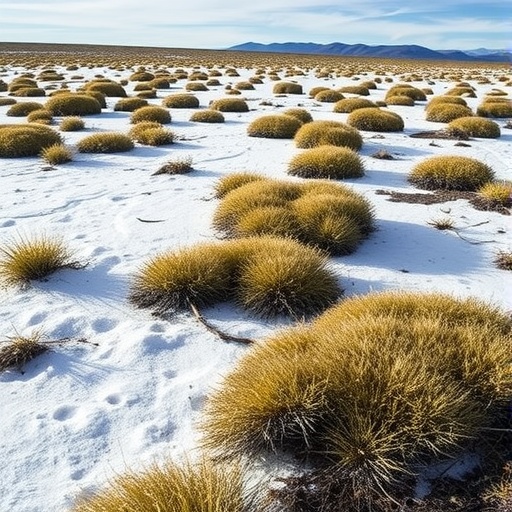
A groundbreaking study published in Nature Climate Change offers unprecedented insights into the dynamics of vegetation recovery following retrogressive thaw slumps (RTS) across northern tundra ecosystems. By harnessing an extensive array of satellite imagery, aerial photos, and advanced remote sensing techniques, researchers have unveiled complex patterns of ecosystem resilience in regions undergoing rapid climatic shifts. This study not only enhances our understanding of thaw slump disturbances but also provides critical quantifications of vegetation regrowth rates essential for predicting future landscape transformations in the Arctic and alpine tundra.
The research focused on eight distinct study areas spanning a diverse range of northern tundra ecosystems, each with unique vegetation compositions and geomorphological traits. These sites include Arctic tussock-shrub and low-shrub tundra in the NT and TL regions, the tall and erect dwarf shrub tundra of northwestern Canada’s tundra uplands (MD), and the high-Arctic sedge and dwarf shrub tundra in WB and EB. Other locations, such as YP in western Siberia, encompass sandy clay lowlands with a mix of dwarf shrubs, sedge, and moss tundra, while the alpine meadows and grasslands of CQ and WQ represent high-elevation ecosystems characterized by specialized vegetation adapted to extreme conditions. Additional validation was conducted using four RTS sites in Siberia and northern Canada, capturing a wide environmental gradient.
To delineate and analyze RTS disturbances, the team leveraged an ensemble of satellite datasets spanning multiple decades, including PlanetScope imagery from 2016 to 2024 and earlier Landsat platforms covering 1984 to 2010. High-resolution imagery obtained from GeoEye-1, QuickBird-2, WorldView satellites, and aerial photographs dating back to 1937 enabled fine-scale observations of terrain changes and vegetation shifts. Crucially, the researchers employed detailed quality control measures and BRDF adjustments to ensure data consistency, calibrating PlanetScope reflectance against Harmonized Landsat and Sentinel-2 images to correct for variations in illumination and sensor viewing geometry.
An innovative space-for-time substitution methodology lay at the heart of this investigation, where thaw slump chronosequences—slopes disturbed at different times—allowed for a temporal reconstruction of vegetation recovery trajectories. By segmenting RTS areas into subparts based on initiation years, the researchers traced vegetation greenness dynamics before disturbance, during active slump phases, and throughout recovery and eventual stabilization. This approach recognized that RTS reactivations represent new perturbations by resetting successional dynamics through sediment deposition, vegetation removal, and alterations in soil moisture and nutrient availability.
Normalized Difference Vegetation Index (NDVI) time series, derived from PlanetScope data, served as the primary quantifier of vegetation dynamics. After rigorous preprocessing—including image co-registration at sub-meter resolution, histogram matching for cross-calibration, and quality filters to remove cloud-contaminated pixels—the NDVI values were averaged spatially within RTS subparts and temporally aligned with disturbance onset. This enabled the construction of robust NDVI recovery curves for each ecosystem, revealing distinct successional patterns and time scales of revegetation across sites with varying climate and vegetation.
To dissect these recovery trajectories quantitatively, the study employed piecewise regression models that segmented the NDVI series into biologically meaningful phases: undisturbed baseline, disturbance-induced decline, recovery growth, and stabilization periods. Not all ecosystems exhibited all stages; for example, some lacked a clear stabilization phase within the observational window. Recovery time—the critical interval for NDVI to return to pre-disturbance levels—was calculated either as the duration between regression breakpoints or extrapolated based on observed recovery trends when stabilization was not yet achieved. Confidence intervals around these estimates were rigorously computed to incorporate model uncertainties.
Complementing NDVI analyses, the research innovatively linked vegetation functional types (PFTs) to ecosystem greenness patterns. High-resolution multispectral satellite imagery, enhanced via pan-sharpening, facilitated manual classification of 3×3 meter grids within RTS subparts into bare ground, low-stature vegetation, and erect shrub categories. This classification exploited subtle spectral and textural differences detectable despite moderate resolution constraints. The study generated composite color codes illustrating PFT proportions, correlating NDVI temporal evolution with shifts in community composition and structural complexity during post-disturbance recovery.
Central to understanding ecosystem productivity implications, the team examined the relationship between recovery times and gross primary productivity (GPP) as measured via satellite-derived solar-induced chlorophyll fluorescence (GOSIF) data aggregated over two decades. Orthogonal distance regression techniques accounted for uncertainties on both variables, revealing a power-law scaling where ecosystems with higher steady-state GPP generally recovered faster from thaw slump disturbances. This relationship was further constrained by GPP ranges known from graminoid- and shrub-dominated permafrost landscapes, lending ecological realism to the model predictions.
Validation of these findings against independent RTS sites in Siberia and Canada confirmed the predictive strength of the identified patterns. The spatial distribution of recovery times aligned with regional climate gradients, vegetation types, and permafrost conditions, underscoring the value of integrating remote sensing with ground-truth datasets. These results illuminate the capacity of tundra ecosystems to regenerate after landscape destabilization despite rapid warming, although recovery pace varies markedly across biome types and environmental contexts.
Topographic and soil datasets complemented the analysis, revealing how elevation, soil texture, and permafrost distribution modulate thaw slump impacts and recovery dynamics. The study’s integration of digital elevation models, circumpolar vegetation maps, and comprehensive permafrost data sets a new standard for multi-scalar ecological investigations in polar regions, offering nuanced predictions of future vegetation trajectories under ongoing climate change.
By quantifying vegetation recovery in terms of NDVI and linking it explicitly to productivity and environmental variables, this research fills a critical knowledge gap about the resilience mechanisms operating in Arctic and alpine tundra ecosystems. The findings carry profound implications for models of permafrost carbon feedbacks, land-atmosphere interactions, and biodiversity conservation amid unprecedented warming rates.
This comprehensive multi-decadal, multi-sensor investigation represents a major advancement in remote sensing ecology, harnessing innovations in data fusion, machine learning classification, and spatial statistics to decode complex disturbance and recovery processes at high spatial and temporal resolutions. Through meticulous calibration and validation protocols, the authors demonstrate that satellite-derived vegetation indices, when properly processed and interpreted, are invaluable tools for monitoring permafrost landscape change.
As Arctic warming accelerates permafrost degradation, understanding how vegetation communities respond and regenerate becomes increasingly urgent. This study’s identification of variable but measurable recovery intervals linked to ecosystem productivity provides critical benchmarks for anticipating regional carbon fluxes, habitat dynamics, and landscape stability. Such insights are fundamental for informing adaptation and mitigation strategies that aim to preserve northern ecosystems’ integrity in a rapidly transforming world.
The study also underscores the potential for leveraging novel satellite constellations, such as PlanetScope, alongside traditional platforms, for near-real-time ecological monitoring. Coupling these data with field observations and ecological modeling promises a new era of precision ecosystem science tailored to the challenges of climate-induced landscape change.
Ultimately, this investigation not only charts the trajectory of vegetation recovery after cryospheric disturbances but also exemplifies the powerful synergy of technology, ecology, and climate science necessary to face the pressing challenges of our warming planet. It heralds a transformative research framework for understanding and managing the Arctic’s vulnerable tundra biomes in the twenty-first century.
Subject of Research: Vegetation recovery following retrogressive thaw slumps across northern tundra regions
Article Title: Vegetation recovery following retrogressive thaw slumps across northern tundra regions
Article References:
Xia, Z., Liu, L., Nitze, I. et al. Vegetation recovery following retrogressive thaw slumps across northern tundra regions. Nature Climate Change (2026). https://doi.org/10.1038/s41558-026-02603-2
Image Credits: AI Generated


