

Hemiparesis, a debilitating condition marked by weakened motor control, muscle strength, and spasticity on one side of the body, afflicts a staggering 80% of stroke survivors in the United States. The resulting impaired mobility profoundly diminishes quality of life, creating immense challenges for millions. Walking, a task often taken for granted, unfolds through a complex interplay of biomechanics. In affected individuals, even a slight loss of strength on one side triggers compensatory overuse of muscles on the opposite side, drastically amplifying energy expenditure. In fact, persons with hemiparesis expend nearly 60% more energy merely to walk, a disparity that manifests in slower gaits, reduced endurance, heightened pain, and elevated fall risks.
In a breakthrough study emerging from the University of Utah’s John and Marcia Price College of Engineering, researchers have engineered a lightweight, portable hip exoskeleton designed to mitigate these obstacles. Collaborating with specialists from the College of Health, the team has demonstrated that their battery-powered device reduces the metabolic cost of walking by nearly 20% in stroke survivors suffering from hemiparesis. These promising findings, documented in Nature Communications, underscore the transformative potential of wearable robotics in neurorehabilitation.
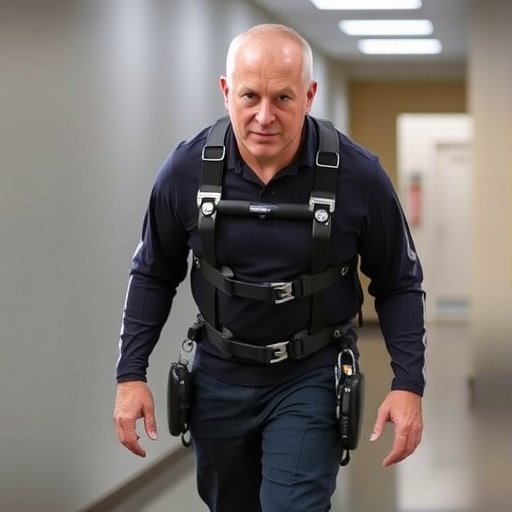
The exoskeleton, weighing a mere 5.5 pounds, is ergonomically strapped around the hips and thighs, harnessing motors synchronized in real time to augment the user’s natural gait. An intelligent control system custom-tunes the degree of assistance to each user’s unique biomechanical requirements, providing propulsion and lift precisely when the hip joint must push off during the walking cycle. This targeted motor-driven augmentation effectively rebalances the muscular demands placed on each leg, thereby enhancing walking economy.
Previous attempts to alleviate hemiparetic walking deficits have predominantly focused on ankle-assistive devices. However, portable ankle exoskeletons have consistently fallen short of reducing energy expenditure in stroke patients. This is in large part because diminished ankle propulsion compels users to compensate via the hip joints, which then bear an excessive workload. Recognizing this biomechanical interdependence, lead researcher Kai Pruyn and the team pivoted toward hip-centric exoskeleton design, reasoning that supporting the hip could remediate compensatory inefficiencies more effectively.
The strategic decision to target the hip joint offers engineering advantages as well. Positioned near the body’s center of mass, the hip demands lower torque for movement assistance compared to distal joints like the ankle. This proximity enables a more compact, lightweight exoskeleton capable of delivering powerful support without encumbering the user. Moreover, the tailored synergy between user and machine, driven by a sophisticated control algorithm, ensures that assistance dynamically matches the user’s gait pattern in real time.
Dr. Tommaso Lenzi, senior author and associate professor at the Department of Mechanical Engineering, emphasized the clinical significance of the device. “Transforming post-stroke rehabilitation with robotic technologies is one of the most profound unmet needs in healthcare today,” he noted. The lab’s extensive expertise in wearable robotics, which previously garnered acclaim for the innovative Utah Bionic Leg, paved the way for this novel intervention targeting hemiparesis.
The research methodology employed precise motion-capture systems and instrumented treadmill setups to analyze the biomechanics of seven hemiparetic patients walking with and without the exoskeleton. Calorimetric measurements captured metabolic energy expenditure during ambulation, allowing the team to quantify the device’s efficiency gains. The results were striking: the exoskeleton offloaded about 30% of the mechanical work performed by the hip joints, resulting in an 18% reduction in metabolic cost across the participants.
Clinically, these improvements translate to functional gains equivalent to removing a 30-pound load from the body during walking, a comparison offered by co-author Dr. Bo Foreman of the Physical Therapy & Athletic Training department. For patients debilitated by hemiparesis, this represents not merely a number but a palpable, life-changing enhancement in mobility and independence. Reports from study participants, such as stroke survivor Lidia, reflected meaningful progress: initial difficulties moving her leg gave way to improved function with exoskeleton assistance, a change corroborated by anecdotal observations from family members.
Despite the device’s promise, the research team acknowledges further challenges lie ahead before widespread clinical adoption is feasible. Future work will focus on optimizing device safety and performance in real-world, uncontrolled environments, expanding support for varied activities beyond walking. Collaborations with prosthetics and orthotics leaders aim to facilitate translation into accessible commercial products, enabling stroke survivors everywhere to reclaim mobility.
In essence, this pioneering hip exoskeleton marks a paradigm shift in stroke rehabilitation by leveraging advanced biomechanics and control systems. By fundamentally addressing the compensatory mechanisms at the hip rather than distal joints, the technology reduces energy costs and enhances gait efficiency, ushering in new hope for hemiparetic individuals constrained by their condition. As the field of wearable robotics matures, innovations like this offer a compelling glimpse into a future where stroke no longer circumscribes human potential.
Subject of Research: People
Article Title: Portable hip exoskeleton improves walking economy for stroke survivors
News Publication Date: 14-Feb-2026
Web References: https://doi.org/10.1038/s41467-026-69580-0
References: Nature Communications, DOI 10.1038/s41467-026-69580-0
Image Credits: Dan Hixson, University of Utah
Keywords
- Bionics
- Mechanical engineering
- Biomechanics
- Robotic exoskeletons


